Banner
Ousiometrics Analysis Says All Human Language Is Biased

A new tool drawing on billions of uses of more than 20,000 words and diverse real-world texts claims...

Wavelengths Of Light Are Why CO2 Cools The Upper Atmosphere But Warms Earth

There are concerns about projected warming on the Earth’s surface and in the lower atmosphere...

Here's Where Your Backyard Was 300 Million Years Ago

We may use terms like "grounded" and terra firma to mean stability and consistency but geology...

Convergent Evolution Cheat Sheet Now 120 Million Years Old

One tenet of natural selection is a random walk of genes but nature may be more predictable than...

User picture.
News StaffRSS Feed of this column.

News Releases From All Over The World, Right To You... Read More »

Blogroll

In America, the cost of health care is not high just because the medicine is the best in the world, it is also because of lawsuits.

Due to judgments in court cases that have earned tens of millions of dollars for lawyers - one aggressive lawyer demonized hospitals for not doing enough caesarian-sections and earned enough money to become a Senator and then a Vice-Presidential contender in 2004 - hospitals and offices have instituted a 'defense medicine' policy; even if there is no doubt, there is a protocol in place that says a number of tests must be run so that all of the boxes can be checked in case something goes wrong and attorneys swoop in. Coupled with malpractice costs, the costs of unnecessary testing can be quite high.

The Hubble Space Telescope has uncovered three Kuiper Belt objects that the New Horizons spacecraft could potentially visit after doing a fly-by of Pluto in July 2015.

The Kuiper Belt is a vast rim of primordial debris encircling our solar system. KBOs belong to a unique class of solar system objects that has never been visited by spacecraft and which contain clues to the origin of our solar system.

The Kuiper Belt objects are each about 10 times larger than typical comets, 1 to 2 percent of the size of Pluto. Unlike asteroids, Kuiper Belt objects have not been heated by the sun and are thought to represent a pristine, well preserved deep-freeze sample of what the outer solar system was like following its birth 4.6 billion years ago. 

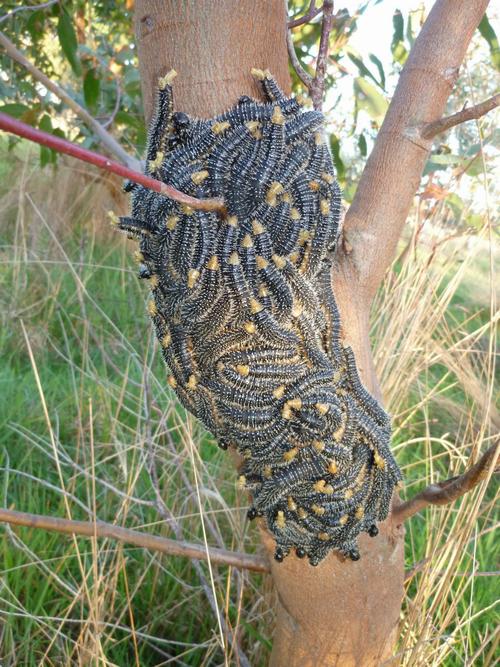
Not every human can be a great leader but not everyone is made to follow either. This has been shown to apply to elsewhere in the animal kingdom as well: insect larvae follow a leader to forage for food, both leaders and followers benefit, growing much faster than if they are in a group of only leaders or only followers, according to a new study.

The research looked at larvae of the iconic Australian steel-blue sawfly Perga affinis often known as 'spitfires'. Sawfly larvae can grow to 7 centimeters long and forage nocturnally in Australian Eucalyptus trees, forming large groups that can strip all of the leaves from a tree in a few days.

By pairing chemical analyses with micropaleontology, the study of tiny fossilized organisms, researchers believe they can decipher how global marine life was affected by a rapid warming event more than 55 million years ago.  

The work revolves around the Paleocene-Eocene Thermal Maximum (PETM), a well-studied analogue for modern climate warming. Documenting the expansion of OMZs during the PETM is difficult because of the lack of a sensitive, widely applicable indicator of dissolved oxygen.  

Patients with severe psoriasis are more likely to have uncontrolled hypertension, according to a cross-sectional study using information collected from a medical records database, which the authors say provides further evidence of a strong link between psoriasis and hypertension. 

Diversity in medical education used to be simple - more black people, more women - but it is not just a numbers game anymore. 

Instead of focus just on recruiting under-represented students, modern education needs to be about creating an optimal learning environment, where people with different ideas, cultures, opinions, and experiences feel comfortable amongst each other and part of a larger dialogue to come together to solve tomorrow's health care problems, says
Mark A. Attiah, a medical student pursuing both a Master's in translational research and bioethics
at the University of Pennsylvania.