





Rejected by a person you like? Just "shake it off" and move on, as music star Taylor Swift says. But while that might work for many people, it may not be so easy for those with untreated depression, a new brain study finds. The pain of social rejection lasts longer for them -- and their brain cells release less of a natural pain and stress-reducing chemical called natural opioids, researchers report in the journal Molecular Psychiatry.

The findings were made in depressed and non-depressed people using specialized brain-scanning technology and a simulated online dating scenario. The research sheds new light on how the brain's pain-response mechanism, called the opioid system, differs in people with depression.

Our brains generate a constant hum of activity: As neurons fire, they produce brain waves that oscillate at different frequencies. Long thought to be merely a byproduct of neuron activity, recent studies suggest that these waves may play a critical role in communication between different parts of the brain.

A new study from MIT neuroscientists adds to that evidence. The researchers found that two brain regions that are key to learning -- the hippocampus and the prefrontal cortex -- use two different brain-wave frequencies to communicate as the brain learns to associate unrelated objects. Whenever the brain correctly links the objects, the waves oscillate at a higher frequency, called "beta," and when the guess is incorrect, the waves oscillate at a lower "theta" frequency.

According to the public databases, there are currently approximately 1,900 locations in the human genome that produce microRNAs (miRNAs), the small and powerful non-coding molecules that regulate numerous cellular processes by reducing the abundance of their targets. New research published in the Proceedings of the National Academy of Sciences (PNAS) this week adds another roughly 3,400 such locations to that list. Many of the miRNA molecules that are produced from these newly discovered locations are tissue-specific and also human-specific. The finding has big implications for research into how miRNAs drive disease.

In a symposium on social psychology, psychologists are challenging the beliefs of other psychologists about the effectiveness of traditional strategies for encouraging healthy eating. 

A paper in the Journal of the American Medical Association observed whether or not photographs of vegetables on a school lunch tray had an impact on the amount of vegetables eaten. The study found that placing photos of carrots and green beans did increase the amounts of vegetables eaten during lunch, but it still was not at levels consistent with government-recommended dietary guidelines. 


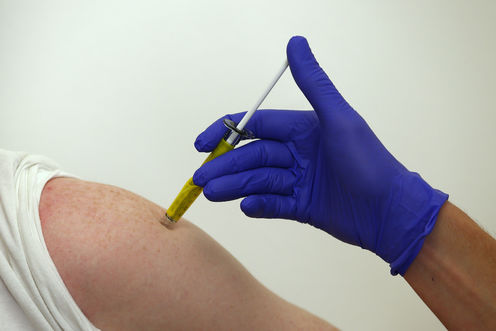
A volunteer receives a trial Ebola vaccine at the Centre for Clinical Vaccinology and Tropical Medicine in Oxford, southern England January 16, 2015. Eddie Keogh/Reuters

Recently, Phase II and III trials of two vaccines for Ebola started in West Africa. The development of possible vaccines is welcome news. Like most vaccine trials, the current Ebola trials are being conducted under ethical guidelines derived from US standards for clinical research in human beings.

After an interventional radiology intranasal treatment, migraine patients report using less pain-relief medicine for headaches, according to a paper at the Society of Interventional Radiology's Annual Scientific Meeting.

Clinicians used a treatment called image-guided, intranasal sphenopalatine ganglion (SPG) blocks to give patients enough ongoing relief that they required less medication to relieve migraine pain.
Too cold for a penguin? An Ice Age brought on by global warming so severe penguins had to move?

Indeed. During the last interglacial, what is colloquially called an ice age though it has been such non-stop for a few million years, only three populations of emperor penguins may have survived, because much of the rest of Antarctica was uninhabitable due to the amount of ice. 

In a new study, 221 college students participated in an online chat room in which they watched a fellow student get "bullied" right before their eyes.

Only 10 percent of the students who noticed the abuse directly intervened, either by confronting the bully online or helping the victim.

The abuse wasn't real - the bully and the victim were part of the experiment - but the participants didn't know that.

"The results didn't surprise me," said Kelly Dillon, lead author of the study and a doctoral student in communication at The Ohio State University.

"Many other studies have shown bystanders are reluctant to get involved when they see bullying. The results disappointed me, as a human, but they didn't surprise me as a scientist."

The therapeutic promise of human stem cells is indisputably huge, but the process of translating their potential into effective, real-world treatments involves deciphering and resolving a host of daunting complexities.

Writing in the February 25 online issue of the journal PLOS ONE, researchers at University of California, San Diego School of Medicine, with collaborators from The Scripps Research Institute (TSRI), have definitively shown for the first time that the culture conditions in which stem cells are grown and mass-produced can affect their genetic stability.


by Marsha Lewis, Inside Science

(Inside Science TV) – Scientists often examine matter that is invisible to the naked eye. This hidden atomic world is a mystery for most people, but now a scientist created a way for people to imagine what they might see as their own bodies interact with the atoms that surround them.


