

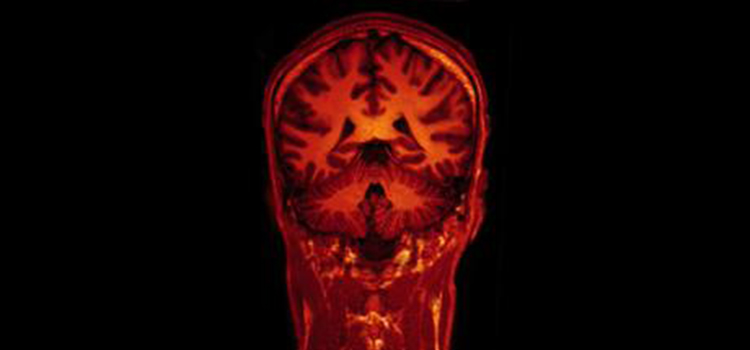






A new genetic therapeutic technique that has the potential to treat more than half of the patients suffering from Duchenne Muscular Dystrophy (DMD), according to a new study. 

Faced with an increased senior population and a dwindling working age one, government accountants have spread the word that elderly people need to be encouraged to work longer.

And they are being encouraged, by changes in pension policies that force them to do so. As a result, a social safety net that was designed to reduce retirement inequality nearly a century ago is once again increasing it - some groups are more likely to be disadvantaged by a rise in the state retirement age than others, because some people are more able to work as senior citizens than others. 

If genes were lights on a string of DNA, the genome would appear as an endless flicker, as thousands of genes come on and off at any given time. Tim Hughes, a Professor at the University of Toronto's Donnelly Centre, is set on figuring out the rules behind this tightly orchestrated light-show, because when it fails, disease can occur.

Genes are switched on or off by proteins called transcription factors. These proteins bind to precise sites on the DNA that serve as guideposts, telling transcription factors that their target genes are nearby.

In their latest paper, published in Nature Biotechnology, Hughes and his team did the first systematic study of the largest group of human transcription factors, called C2H2-ZF.

The size of the human brain expanded dramatically during the course of evolution, imparting us with unique capabilities to use abstract language and do complex math. But how did the human brain get larger than that of our closest living relative, the chimpanzee, if almost all of our genes are the same?


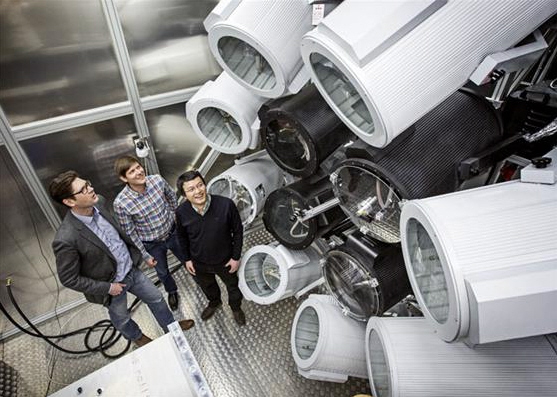
Credit: Jon Olav Eikenes, CC-BY-SA

By: Carrie Peyton Dahlberg, Inside Science

(Inside Science) - Brain imaging can already pull bits of information from the minds of willing volunteers in laboratories. What happens when police or lawyers want to use it to pry a key fact from the mind of an unwilling person?

Will your brain be protected under the U.S. Constitution's Fourth Amendment from unreasonable search and seizure?  


Sunlight may have benefits not yet discovered. Joseph D'Mello CC BY-NC

Summer sunshine makes most of us feel better, but there may be more to the benefits than just feeling good.

A growing body of evidence suggests sunlight itself – with adequate protection, of course – may actually be good for health.

Mandarin-speaking Chinese more likely to read emotions in the voices of others, while English-speaking North Americans rely more on facial expressions, according to a new paper. That may be why Americans think Chinese language is exaggerated while the Chinese believe Americans are too physically expressive.

Yet it isn't just a style issue, it can be seen in brain activity.
Stockholm is considered the world's most sunlight-deprived capital - in November of 2014 the Swedes living there had just a few hours of the stuff and in winter months, it will get dark at 3 PM anyway, so if the sun is hidden by clouds, it can be a real downer. 

Yet not everywhere in Sweden is so bleak. Because there are so few solar laboratories in the world, KTH Royal Institute of Technology reasoned that Stockholm was the perfect place to build one and in there, the future is bright 24 hours a day.

Will the FCC repeat past mistakes of regulating telecommunications as utilities? Shutterstock

Federal Communications Commission (FCC) chairman Tom Wheeler claims that his plan to regulate Internet Service Providers (ISPs) under Title II of the 1934 Telecommunications Act is “rooted in long-standing regulatory principles.”

That’s not necessarily a good thing.


Regular concert-goers are used to seeing singers use expressive and even very dramatic facial expressions - that's because it works.

Music and speech are alike in that they use both facial and acoustic cues to engage listeners in an emotional experience and so  a team of researchers at McGill University wondered what roles these different cues played in conveying emotions.


