








A 10-year retrospective study of 383 children is the first to examine the prevalence of positive drug screens in pediatric patients undergoing  multiple sleep latency test (MSLT) for narcolepsy.

The results in Journal of Clinical Sleep Medicine showed that 43 percent of children with urine drug screens positive for marijuana actually had test results consistent with narcolepsy or abnormal REM sleep patterns. No child younger than 13 years of age had a positive urine drug screen. The data showed that males were more likely to have a positive urine drug screen and MSLT findings consistent with narcolepsy.  

Many of us have asked ourselves in the past few days: can you really falsely remember something as significant as being in a helicopter that was shot down?

And many of us probably think “No way,” and quickly conclude that NBC news anchor Brian Williams invented this story to embellish his public image as a news anchor who put his life in danger.

But before condemning Brian Williams as a narcissistic liar, let’s take a closer look at what memory research has to say about false memories and memories of traumatic experiences. This work suggests it’s plausible that Williams is truthfully describing what he remembers.

Suppose we we tell you everything quantum mechanics can tell you about a quantum particle; what do you really know? Unfortunately, you still cannot predict with certainty the outcome of a simple experiment to measure its state. All quantum mechanics can offer are statistical probabilities for possible results.

This indeterminacy is not a defect, it's a defining feature of its undefined nature. The particle's state is not merely unknown, but truly undefined before it is measured. The act of measurement itself forces the particle to collapse to a definite state.
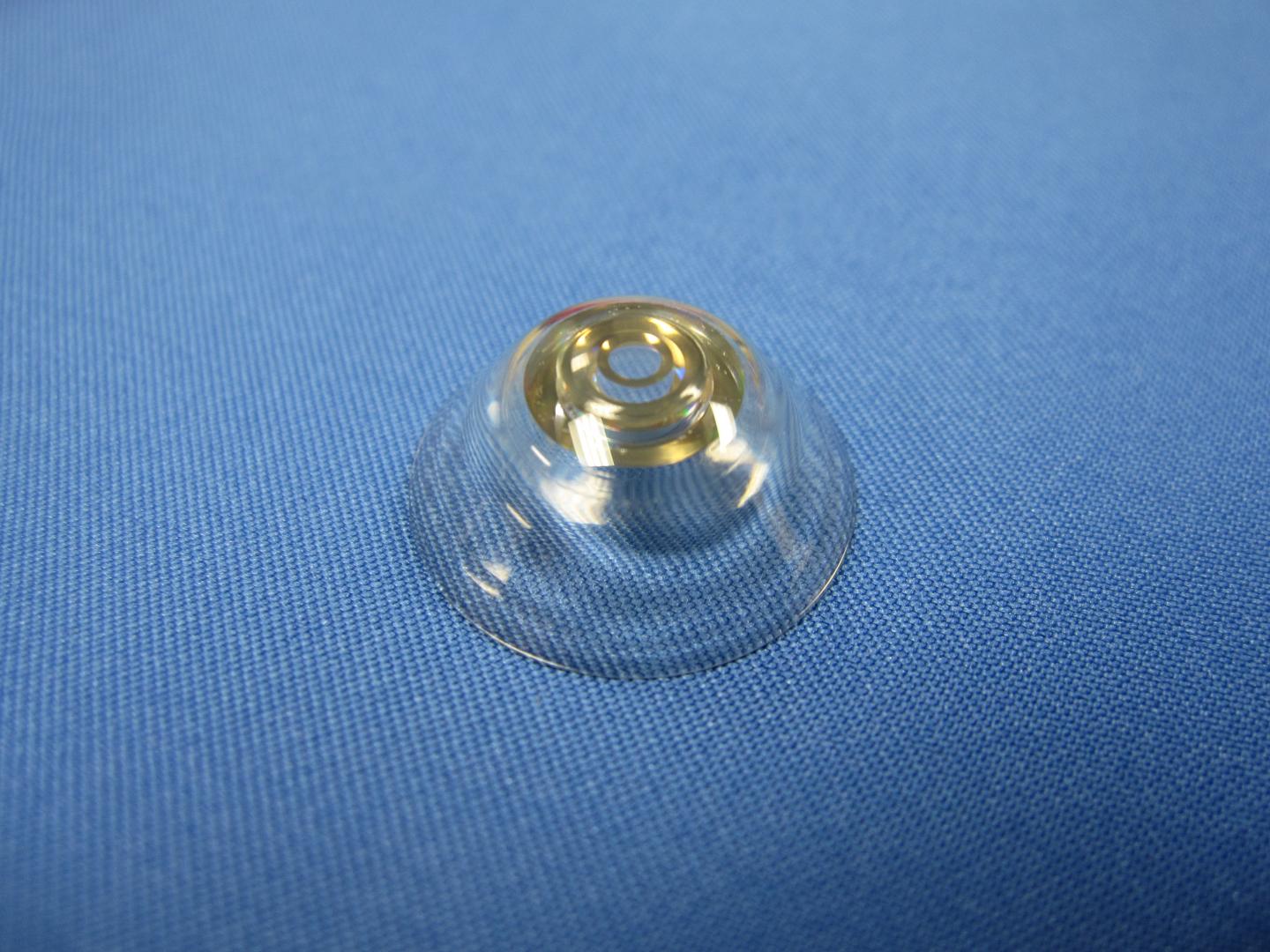
Researchers from Paragon Vision Sciences, Innovega, Pacific Sciences and Engineering,  EPFL and the University of California, San Diego and Rockwell Collins have developed a novel method to electronically switch the wearer's view between normal vision and telescopic - a wink.

That kind of switching functionality is crucial for the lenses to be widely useful for non-AMD sufferers who would still like to be able to have magnification "on demand", like if they want to read something.

The obvious problem is that we 'wink' every second, but they are instead blinks.

Problem solved, in a new prototype system. The electronic glasses use a small light source and light detector to recognize winks and ignore blinks.
The U.S. Department of Agriculture's (USDA) Animal and Plant Health Inspection Service (APHIS) announced approval of the first two nonbrowning apple varieties, Arctic Golden and Arctic Granny apples. 
An estimated 285 million people are visually impaired worldwide and age-related macular degeneration alone is the leading cause of blindness among older adults. There may be some new hope, in the form of prototype telescopic contact lenses. 

Eric Tremblay from EPFL in Switzerland says the first iteration of the telescopic contact lens--which magnifies 2.8 times--was announced in 2013. Since then the scientists behind the DARPA-funded project have been fine-tuning the lens membranes and developing accessories to make the eyewear smarter and more comfortable for longer periods of time, and thus more usable in every day life.
Known as the ‘Heart of Voh’ for its proximity to the Voh commune, a mining colony controlled by the French, these Mangrove swamps along the coast of New Caledonia in the southwest Pacific Ocean formed this natural structure, caused by changes in vegetation cover. Photographer Yann Arthus-Bertrand made it famous by using a photograph of the heart on the cover of a book, The Earth from the Air.

This false-color satellite image of the heart-shaped formation was captured by the Korea Aerospace Research Institute’s Kompsat-2 satellite on 1 April 2009.  No undead lichs had to be sent to their final resting place to obtain it. 


Despite the claims of people selling books on ascension into being robots or diet fads, you are not going to live forever.

It used to be life was truly short and now we are in a period where life is much longer but after the age of 65 it is not better, it is instead a slow steady decline toward death.

The goal cannot be to try and live forever, nature has built in too many biological landmines to control that, but to live healthier until we do die. First, we'd have to agree on what this 'successful' aging would look like, without wellness psychobabble.
I’ll demonstrate how to build a simple magnetic optical mount for a cat toy (laser pointer). Though it is simple—that is, there aren’t any fine tuning mechanisms one would find on an optical bench—it is, nonetheless, inexpensive and flexible enough to use for simple optical experiments such as demonstrating the Tyndall effect, .

I used a magnetic chip clip to clamp the laser pointer switch (a press switch) in the on position and attach the laser pointer to the Erector set mount.


