





A new paper says that human civilization has crossed four of nine so-called planetary boundaries as the result of human activity that put humanity in a "safe operating space." 

The four that are already beyond that point-of-no-return are climate change, the loss of biosphere integrity, land-system change, and altered biogeochemical cycles like phosphorus and nitrogen runoff. That makes us 44 percent of the way on the path to doom.

It should be a wake-up call to policymakers that "we're running up to and beyond the biophysical boundaries that enable human civilization as we know it to exist," says co-author Steve Carpenter, director of the University of Wisconsin-Madison Center for Limnology. 

Brownbanded bamboo sharks take the term "resourceful" to a whole new level. Biologists have found that a shark egg case dropped by an adult bamboo shark showed signs of healthy development. What surprised them was that the aquarium's female Chiloscyllium punctatum adults had spent nearly four years--45 months--in complete isolation from males.

Everyone who has lived in snow knows it is not as white as it looks - it's rarely white at all. Mixed in with the reflective flakes are tiny, dark particles of pollution. University of Washington scientists recently published the first large-scale survey of impurities in North American snow to see whether they might absorb enough sunlight to speed melt rates and influence climate.

The results, published in the Journal of Geophysical Research, show that North American snow away from cities is similar to Arctic snow in many places, with more pollution in the U.S. Great Plains. They also show that agricultural practices, not just smokestacks and tailpipes, may have a big impact on snow purity.

A team of researchers has demonstrated the therapeutic potential of triheptanoin in ten patients with Huntington's disease. Derivatives of this triglyceride, with its unique composition, might be able to slow the progression of the disease by improving the energy metabolism of the brain. This research is published in the journal Neurology.

Huntington's disease is a genetic disease that affects approximately 5,000 people in France, with another 10,000 individuals at risk of developing it. Mutation of the gene encoding the huntingtin protein results in a progressive degeneration of the neurons, especially in regions of the brain involved in the control of movement, thereby causing serious neurological, motor, cognitive and psychiatric problems.


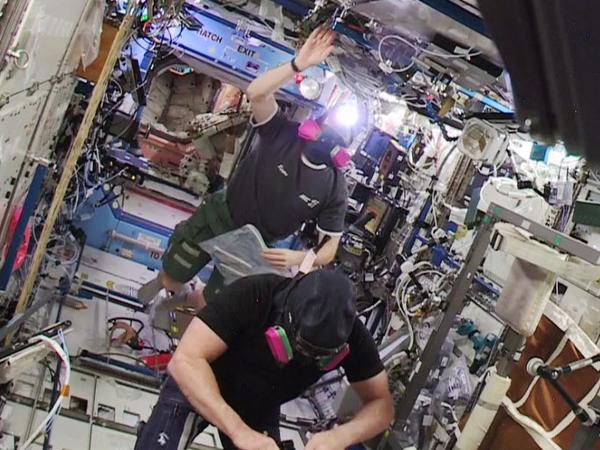
Credit: International Space Station

By Monica Grady, The Open University

A new paper believes that planets outside our solar system - exoplanets - may be a lot more agreeable to life than assumed. The astrophysicists suggest that exoplanets are more likely to have liquid water and be more habitable than we thought.

Scientists have thought that exoplanets behave in a manner contrary to that of Earth - that is they always show their same side to their star. If so, exoplanets would rotate in sync with their star so that there is always one hemisphere facing it while the other hemisphere is in perpetual cold darkness.

The new study suggests, however, that as exoplanets rotate around their stars, they spin at such a speed as to exhibit a day-night cycle similar to Earth.


Poverty causes more deaths than climate change. Otis Historical Archives, CC BY

By Andrew Papworth, University College London

The picture is awesome but are you risking your health? Steve Marcus/Reuter

By Andrew Maynard, University of Michigan

The simple training exercise of catching a weighted medicine ball can improve balance and may help prevent falls in the elderly - and if you have a grandkid that wants to go out in the yard and toss a baseball, it will be good for both of them in many ways.

When someone is jostled by a bump or a stumble, the brain uses two strategies to maintain balance and prevent a fall, says Alexander Aruin, professor of physical therapy at University of Illinois at Chicago and principal investigator on the two studies.

"When the perturbation is predictable, for example, if when walking down the street you see someone about to bump into you, you brace yourself," Aruin said. The brain activates muscles in anticipation of the jolt.


