






Frightening experiences stick with us but a new study finds that the bonding hormone oxytocin inhibits the fear center in the brain and allows fear stimuli to subside more easily. 

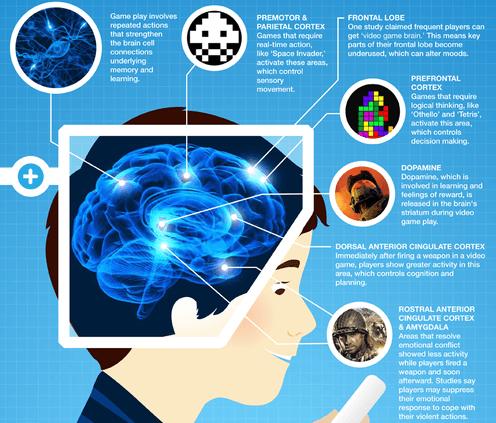
Whether playing video games has negative effects is something that has been debated for 30 years, in much the same way that rock and roll, television, and even the novel faced much the same criticisms in their time.

Purported negative effects such as addiction, increased aggression, and various health consequences such as obesity and repetitive strain injuries tend to get far more media coverage than the positives. I know from my own research examining both sides that my papers on video game addiction receive far more publicity than my research into the social benefits of, for example, playing online role-playing games.


Instead of dying out, Anti-Semitic myths have withstood the test of time.

By Asa Simon Mittman, California State University, Chico

With over one billion people worldwide using social media, including 80 percent of employees using private sharing sites at work, members have been scrambling to insist that not only does it not negatively affect their work performance, but that it improves it. Yahtzee! probably wishes they could get the kind of free public relations Twitter gets.

Few studies have been done to examine the issue. Postdoctoral Fellow Dr. Cecilie Schou Andreassen and colleagues at the University of Bergen looked at the consequences of the use of social media during working hours.

 Everyone inherits two copies of most genes, one copy from each parent. In a recent study, researchers found in a rare mutation, people with one inactive copy of the gene NPC1L1 appeared to be protected against high LDL cholesterol, commonly called the "bad" cholesterol, and coronary heart disease, a narrowing of the heart's arteries that can lead to heart attacks. 

This mutation meant a 50 percent reduction in the risk of heart attack, at least epidemiologically, according to the paper
in The New England Journal of Medicine. NPC1L1 is of interest because it is the target of the drug ezetimibe, often prescribed to lower cholesterol.

Uranus is generally boring but it recently got interesting. It has become so stormy, with enormous cloud systems so bright, that for the first time ever amateur astronomers are able to see details in the planet's hazy blue-green atmosphere.

This one is definitely too juicy to ignore - I need to join the crowd of bystanders-in-awe. 
As you may have heard, ESA's ROSETTA spacecraft successfully landed yesterday on the solid nucleus of comet 67/P, Churyumov-Gerasimenko - a 2.5 mile long conglomerate of rock and ice. I refrain from giving detail of that enormous achievement for humankind, because I rather want to comment on this rather funny twist of the whole story. But still let's first enjoy at least one nice picture of the surface of that distant solar system body...


An analysis of two African tribes has led anthropologists to suggest that men evolved better navigation ability than women because men with better spatial skills - the ability to mentally manipulate objects - can roam farther and have children with more mates.

Driving to work is routine, you might even forget you are doing it, but how aware would you be if you had to doit in reverse?

We're used to seeing objects pass behind us as we go forward. Moving backwards feels unnatural and a new study finds why that is: Moving forward actually trains the brain to perceive the world normally. The relationship between neurons in the eye and the brain is more complicated than previously thought--in fact, the order in which we see things could help the brain calibrate how we perceive time, as well as the objects around us.

Reversing the Map

Supplement marketers have been aggressively claiming that vitamin B12 and folic acid reduce the risk of memory loss, but a large study on long-term use of supplements found no benefits.   

The study involved people with high blood levels of homocysteine, an amino acid. High levels of homocysteine have been linked to memory loss and Alzheimer's disease. Early observational studies claimed there may be some benefit to thinking and memory skills in taking folic acid and vitamin B12, but the results were not duplicated in later randomized, controlled trials.


