




The coffee plant has a newly sequenced genome and that can tell scientists what they really want to know about: the evolution of caffeine.

The sequences and positions of genes in the coffee plant show that they evolved independently from genes with similar functions in tea and chocolate, which also make caffeine. Coffee did not inherit caffeine-linked genes from a common ancestor, but instead developed the genes on its own.

Why Coffee?

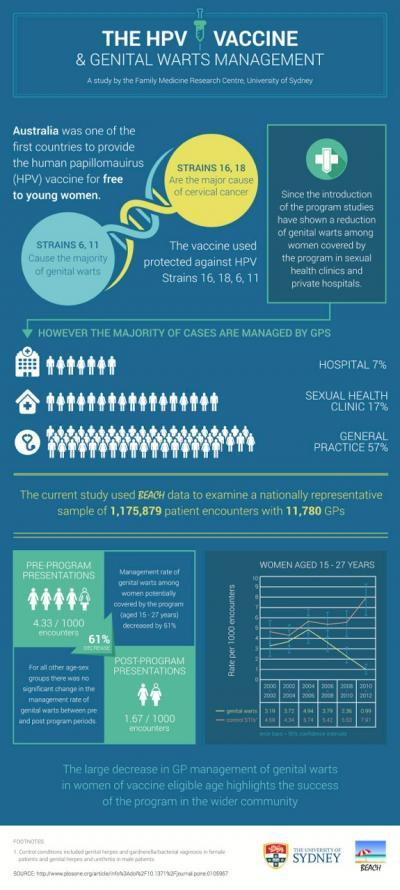
Doctors in Australia are reporting 61 percent fewer cases of genital warts among young women since the introduction of the national human papillomavirus (HPV) vaccination program.

The study reviewed more than a million patient encounters between 2000 and 2012 and found a significant year-on-year reduction in the management rate of genital warts in women aged 15-27 years since the vaccination program started. 

The HPV vaccination program was introduced in 2007, and the rate of genital wart presentation fell dramatically from 4.33 per 1,000 encounters pre-program (2002-2006) to 1.67 per 1,000 encounters in the post-program period (2008-2012).

Asteroid 2014 RC will buzz the Earth today. But don't be alarmed. 

The small asteroid was initially discovered on the night of August 31st by the Catalina Sky Survey near Tucson, AZ, and independently detected the next night by the Pan-STARRS 1 telescope, located on the summit of Haleakala on Maui, Hawaii. Both reported their observations to the Minor Planet Center in Cambridge, MA. Additional follow-up observations by the Catalina Sky Survey and the University of Hawaii 88-inch on Mauna Kea confirmed the orbit of 2014 RC. From its brightness, astronomers estimate that the asteroid is about 60 feet in size. 

Different kind of chocolate factory. Credit: Cklaighe/Conversation composite

By Jordan Gaines Lewis, Penn State College of Medicine

Hospitals can greatly improve their flu vaccination rate among health care workers by forcing employees to get them, finds the Henry Ford Health System where they did just that.

Citing its own data, Henry Ford researchers say the health system achieved employee vaccination rates of 99 percent in the first two years of its mandatory policy, in which annual vaccination compliance is a condition of employment. Nationally, 63 percent of health care workers were immunized against the flu in the past two years, according to the Centers for Disease Control and Prevention. 

Wheat is the latest fad diet victim and a new study presented at the European Respiratory Society's International Congress adds to its villainy. It says flour is worse for occupational asthma in French workers than toxic chemicals.

The scholars analyzed all cases of occupational asthma in France to understand who was most affected by the condition and what the main causes were. Data were collected over a 3-year period from a network of respiratory doctors specialized in occupational diseases. 330 cases were analyzed.  

The critical links between water, sanitation, and our global consumption of energy – the “energy-water nexus” are more obvious than ever before. But how many of us will take direct action at the most basic level of all?

It turns out that the way we use the toilet has a profound impact not only on our water resources, but is implicated in global energy security and perhaps the future of industrial agriculture as we know it. Flushing a standard WC accounts for around 30% of daily domestic water consumption in developed countries. This water must then be decontaminated before it is released back to the environment – an increasingly vital process of recycling as water stress grows globally.

Blood may look like blood but it doesn't always behave like blood. 

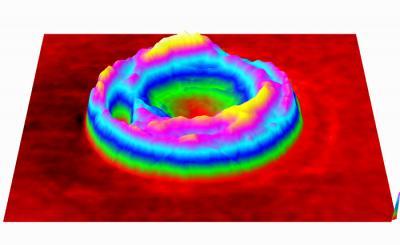
The longer blood is stored, the less it can carry oxygen into the tiny microcapillaries of the body, says a new study that used optical techniques to measure the stiffness of the membrane surrounding red blood cells over time. They found that, even though the cells retain their shape and hemoglobin content, the membranes get stiffer, which steadily decreases the cells' functionality.

If you enjoy a sweet, fleshy peach today, give some thanks to scientifically minded, free-market farmers in China 7,500 years ago.

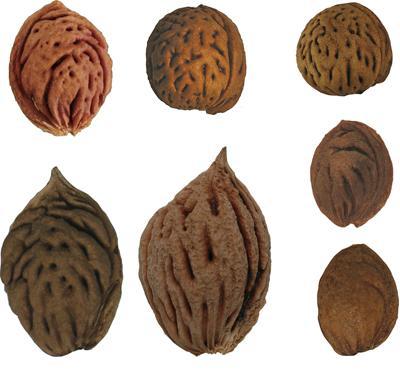
A new analysis has found that the domestic peaches popular worldwide today can trace their ancestry back to the lower Yangtze River Valley in Southern China at least that long ago.  Radiocarbon dating of ancient peach stones (pits) discovered in the Lower Yangtze River Valley indicates that the peach seems to have been diverged from its wild ancestors as early as 7,500 years ago. 

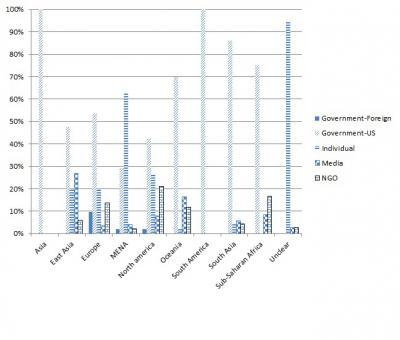
The Obama administration opened up a new front in the culture wars by creating a stunning social media campaign to get out the vote, and they have leveraged new media since; only one internal photographer gets to take pictures, for example, and those pictures go right to social media.

And they don't involve media organizations in reaching places like the Middle East and North Africa, they go right to Twitter.


