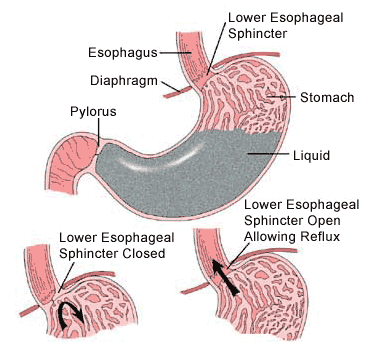
If you suffer from occasional or frequent heartburn, you know who you are. You may avoid eating certain foods, keep an arsenal of antacids beside your bed, and still suffer from pain caused by renegade stomach acid wrecking havoc on your esophagus.
For the 1 in 10 Americans who suffer from “heartburn” or occasional acid reflux, options and medications are plentiful, but for the 19 million Americans who suffer from severe acid reflux symptoms or GERD (gastroesophageal reflux disease), medicine simply isn’t enough.
When want to understand something complex, we make something similar but simpler - a model. Models in engineering re-imagine complex structures as sticks, strings, and hinges. Biology uses simpler living systems, like yeast and mice. But plenty of scientific questions defy our tried-and-true modeling strategies. If a system is too complex or too slow for us to accurately simplify, we must wait for a model to present itself.
To ring traditional church bells, a team of human operators pulls ropes that spin the giant bells (some in the multiple tons) and the mechanics of the system impose strict rules on what can be played. Gone entirely is melody, replaced by the idiomatically frenetic and somewhat cacophonous sound of cascading tones played for maximum note density.
Within the two seconds it takes a bell to rotate, the tones are slightly offset so that each rings before any bell sounds twice.

When we emerge from a supermarket laden down with bags and faced with a sea of vehicles, how do we remember where we've parked our car and translate the memory into the correct action to get back there? A paper in PLoS Biology identifies the specific parts of the brain responsible for solving this everyday problem, which could have implications for understanding the functional significance of a prominent brain abnormality observed in neuropsychiatric diseases such as schizophrenia.
Scientists at Cambridge University have discovered that freshwater algae can form stable groupings in which they dance around each other, miraculously held together only by the fluid flows they create. Their research was published today in Physical Review Letters.
The researchers studied the multicellular organism Volvox carteri, which consists of approximately 1,000 cells arranged on the surface of a spherical matrix about half a millimetre in diameter. Each of the surface cells has two hair-like appendages known as flagella, whose beating propels the colony through the fluid and simultaneously makes them spin about an axis.
Transcatheter valve implantation is a newly developed technique for the curative treatment of high-grade aortic stenosis. It is likely to be of benefit especially to elderly, multimorbid patients for whom the risk of open heart surgery would be too great. The initial results obtained with this technique at the German Heart Center in Munich are presented in the current issue of Deutsches Ärzteblatt International by Sabine Bleiziffer and her colleagues .
We've all heard it before. Some of you may even have used it: "I thought she was X" age. Alcohol impairs judgment, it is said, or releases inhibitions, depending on whether you like the effects.
There may be nothing to that argument, according to a new study. Consuming alcohol did not affect how men judged the age of women, which has important legal implications if alcohol is cited as a cause of impairing judgement in cases of unlawful sex with a minor, because men always think women look older.
The fossil record usually shows what adult animals looked like. But the appearance and lifestyle of juvenile animals often differ dramatically from those of the adults. A classic example is provided by frogs and salamanders. New discoveries from Uppsala, Cambridge and Duke Universities, published in Science, show that some of the earliest backboned land animals also underwent such changes of lifestyle as they grew up.
Scientists at the University of Liverpool have developed a new method to help researchers identify genes that can help protect the body during the aging process.
The team developed a method of analysing genes in multiple ageing tissue types in both animals and humans. The analysis, which included more than five million gene measurements, highlighted the mechanisms used by the body to protect against cellular changes with age that can result in conditions such as muscle degeneration and cognitive aging.