






If you're in the prejudice business the worst thing that can happen is to have a woman and an African-American fighting it out to be President.   A white guy has a tough time out there these days and that's a good thing for society because it means that America continues to be the least racist country in the world.

But if you're in the prejudice business the death of institutional racism and the demise of cultural racism means you'll need to look deeper;  namely to find people being prejudiced against themselves.    Then you can say it's the legacy of old prejudice and the cycle continues.
Okay, you're thinking a guy who started a site where scientists write feature articles directly to the audience must be insane to endorse big media science journalism, right?   

Not at all.  Science journalism is a different beast than what we do here but it still has more commonality than it lacks and that's why I was intrigued by a recent back and forth between Professor Larry Moran of the University of Toronto and Chris Mooney of Seed Media's Scienceblogs.com.

Moran is never one to pull punches - that's why I have him on my blogroll - but that doesn't mean I always agree with him, I just like his style.
Show Me The Science Month Day 21


Why do certain species of fruit flies prefer some fruits over others? Two biologists have looked at the genetic basis behind the evolution of fruit preference, in a paper in this month's issue of Genetics (an incredible issue which happens to contain another amazing, pioneering, paradigm-shifting, ground-breaking paper).

Many insects specialize in feeding on just one or a few types of plants. This fact isn't that surprising, since plants have all sorts of defenses for warding off insects, including the production of toxic chemical compounds, and insects that feed on plants have typically evolved ways to get around the defenses of one type of plant, but not another. This phenomenon is dramatically played out in the hundreds of species of fruit flies around the world, many of which specialize in just one or a few types of fruit. Researchers at Michigan State and UNC Chapel Hill have looked at the genetic changes that enabled one species of fruit fly to specialize in the fruit of the Morinda plant, also known as cheese fruit, a fruit that is toxic to other flies.


Morinda citrifolia, photograph by Eric Guinther
Over at the Chronicle of Higher Education, Columbia University humanities professor Andrew Delbanco takes stock of recent arguments that the intellectuals are back in charge of government:

What goes on here? Was the historian Richard Hofstadter wrong in his classic Anti-Intellectualism in American Life to detect an irresistible current in our society of "resentment and suspicion of the life of the mind and of those who are considered to represent it"? Has that current weakened or been sufficiently dammed up to explain the election of a president who is reflective about history and ideas as well as about policy and practice?

New evidence of a carnivorous killer has been found in Africa. This ancient killer almost had the misfortune of going extinct twice.

While evidence of 95-million year old therapods from Africa is quite scare making one think that each fragment would be treated like gold, this was not the case the first evidence of Carcharodontosaurus iguidensis, a newly described dinosaur from the Cenomanian of Nigeria and published in the December 2007 issue of the Journal of Vertebrate Paleontology.


Academia is notoriously resistant to change, which to some extent is a good thing. It was therefore no surprise that when Wikipedia became a phenomenon most academics scoffed at it as a passing fad, fatally flawed by its very core idea: anybody, and I mean anybody, can become a Wiki author and post new entries or edit existing ones. Surely, this will inevitably lead to chaos and complete unreliability, the critics said.
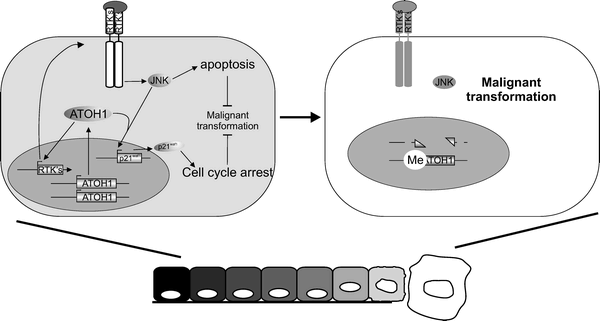
Starting with the tiny fruit fly, and then moving into mouse and human patients, researchers at VIB connected to the Center for Human Genetics (K.U. Leuven) say they have showed that the same gene suppresses cancer in all three. Reciprocally, switching off the gene leads to cancer. The scientists think there is a good chance that the gene can be switched on again with a drug.
With sexual activity among adolescents in the United States resulting in over 750,000 teenage pregnancies each year and reports of up to 25 percent of all female adolescents in the US having sexually transmitted infections, researchers and public health officials are looking for those factors that might increase sexual activity in teens. In an article published in the April 2009 issue of the American Journal of Preventive Medicine, researchers say that teenagers who preferred popular songs with degrading sexual references were more likely to engage in intercourse or in pre-coital activities. 
A team of scientists has used game theory to explain the bizarre behavior of a group of ravens.   Juvenile birds from a roost in North Wales have been observed adopting the unusual strategy of foraging for food in 'gangs.'   New research published in PLoS One explains how this curious behavior can be predicted by adapting models more commonly used by economists to analyse financial trends.

This is the first time game theory has been used to successfully predict novel animal behavior in the real world. The researchers believe this analysis could also shed light on the variation in feeding strategies in different populations in other species.
Women undertaking a ten week program of 75 minute Restorative Yoga (RY) classes gained positive differences in aspects of mental health such as depression, positive emotions, and spirituality (feeling calm/peaceful) compared to the control group. The study, published today in a special issue of Psycho-Oncology focusing on physical activity, shows the women had a 50% reduction in depression and a 12% increase in feelings of peace and meaning after the yoga sessions.


