Contrary to the TV sitcom where the wife experiencing strong labor pains screams at her husband to stay away from her, women rarely give birth alone. Today, there are typically doctors, nurses and husbands in hospital delivery rooms, and sometimes even other relatives and friends. Midwives often are called on to help with births at home.
Assisted birth has likely been around for millennia, possibly dating as far back as 5 million years ago when our ancestors first began walking upright, according to University of Delaware paleoanthropologist Karen Rosenberg. She says that social assistance during childbirth is just one aspect of our evolutionary heritage that makes us distinctive as humans.
U.S. intelligence officials have spent more than seven years searching for Osama bin Laden but UCLA geographers say that, if he is still alive, they have a good idea of where he was at the end of 2001 — and perhaps where he has been in the years since.
Show Me The Science Month Day 15

What happens when a big chunk of your genome is accidentally copied? Bad things could obviously happen when when sudden and dramatic changes are made to your genome (which is why we wear sunblock on the beach and lead shields when getting X-rayed). Recent studies have found that accidental duplications in the genome (which can change the copy number of sets of genes) are involved in a growing list of diseases, including autism, psoriasis, and susceptibility to AIDS. And yet we also know that big DNA duplications aren't always harmful, because we can find ancient duplications in our genomes that harbor genes filling useful roles in our physiology.
How frequently do these large duplications arise, and what role have they played in human evolution? A group led by Evan Eichler, at the University of Washington, aided by the DNA sequencing powerhouse of the Genome Sequencing Center at Washington University (in St. Louis - not the same place as the University of Washington!), has studied these questions
by looking for big, duplicated chunks in our closest relatives - the great apes. Their results show that big DNA duplications have probably played an important role in the evolution of our species.
The
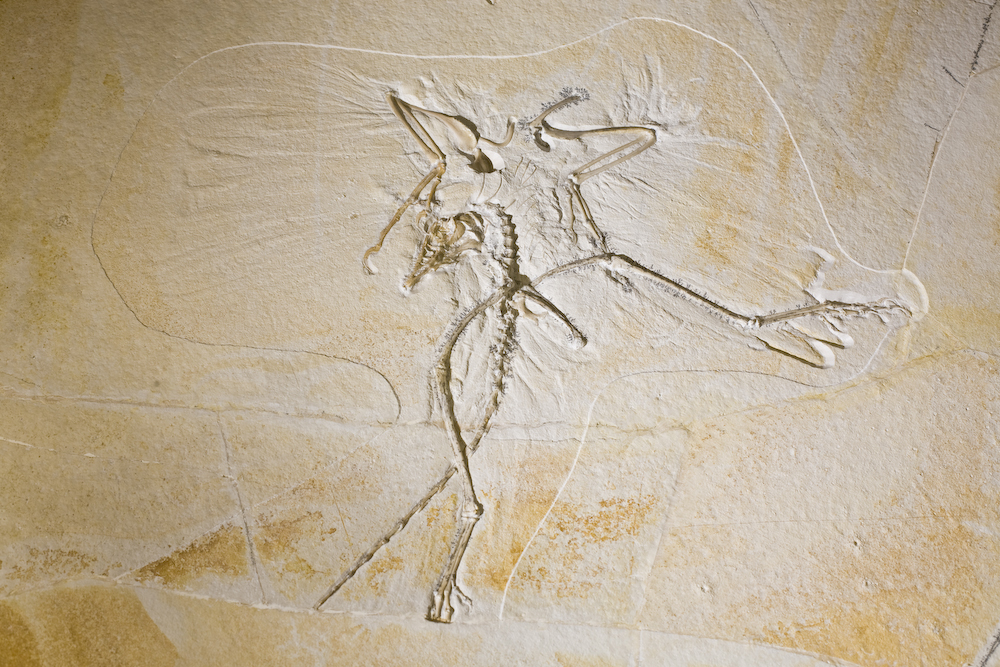
Archaeopteryx is experiencing a phoenix-like reascent to fossil celebrity status. The disovery of this clearly birdlike dinosaur in 1861 lent ethos to Darwin’s brand new Theory of Evolution. In December, the Thermopolis, WY archaeopteryx fossil was escorted to the
Stanford Synchrotron Radiation Lightsource laboratory for synchrotron X-ray analysis. According to researcher Uwe Bergmann, "What you normally can't see are the chemical elements from the original organism that might still be present in the fossil. Using X-ray fluorescence imaging, we can bring these elements to light, getting a better look at the fossil and learning more about the original animal.”
"When people live where the weather is colder and they are more covered with clothing, they depend on their diet for their vitamin D," reports Raymond Hobbs, MD. Dr. Hobbs’ study in the January/February issue of Endocrine Practice reveals that Detroit-area Arab-American women who wear the hijab, modest dress with headscarf, receive approximately half of the vitamin D of their western-dressed Arab-American neighbors.
Last night at two in the morning I woke to find someone had grafted a zombie arm to my left shoulder. I commanded it to move—no response. I jabbed it with my right hand—no response. I threw it against the wall—no response. Would this limb remain forever zombific? Medical literature is conflicted.
The current guidelines for tourniquet use suggest a one-hour maximum for restricted blood flow to upper extremities and a two-hour maximum for lower extremities, but also admit that the onset and degree of tissue death (necrosis) varies according to patient age and physical condition. Past these thresholds, restricted blood flow can result in nerve damage. (The tingling you feel is your nerves’ way of expressing angst—a call to roll over before they get really pissed.)
“The Extended Phenotype – The Long Reach of the Gene” is the book Richard Dawkins wants you to read “if you read nothing else of mine” because “It is probably the finest thing I shall ever write.”
It purports to be about science, for scientists, yet at the very beginning there is a quite remarkable disclaimer. Dawkins warns the reader that the book contains nothing new, that it is “unabashed advocacy”, (in other words a mere personal opinion) and that it contains no hypotheses that are testable. In short, the book is declared from the outset to be non-scientific.
Cancer cells need a lot of nutrients to multiply and survive. While much is understood about how cancer cells use blood sugar to make energy, not much is known about how they get other nutrients. Now, researchers at the Johns Hopkins University School of Medicine have discovered how the Myc cancer-promoting gene uses microRNAs to control the use of glutamine, a major energy source. The results, which shed light on a new angle of cancer that might help scientists figure out a way to stop the disease, appear Feb. 15 online at Nature.
Without formalized sign language instruction, deaf children in families develop their own language using simple gestures that become more complex over time. Unless they are gather in large groups, those specific deaf languages can result in thousands of dialects, called 'homesigns' by researchers.
There may be thousands of homesigners in a given society. Marie Coppola, postdoctoral fellow at the Department of Psychology, University of Chicago, Illinois, says her work with four Nicaraguan homesigners shows how such individual gesture systems likely provided the raw materials for the language that emerged in a school for the deaf there.
A research review published recently in Nutrition Today(1) says that the high-quality protein in eggs makes a valuable contribution to muscle strength, provides a source of sustained energy and promotes satiety. High-quality protein is an important nutrient for active individuals at all life stages, they say, and while most Americans consume the recommended dietary allowance (RDA) for protein, additional research suggests that some Americans are not consuming enough high-quality protein to achieve and maintain optimal health.(2,3,4)
Study Findings