If you hand food to a child when they are sad, or angry, or anything else, they will begin to associate food with those feelings. As adults, this emotional eating will be a tough habit to break. In youth, it will be even more difficult because kids aren't always aware that good things can be bad for you in excess.
For the better part of this century, the federal government
has promoted the notion that only government-funded science is
real science, and the private sector is the icky kind that, let's face it, the kind of people who overwhelmingly prefer to stay in academia dislike. (1)
The IARC monograph program on Evaluation of Carcinogenic Risks must be reformed and brought into the 21st century – or it should be abolished
The World Health Organisation’s International Agency for Research on Cancer (IARC) monograph program is an outmoded cancer classification scheme that has remained fundamentally unchanged since the monograph program was established in the early 1970s. In the intervening 45 years, scientific understanding of cancer causation has deepened and provided decision makers with an evolving appreciation of how effects seen in laboratory animals should be used to protect human health.
With a slightly anti-climatic timing if we consider the just ended orgy of new results presented at winter conferences in particle physics (which I
touched on here), the LHCb collaboration outed today the results of a measurement of unity, drawing attention on the fact that unity was found to be not equal to 1.0.
In the late 2000s, after natural gas uptake caused American carbon dioxide emissions to plummet, panicked environmentalists began to scramble for new ways to campaign on ending so-called fossil fuels. Methane, with 23X the warming power of CO2, was ideal, but they had just spent a decade insisting methane could explain increased warming, because it did not persist long enough.
And it would have started long before then, if the methane were linked to global warming by frozen tundra melting and releasing its methane. But it wasn't detected.
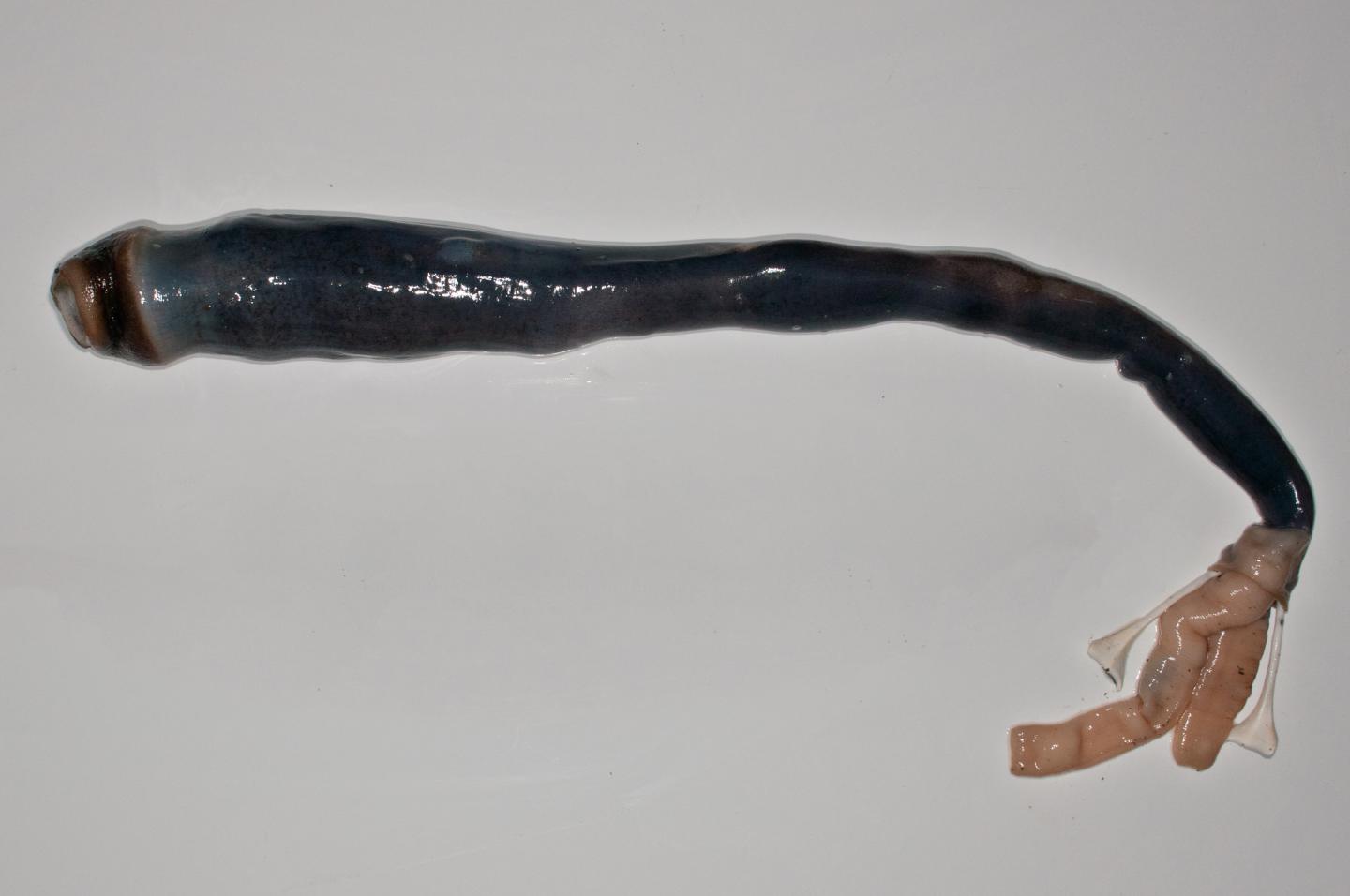
A newly named species, a giant, black, mud dwelling, worm-like animal, doesn't seem to eat much, instead it gets its energy from a form of sulfur.
The public is often confused what 'discovery' means in science. It means it is being identified as a new species, not never seen before. The three- to five-foot long, tusk-like shells that encase the animal were first documented in the 1700s and are fairly common, it's the living animal inside that is being identified as a new species.
A new bio-inspired algorithm seems to use the social behavior of bee colonies, which allows them to attack in an optimal way, could help dismantle social networks linked to organized crime, jihadist terrorism, or facilitate the design of vaccination strategies capable of containing the spread of a pandemic.
The tool automatically detects and identifies the most dangerous actors or nodes within a given social network and the density of the interconnected relationships between them, which may help law enforcement authorities make their decisions and act in the most efficient way possible.
Starburst galaxies are where stars are forming at such a breakneck rate that the galaxy is eating up its gas supply faster than it can be replenished. There are several different factors that can lead to such an ideal environment in which stars can form at such a rapid rate. Crucially, there has to be a sufficiently massive supply of gas. This might be acquired in a number of ways -- for example by passing very close to another galaxy, in a full-blown galactic collision, or as a result of some event that forces lots of gas into a relatively small space.
This content of this blog is adapted from my lecture on Cognitive Bias in Decision Making, for
the module Cognition and Emotion. I
present this lecture to third year Psychology students at the University of Roehampton, London.
The Structure of an Argument
How to sort good information from bad!
This evening I am blogging from a residence in Sesto val Pusteria, a beautiful mountain village in the Italian Alps. I came here for a few days of rest after a crazy work schedule in the past few days -the reason why my blogging has been intermittent. Sesto is surrounded by glorious mountains, and hiking around here is marvelous. But right now, as I sip a non-alcoholic beer (pretty good), chilling off after a day out, my thoughts are focused 500,000,000 kilometers away.