Often, we do not understand because we do not see the issue from the other side. For example, the person who believes in some sort of determinism, the "determinist", wonders why those others, people such as those who believe in ‘free will’, the “free-willers”, make a big deal out of that determinism may be used as an excuse. He exclaims: “Look, determinism does not imply that people stop feeling guilty about their misdeeds and start acting irresponsible. People are just as well determined to believe in ‘free will’.” A determinist naturally looks at what the assumed determinism implies, and in this sense, “what determinism may imply” is that.
Zika virus can cross the placenta, intended to protect the developing fetus, and appears to lead to a high percentage of miscarriages and to babies born with thin brain tissue and inflammation in brain cells, at least in mice.
Mice are not little people, of course, or every disease would have been cured by now and every chemical would be toxic, but it's a starting point for understanding the role of zika in birth defects beyond vague epidemiology.
It’s
not hard these days to find stories in the popular media about the presence of
various chemical contaminants in our environment. Included in this genre are stories about
trace levels of chemicals in common consumer products, in the air we breathe,
and in the water we drink. Almost
inevitably the stories suggest that even minor exposures are harming our
health.
Today I would like to mention that my book
"Anomaly! Collider Physics and the Quest for New Phenomena at Fermilab" is now available for purchase as E-Book at its
World Scientific site.
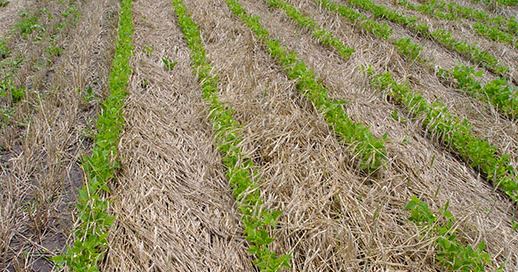
No-till farming uses cover crops to conserve soil and suppress weeds but many vegetable producers haven't embraced it yet.
The reason is simple; small-seeded vegetable crops struggle to emerge through thick cover crop residues. A recent program sought to see how it might work better with string beans, a common staple of many dinners, and possessing larger seeds. In both Illinois and Washington, USDA-ARS agronomist Rick Boydston and University of Illinois ecologist Marty Williams grew vetch, rye, and a combination of the two cover crops before killing them with a roller-crimper—a machine that evenly flattens and crimps standing plant biomass—or with a combination of the roller-crimper and a burndown herbicide.
I would like to use this space to advertise a couple of blogs you might be interesting to know about. Many of you who erratically read this blog may probably have already bumped into those sites, but I figured that as the readership of a site varies continuously, there is always the need to do some periodic evangelization.

Never compare between only Blacks (B) and others for example, or only Caucasian Whites (CW) and B. One should consider at least three together instead of only two. For example, consider also the North East Asians (NEA). Why? Without considering NEA, B and CW are merely two different regions in whatever parameter space, say crime rates, and all interpretations are still on the table. But relative to B, NEA are almost invariably on the other side of the CW data points, at even higher intelligence, even less crime, even less sexual dimorphism/rape, even higher GDP, graduation rates, and so on.
There is no correct moral theory.
All morality is politics. People do not act on the basis of morality. Everybody
does everything they do for the most meaningful reason at the time. If an act
may be judged as moral, so much the better. But, if an act cannot be judged as
moral, and if it is meaningful enough to a person to do it, and if it seems
like a good idea at the time, then it will be done. Morality is just political
correctness masquerading as the right thing to do – at the time. However, the
social psychology of the individual will always weigh the political correctness
of an act against the meaningfulness of the act, and proceed accordingly. Yet, the
point is none of us do what we do because we want to be moral authorities.

Sitting has been branded the “
new smoking” for its supposed public health risks, especially for people with sit-down office jobs.
Over the past 15 years or so sitting has been linked with cancer, heart disease and diabetes and even