
Among the many things that CMS and ATLAS physicists are looking forward to checking up, using the data that the LHC is starting to deliver from 13 TeV proton-proton collisions, one is the WH resonance signal that CMS found in a recent analysis. Mind you, "signal" here is a misnomer: what was seen was most probably a insignificant fluctuation of the background; yet we must keep our mind open to interpretation changes.

The search I am talking about is one CMS did for boosted Higgs bosons recoiling against boosted W bosons, in a "back-to-back" topology (paper is here).
Though ocean acidification and corals have been a concern, not all coral reefs are at risk. Instead, some thrive as they have absorbed atmospheric carbon dioxide (CO2) released by the burning of fossil fuels.
In ocean acidification, the CO2 reacts with water molecules, lowering ocean pH (making it more acidic), and that process also removes carbonate, an essential ingredient needed by corals and other organisms to build their skeletons and shells.

World Oceans Day today has meant new questions about ocean acidification, which threatens coral reef ecosystems worldwide - but not all reefs. 
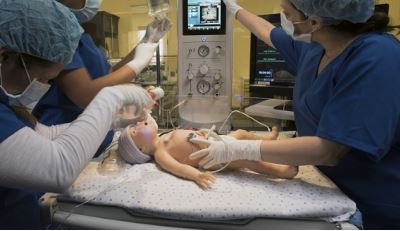
 The Newborn Tory S2210 is the industry's most advanced, life-like newborn patient simulator, according to manufacturer Gaumard Scientific Company.

Fully tetherless and wireless, Newborn Tory enables health care professionals to easily administer and monitor simulated care as they transition from the delivery room to the operating room, the nursery or the NICU, while training for a large number of programmable scenarios. Tory integrates seamlessly with Gaumard's Victoria Birthing Simulator via a wireless link, allowing healthcare providers to first tend to labor and delivery and then stabilize or treat the newborn.

Newborn Tory's features include: 

Lifelike appearance, weight and size
At the Biotech Literacy Project Boot Camp, held a week ago at the U.C. Davis World Food Center, I was on a journalism roundtable with Brooke Borel, Keith Kloor and Razib Khan, moderated by Professor Kevin Folta, and I was asked about the most important thing for scientists to keep in mind regarding increasing science acceptance.

It's always difficult to pick just one but given the nature of the assault on food science, 'don't engage in deficit thinking' was my response. Basically, don't assume the other person simply lacks the proper facts or that if things are framed properly it would change their minds. It probably will not, at least for the most vocal critics.

What if your doctor told you that your weight is somewhere between 100 and 400 lbs.? With any ordinary scale every patient can do better at home. Yet, one patient can't: the Milky Way. Even though today we peer deeper into space than ever before, our home galaxy's weight is still unknown to about a factor of four. Researchers at Columbia University's Astronomy Department have now developed a new method to give the Milky Way a more precise physical checkup.

A close-up of Comet 67P/Churyumov-Gerasimenko by NASA's ultraviolet instrument surprised scientists by revealing that electrons close to the comet's surface -- not photons from the Sun as had been believed -- cause the rapid breakup of water and carbon dioxide molecules spewing from the surface.

A new global study finds that, despite lower yields, a target market for whom cost is not really an object makes organic agriculture more profitable for farmers than conventional agriculture.

In the fickle, unpredictable system that is our climate, it looks like El Niño, which was already said to have came and gone with a whimper months ago by climate scientists, may finally be arriving.

When it happens, we may know by bunny breeding.

At times during the past 10,000 years, cottontails and hares surged when the El Niño weather pattern drenched the Pacific Coast with rain, according to an analysis of 3,463 bunny bones. The number of El Niños per century "correlates very strongly with the total rabbit population in Baja California, as well as relative abundance of the moisture-loving species of rabbits," says University of Utah anthropology doctoral student Isaac Hart.

A new study gives insight into the behavioral medications that medical caregivers sometimes prescribe for kids with Down syndrome.

The impact of scary TV on children's wellbeing has been overstated, according to a new paper. While research has shown that a small minority of children can have extreme reactions to a scary program, overall there is very little sign of increased anxiety, fear, sadness or sleep problems.