




Most of the time, we learn only gradually, incrementally building connections between actions or events and outcomes. But there are exceptions--every once in a while, something happens and we immediately learn to associate that stimulus with a result. For example, maybe you have had bad service at a store once and sworn that you will never shop there again.

Most psychiatric disorders - including depression -- do not predict future violent behavior, according to a longitudinal study of delinquent youth. Some delinquent youth with current psychiatric illness may also be violent - males with mania were more than twice as likely to report current violence than those without - but those relationships are not necessarily causal. 

The one exception is when there is substance abuse and dependence. That was a predictor of violence in people with psychiatric conditions.

A new study found that alternative providers of primary care in the UK's NHS do not perform as well as traditional GP practices.

Since 2006, some schools have been giving up desks in the belief that sedentary education is doing a disservice to children. Another study adds to that debate. The Texas A&M Health Science Center School of Public Health finds students with standing desks are more attentive than their seated counterparts, with 12 percent greater on-task engagement in classrooms with standing desks 

 The findings were based on a study of almost 300 children in second through fourth grade who were observed over the course of a school year. Engagement was measured by on-task behaviors such as answering a question, raising a hand or participating in active discussion and off-task behaviors like talking out of turn.

Researchers have described the role of the calcium sensing receptor (CaSR) in causing asthma, a disease which affects 300 million people worldwide, by using mouse models of asthma and human airway tissue from asthmatic and non-asthmatic people.

Up to 6 out of 1,000 children worldwide may be on the spectrum of an autistic disorder (ASD) and 50 percent of those kids demonstrate serious and disruptive behavior, including tantrums, aggression, self-injury and noncompliance. For children with ASD, serious disruptive behavior interrupts daily functioning and social skills development, limits their ability to benefit from education and speech therapy, can increase social isolation and intensify caregiver stress. 

Luc Lecavalier and colleagues from The Ohio State University Wexner Medical Center conducted a 24-week parent training study designed to effectively reduce serious behavioral problems in young children with ASD. 

What happens when a patient with multiple sclerosis (MS) who is clinically stable stops taking their medication?

An international, multi-site study found almost 40 percent of patients had some disease activity return after they stopped, according to research presented at the American Academy of Neurology Annual Meeting last week.

"Despite long periods of disease stability while taking medication, we found a large minority of patients who stopped experienced relapses or disability progression," says lead study author Ilya Kister, MD, an assistant professor of neurology at the NYU Langone Multiple Sclerosis Comprehensive Care Center. "We need to identify situations when it is safe for patients with MS to stop taking these medications."

You may find these remarks cynical. You may find them helpful.

Strategy

Can earthquakes ever be predicted? This question is timely after the magnitude 7.8 earthquake that struck Nepal recently. If authorities had more warning that the earthquake was coming, they may have been able to save more lives.

While Nepal is a documented area of previous seismic activity, at the moment there is no technique that provides predictions of sufficient clarity to allow for evacuations at short notice. So if we cannot predict these events now, are there avenues of research to provide useful predictions in the future?

Married people have better overall health and longevity than single people, say epidemiologists, but more is not always better. 

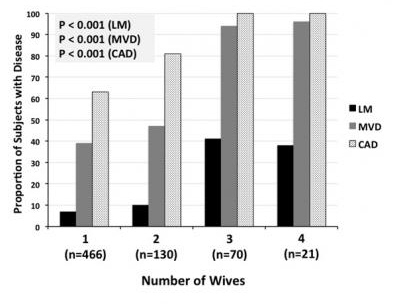
A recent prospective multicenter observational study assessed the effect of polygamy on cardiovascular health and found a significant association between number of wives and the presence of coronary artery disease (CAD), left main disease (LMD) and Multivessel disease (MVD). Risk increased with the number of wives. After adjusting for baseline differences, the researchers showed that men who practiced polygamy had a 4.6-fold increased risk of CAD, a 3.5-fold increased risk of LMD and a 2.6-fold elevated risk of MVD. 

That was even for men with up to four concurrent wives who didn't reside in the same house.


