





Europeans may be slightly less anti-science than they are portrayed - at least when it comes to food.

Though American activists want the USA to be more like Europe and ban GMOs (except, oddly, in the food that organic meat ate), that is either not a policy that actual European consumers wanted, or they have become more educated since those laws were passed, or surveys lack controls too much to be worthwhile.
How to present in a simple way the spinorial space-time and the privileged space direction it generates? What is the fundamental difference between space-time spinors and the conventional description of space and time? What is the relevance for the analysis of WMAP and Planck data ?
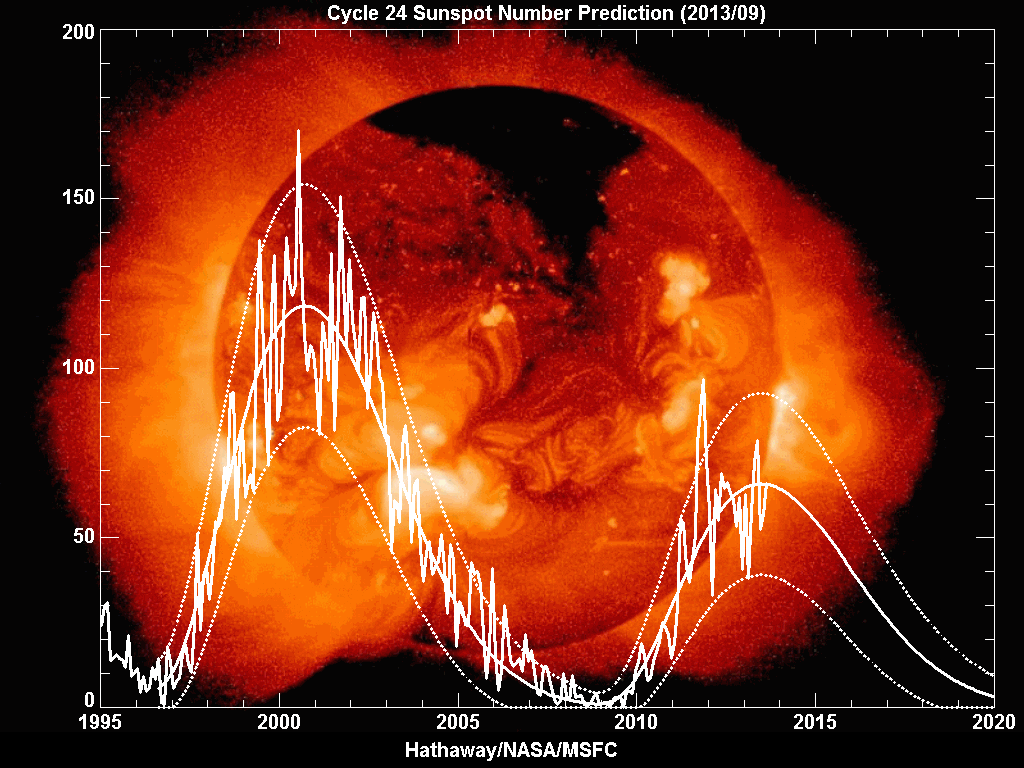
Predicting the behavior of a sunspot cycle is fairly reliable once the cycle is well underway (about 3 years after the minimum in sunspot number occurs(1). Prior to that time the predictions are less reliable but planning for satellite orbits and space missions often require knowledge of solar activity levels years in advance.

A number of techniques are used to predict the amplitude of a cycle during the time near and before sunspot minimum. Relationships have been found between the size of the next cycle maximum and the length of the previous cycle, the level of activity at sunspot minimum, and the size of the previous cycle.

A multi-center study has determined that wearing back braces would prevent the need for spinal correction surgery in children with adolescent idiopathic scoliosis (AIS) - early results were overwhelmingly in favor of bracing.

Extreme weather event coverage may lead people to think more seriously about climate change, according to new surveys of New Jersey college students which found that shortly after Hurricane Irene and "Super Storm" Sandy, they were more likely to show support for a politician running on a "green" platform and expressed a greater belief that climate change is caused by human activity.

6,000 light-years away, in the constellation of Scorpius, nebula IC 4628 is a huge region filled with gas and clumps of dark dust which produces brilliant hot young stars. In visible light, these stars appear as a blue-white color, but they also emit intense radiation in other parts of the spectrum — most notably in the ultraviolet.

The Toxoplasma parasite has been linked spontaneous abortion in pregnant women and killing immune-compromised patients, but it has even stranger effects in mice. 

Infected mice lose their fear of cats.

That's good for cats and then for the parasite, because the cat gets an easy meal and the parasite gets into the cat's intestinal track, the only place it can sexually reproduce and continue its cycle of infection.

New research reveals a scary twist to this scenario: the parasite's effect seem to be permanent. The fearless behavior in mice persists long after the mouse recovers from the flu-like symptoms of toxoplasmosis, and for months after the parasitic infection is cleared from the body. 

Observational satellite data and a computer model have predicted response to human influence have a common latitude/altitude pattern of atmospheric temperature change.

The key features of this pattern are global-scale tropospheric warming and stratospheric cooling over the 34-year satellite temperature record.

The troposphere is the lowest portion of Earth's atmosphere. The stratosphere lies above the troposphere. 
A new report compared multiple satellite records of atmospheric temperature change with results from a large, multi-model archive of simulations. Fingerprint information has proved particularly useful in separating human, solar and volcanic influences on climate.

Employees who have a sense of unjustified entitlement are more likely to say that their bosses are abusive and mistreat them than their less entitlement-minded coworkers, according to a new paper.

A protein called isocitrate dehydrogenase (IDH1) is present at high levels in lung cancers and can be detected in the blood, making it a noninvasive diagnostic marker for lung cancers, according to a new study.

Lung cancer is the leading cause of cancer deaths in both men and women in the United States and worldwide. To detect lung cancer in blood, currently certain biomarkers including CEA, Cyfra21-1 and CA125 are used, but these markers are not very sensitive, according to He.

