


On July 16th, 2013, at 12:09 a.m. EDT, the sun erupted with an Earth-directed coronal mass ejection, sending billions of tons of particles into space. These particles cannot travel through the atmosphere to harm humans on Earth, but they can affect electronic systems in satellites and on the ground.   The particles will reach Earth over the next few days.  

Experimental NASA research models, based on observations from NASA's Solar Terrestrial Relations Observatory, show that the CME left the sun at speeds of around 560 miles per second, a fairly typical speed.

90% of East Asian adolescents in British Columbia are not sexually active, so East Asian parents are doing something right, but the ones who do have sex engage in some risky behavior

The paper in the Canadian Journal of Human Sexuality
also says it is the first population-based survey in Canada that asked East Asian adolescents their reasons for abstaining from sex: the top two reasons for waiting were not feeling ready and wanting to meet the right person. 

In 2011 the Very Large Telescope (VLT) discovered a gas cloud with several times the mass of the Earth accelerating towards the black hole at the center of the Milky Way.   The cloud is now so stretched that its front part has passed the closest point and is traveling away from the black hole at more than 10 million km/h, whilst the tail is still falling towards it.

The black hole at the center of the Milky Way, known as Sgr A* (pronounced Sagittarius A star), is estimated to have a mass of about four million times that of the Sun and is the closest supermassive black hole known - so it is the best place to study black holes in detail.

Despite much research on the many processes that erode rocky coastal cliffs, accurately predicting the nature, location and timing of coastline retreat remains challenging. This is also confounded by the apparently episodic nature of cliff failure. 

Coastline retreat via progressive failure of rocky coastal cliffs

The dominant drivers of coastal erosion, marine and sub-aerial processes, are anticipated in future to increase, so understanding their present and combined efficacy is fundamental to improving predictions of coastline retreat.

When is a tuna more like a seahorse than a marlin?

Science!

The first comprehensive phylogeny of the "spiny-rayed fish," a group that includes about a third of all living vertebrate species, has been published in the Proceedings of the National Academy of Sciences.

After nearly 25 years of searching, three scientists have finally found Waldo. No, not the lovable bespectacled character in children's picture books, but rather an unusual clam they have named Waldo arthuri and which was discovered off the coast of California and British Columbia.

Paul Valentich-Scott from the Santa Barbara Museum of Natural History, and Diarmaid Ó Foighil from the University of Michigan, Museum of Zoology first began discussing this unusual clam back in 1989. Valentich-Scott discovered his strange specimens off the coast of Santa Barbara and Morro Bay, California, while Ó Foighil uncovered his while trawling for invertebrates off Vancouver Island, British Columbia.

Testing a new therapeutic intervention such as a drug or surgical procedure on human subjects is not an option so the vast majority are first tested on animals and only when they have been established in those trials can human trials be considered.

But in recent years cultural campaigns against animal testing have increased, making researchers increasingly leery of them. That means size constraints and limited statistical power, and as a result the scientific literature contains many studies that are either uncertain in their outcomes or even contradictory.


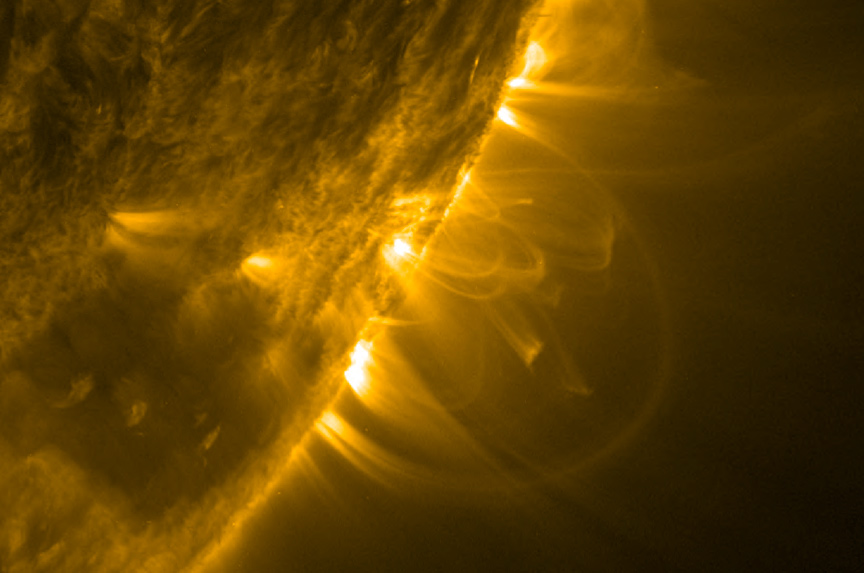
If the Sun's outer atmosphere - corona - is so hot, why does it always look so cool?

The Sun's visible surface is 'only' 10,000 degrees Fahrenheit, but as you move outward the temperature shoots up to millions of degrees. It's like a campfire that feels hotter the farther away you stand. That defies common sense, but so do dogs named Checkers and Esther Williams swimming pools so let's talk about coronal loops.

By the time Sandy hit New Jersey and New York, it had been reduced to a tropical storm but its rare angle of approach still meant a lot of devastation.

Environmentalists in New York are resistant to creating barriers against future storms, like subway doors that can prevent flooding, and seawalls, but the stories of two residential beach communities on the New Jersey shore provide compelling evidence.

While America has dramatically dematerialized its environmental footprint in recent decades, producing far more food on far less land than 30 years ago, that's not true for the rest of the world. 

Heavy financial incentives in places like Europe - which accounts for 85% of the agricultural subsidies for the entire world - mean there is no reason to embrace modern science and technology. But a new paper notes that allowing land use to be determined purely by those agricultural constituencies results in considerable financial and environmental costs to the public.

