
Researchers have found that a human monoclonal antibody developed by MassBiologics of the University of Massachusetts Medical School (UMMS) protected chimpanzees from hepatitis C virus (HCV) infection in a dose-dependent manner.

The study was conducted at Texas Biomed's Southwest National Primate Research Center.  Chimpanzees are the only species other than humans that can be infected by HCV and therefore the results from this study were critical in the development of the monoclonal antibody.  

Social security is in a crisis even worse than Medicare. Because Congress has consistently spent contributions, social security is always on the edge of insolvency and now that the Baby Boomers have begun retiring, the crisis is going to get worse, with not enough workers to fund the retirees.

Ideas such as raising the retirement age are floated by University of Michigen economists have a more positive approach; they say if we stop collecting social security payroll taxes when workers are 55-years old, their take-home pay would jump by 10.6 percent, older people would work 1.5 years longer on average and end up still paying more in income taxes and helping to reduce the Federal deficit while not drawing retirement.
The question is posed, and then answered, by  Jonathan Harrison, former chair of Philosophy at the University of Nottingham, UK, in his online essay “Is Eating People Wrong?”
The professor points out that -

“Animals that can be eaten are often better taken care of than men, whose artificially induced inedibility provides those responsible for them with no such incentive. “

That said, however -

Neil Armstrong, the first man to walk on the moon, died last Saturday in Ohio at age 82 and his funeral service is tomorrow.  Like most everything else about him, the service is private.

Yet the cosmos has decided to ignore the wishes of his family and so Armstrong is getting a special event for the occasion: a blue moon. Either that, or his family is being clever.
There is little doubt that there is an abundance of evidence regarding the role of cooperation among social animals and it is mentioned here as a precondition for the discussion of group selection and altruism; specifically in humans.

While many of the elements that constitute human behavior are present in other animals, there is little question that humans represent an extremely unique existence.  Beyond even the obvious differences regarding intellectual capacity, humans represent a eusocial mammal that exploits an extreme division of labor, such that it is human society that operates to support human existence, rather than the capabilities of any individual (1).


A large study published in Human Reproduction (1) looked at the effect of induced abortions on a subsequent first birth and found that women who have had three or more abortions have a higher risk of adverse birth outcomes, such as delivering premature and low birth weight babies.

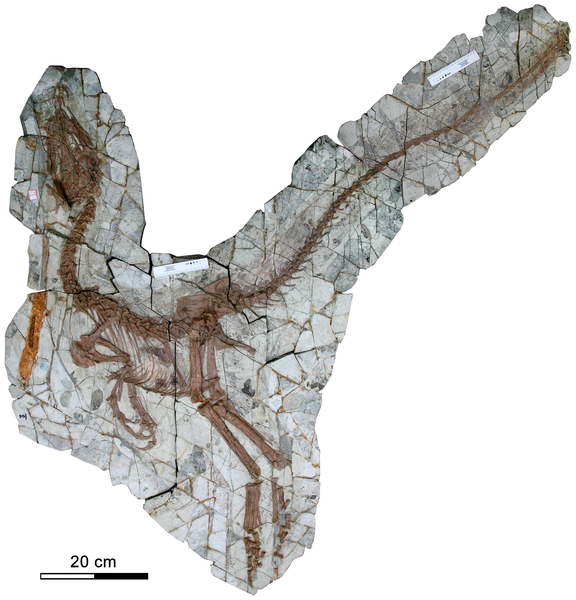
Analysis of the abdominal contents of two dinosaur fossil specimens reveals new information about their hunting and eating behavior, according to a new report.  They may have been stealth hunters.

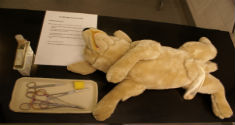
Danish veterinarians are a little squeamish about working on dead animals - instead of encouraging them to find other careers, the Faculty of Life Sciences at the University of Copenhagen is encouraging them to work on stuffed animals to lessen their anxiety.

The stuffed animal operating room laboratory allows students to train basic surgical skills on toys which resemble animals, featuring organs, veins and arteries. Measurements of students' heart rate, questionnaires and interviews show that after attending the 'teddy laboratory', students are less fearful about the possibility of surgery on living animals.
Politicians make a lot of promises when they are trying to get elected. So many they probably can't keep track of them of them. That's understandable. Believing candidates is one of the 'sweet little lies' we tell ourselves.(1)