What does
“Uh(m)” mean?
Professional linguists from a selection of highly respected international academic institutions have pondered the question in some detail over the years, but now a new paper from
Emanuel A. Schegloff, Professor Emeritus at the Department of Sociology, University of California, Los Angeles, goes considerably further towards consolidating the answer(s).
Oxford BioMedica plc biopharmaceuticals and its partner Sanofi announced a positive interim review of the RetinoStat(R) Phase I study in neovascular "wet" age-related macular degeneration (AMD) and the StarGen(TM) Phase I/IIa study in Stargardt disease by the Data Safety Monitoring Board (DSMB); an independent panel of specialists in the fields of ophthalmology, virology and vectorology. RetinoStat(R) and StarGen(TM) were designed and developed by Oxford BioMedica using the Company's proprietary LentiVector(R) gene delivery technology.
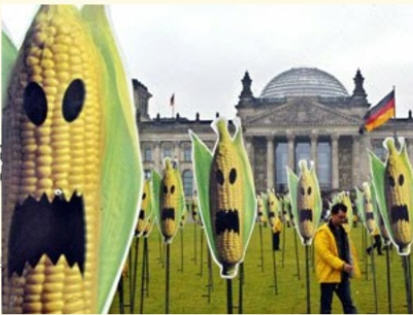
The US Food and Drug Administration says requiring special labels for foods that contain ingredients from genetically modified crops would be "inherently misleading" to consumers - that is exactly what proponents of GM food labeling are hoping for. People inherently side with the precautionary principle and there is no requirement that ballot initiatives be written clearly or well; the assumption is the public will figure it out.
The American Medical Association agrees with the USDA and wrote two months ago, "There is no scientific justification for special labeling of bioengineered foods."
And yet we are going to get it, and the cost, because spin doctors are calling it 'awareness'.
The Large Hadron Collider is delivering as expected a large amount of integrated luminosity of proton-proton collisions to CMS and ATLAS, running at a centre-of-mass energy of 8 TeV. The total collected in 2012 by CMS has just now crossed the mark of 10 inverse femtobarns: this is twice as much data as that collected in 2011. And the CMS detector is working like a charm, with all subsystems collecting data flawlessly.
Physicists need large integrated luminosity to explore rare phenomena, and high energy to probe processes which may only "turn on" above a certain threshold. So given the x2 luminosity so far collected (but we will get to x5 by the end of the year!) and x1.14 energy, the discovery potential of 2012 data is already several times larger than that of 2011 data.
CD-adapco has released the STAR-CCM + Battery Simulation Module, designed to simulate spirally wound lithium-ion battery cells, which could help the automotive and battery industries more quickly design and develop advanced electric drive vehicle power sources.
Being able to print electronic equipment has led to a cost-effective device that could change the way we interact with everyday objects - namely by using a phone's emitted radio waves for wireless power.
Can't tell a $4 bottle of wine from a $40 one? Neither can the best sommeliers in the world. But in the future you might at least seem like an expert, thanks to the power of semantic Web technology.
Deborah McGuinness, professor at Rensselaer Polytechnic Institute, has been developing applications for tech-savvy wine connoisseurs since her days as a graduate student in the 1980s, before what we now know as the World Wide Web had even been envisioned. We must assume she had a wine lovers BBS.
Excuse my use of the personal pronoun in this short article, but I am writing to get input as much as I am to simply observe a phenomenon.
I am increasingly drawn to the connection between bench science and the companies that provide them with their tools - from commercial assays, probes, and imaging chambers to engineered animals and so-called "experiment in a box" products.
As a journalist I am drawn to the subject for many reasons: it is an industry that is almost completely uncovered and one that supports, via advertisements and sponsorships, a growing number of science magazines and science venues.
And there seem to be a growing number of 'artifactual' findings due to reliance on them.
Dark matter, up to 25 percent of the universe, hasn't actually been found. It is a hypothesis, though not an unreasonable one, given that something must create a gravitational force.
There are calls in some quarters that we need to be more like people in the past; war, pestilence, disease, early death, it's all good as long as we use no pesticides.
And clear cutting forests is what ancient man did too.
During the Neolithic Age, 10,000 B.C., early man changed from being hunter-gatherers to farmers - ancient scientists told that the food supply was running low and listening to calls for mitigation and rationing instead invented domesticated livestock and agriculture. As a result, we got larger, permanent settlements with a variety of domesticated animals and plant life. and that transition brought about significant changes in terms of culture, economics, architecture, etc,