

Climate science is suffering a crisis of confidence among the public but the data is there - what climate scientists need are effective climate change communication strategies and ways to engage the people on the street who influence policy decisions.
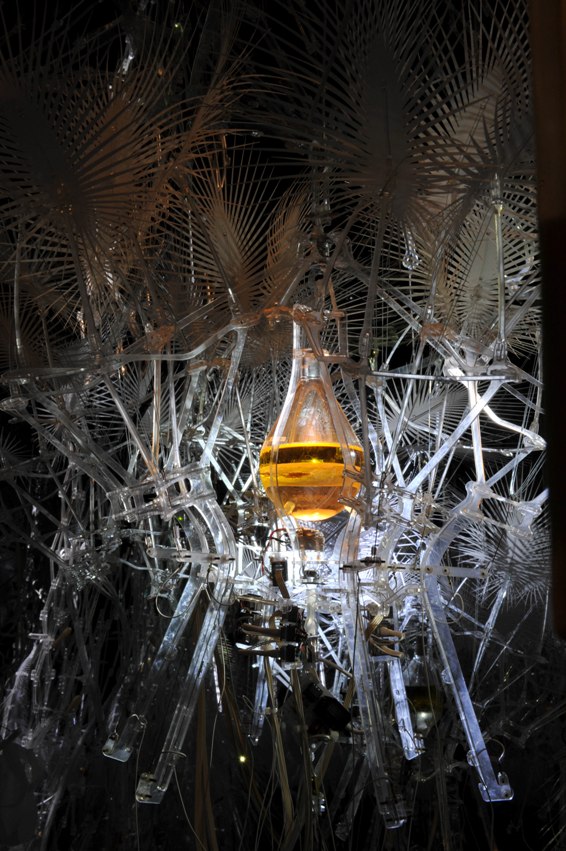
One solution to reducing the environmental footprint of buildings is to create 'living' materials using synthetic biology and cover them with it.  Those materials could eventually produce water in desert environments or harvest sunlight to produce biofuels.

Researchers from the University of Greenwich, the University of Southern Denmark, University of Glasgow and University College London are working with an architectural firm and a building materials manufacturer to use protocells - bubbles of oil in an aqueous fluid sensitive to light or different chemicals – to fix carbon from the atmosphere or to create a coral-like skin, which could protect buildings.
The Herschel Space Observatory is the largest telescope in space.   It's capable of detecting longer-wavelength light than the human eye can, light in the far-infrared portion of the electromagnetic spectrum, which is the type emitted by galaxies lined up behind other ones in the foreground.

The result is that scientists are discovering hundreds of new galaxies through brighter galaxies in front of them that deflect their faint light back to the massive Herschel telescope, an effect identified by Albert Einstein a century ago known as cosmic gravitational lensing.
With the BP oil spill in the Gulf of Mexico and the toxic mud spill in Hungary, the big question is how long will recovery take?   Unfortunately, yet at least scientifically apt, is that there are previous disasters to help answer those questions.
2010 is the biggest year for life on Mars since 1898.  Or 1955 or whenever the last 'life on other planets' craze hit the public.  
 
But unlike those other times, there is good reason.  This year, over 20 different papers have invoked the chance there may once have been life on Mars in their work.    There is now all kinds of data discussing water on Mars, minerals on Mars and even that the soil might support life.  The Journal of Geophysical Research-Planets alone has 64 papers on Mars so far this year.

