





Abandoned mine shafts could be used to provide geothermal energy to local towns, say two engineers from the University of Oviedo in the journal Renewable Energy. They say the method they have developed makes it possible to estimate the amount of heat that a tunnel could potentially provide.

Rafael Rodríguez, from the Oviedo Higher Technical School of Mining Engineering and colleague María Belarmina Díaz have developed a "semi-empirical" method (part mathematical and part experimental) to calculate the amount of heat that could be produced by a mine tunnel that is due to be abandoned, based on studies carried out while it is still in use.
Switching off a key DNA repair system, Xrcc1 , in the developing nervous system was linked to smaller brain size as well as problems in brain structures vital to movement, memory and emotion in new research.

The study in Nature Neuroscience also provided the first evidence that cells known as cerebellar interneurons are targeted for DNA damage and are a likely source of neurological problems in humans. The cerebellum coordinates movement and balance. The cerebellar interneurons fine tune motor control.
We know how oil and natural gas deposits were created; living organisms died, were compressed, and heated under heavy layers of sediments in the Earth's crust.

Scientists have debated for years whether some of these hydrocarbons could also have been created deeper in the Earth and formed without organic matter.  Now scientists say they have found that ethane and heavier hydrocarbons can be synthesized under the pressure-temperature conditions of the upper mantle; the layer of Earth under the crust and on top of the core.
I’m reviewing a book by philosopher of science Peter Godfrey-Smith entitled “Darwinian Populations and Natural Selection.” (This is not the book review, forthcoming.) Godfrey-Smith makes an excellent argument at some point in the book (chapter 7, on the gene’s eye view) that genes are not at all the sort of things Richard Dawkins and some other biologists think they are.
One year ago, a paper by a distinguished group of theorists announced first evidence of new physics from measurements of the properties of B_s mesons performed at the Tevatron by the CDF and DZERO experiments. They had combined all the available information, obtaining a result which disagreed with the Standard Model (SM) prediction by more than three standard deviations.
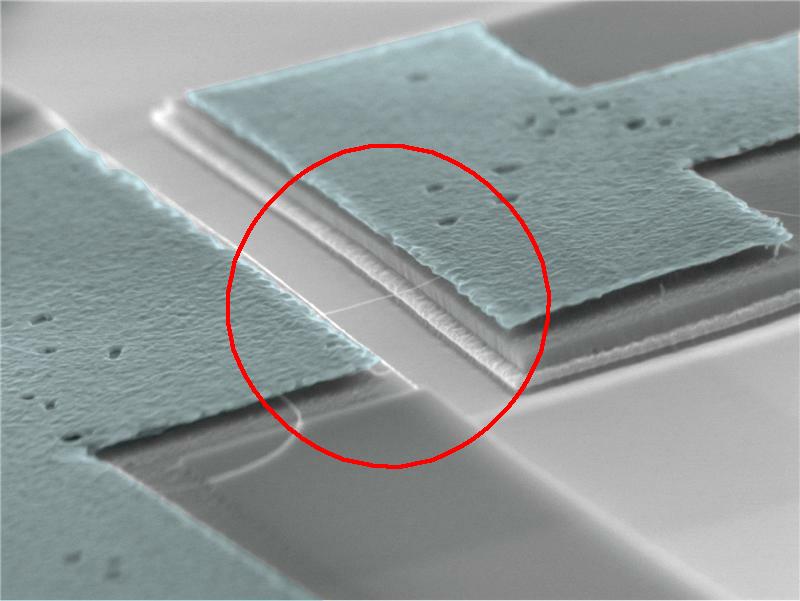
Researchers at TU Delft have succeeded in measuring the influence of a single electron on a vibrating carbon nanotube.   That can be a real milestone on the road to ultra-small measuring instruments.

Researchers in the Kavli Institute for Nanoscience at TU Delft basically suspended a carbon nanotube, comparable in size to an ultra-small violin string, and then applied an alternating electric field to the nanotube using an antenna.
Metabolic conditions and immunologic conditions rarely coincide but a group of papers appearing in Nature Medicine have linked type 2 diabetes with immunology in an intriguing way. 

In the first study, researchers used two common over-the-counter allergy medications, Zaditor and cromolyn, to reduce both obesity and type 2 diabetes in mice. Zaditor and cromolyn stabilize a population of inflammatory immune cells called mast cells.
In America, there is a debate over 'high risk, high reward' independent research versus Big Science - largescale science projects usually being done by taxpayer funded grants to large universities and basic research primarily being done in the private sector.   Germany tries to have government funding for both and prof. Manfred Bayer from TU Dortmund recently got a $2 million grant to do work in ultrafast acoustics.

Ultrafast acoustics first began to get serious research over 20 years ago at General Motors(1).   The basic concept is that sub-picosecond optical pulses generate longitudinal acoustic pulses with frequencies of 100 GHz and up.    As a thin metal film is hit with alaser pulse, it reacts with a “breathing movement”: it expands and then it contracts.
Pop Quiz: What is the role of the mitochondria in a cell?

Until just a few days ago, the only correct answer to this question would have been #3. The mitochondria of a cell are well recognized as the powerhouses of the cell. They are the location where energy-rich nutrients such as carbohydrates and fats are brought in and "burned"in the presence of oxygen to produce the energy (in the form of ATP) to power our cells. It is one of the earliest lessons of any introductory biology course.

In his July 23 column, Gary Herstein presented a thoughtful discussion and analysis of scientific controversies (What Does A Real Scientific Controversy Look Like?), with an example from physics. Perhaps readers of Scientific Blogging will be interested in another scientific controversy that emerged in biophysics over a 20 year period.

