HONG KONG, December 18 /PRNewswire/ --
- Convergence of wireless power technologies inspires global alliance promoting universal solution and electronic convenience worldwide
A new global initiative to drive convenience in electronics charging was launched at the first Wireless Power Consortium conference at Hong Kong Science Park today.
The Consortium's eight members include ConvenientPower Limited, Fulton Innovation LLC, Logitech SA, National Semiconductor Corporation, Royal Philips Electronics N.V., Sanyo Electric Co. Ltd., Shenzhen Sang Fei Consumer Communications Co. Ltd. and Texas Instruments Incorporated.
A LARGE, GROWING PROBLEM
FRANKFURT, Germany, December 18 /PRNewswire/ --
- Major Development Contribution Through Sustainable and Environmentally Sound Electricity Generation. Project to Avoid Some 340,000 Tonnes of CO2 p.a.
- Around EUR 180 Million Financed Through KfW Entwicklungsbank
For the first time, researchers at the UCLA Henry Samueli School of Engineering and Applied Science have successfully pushed nature beyond its limits by genetically modifying Escherichia coli, a bacterium often associated with food poisoning, to produce unusually long-chain alcohols essential in the creation of biofuels.
"Previously, we were able to synthesize long-chain alcohols containing five carbon atoms," said James Liao, UCLA professor of chemical and biomolecular engineering. "We stopped at five carbons at the time because that was what could be naturally achieved. Alcohols were never synthesized beyond five carbons. Now, we've figured out a way to engineer proteins for a whole new pathway in E. coli to produce longer-chain alcohols with up to eight carbon atoms."
New research in Science suggests that some meat-eating dinosaurs were super dads - three types of dinosaurs were sole care givers for their mate's eggs. They also may have had multiple mates and watched all their eggs at once.
The dinosaurs in the study were close ancestors of birds, and their fossils were found on top of unusually large clutches, said David Varricchio, a Montana State Universitypaleontologist and lead author of the paper. It's possible, he said, that the males mated with several females who laid their eggs in one large clutch. When the females left, the males incubated and protected the eggs on their own.
If you're man, and you give to charity at all, it is more likely to go to a needy person in your neighborhood but if you're a woman you are more likely to be charitable and you will also give to someone local or someone in a foreign country, says new research by Texas A&M University marketing professor Karen Winterich .
Winterich, who teaches marketing at Texas A&M's Mays Business School, says she can predict charitable behavior to different groups by an individual based on just two factors: gender and moral identity. (Moral identity does not measure how moral a person actually is, but rather how important it is to that person to be caring, kind, fair, honest, etc.)
65 million years of evolution divergence and being rodents is too much difference, says Stanford immunologist Mark Davis, PhD , so we need to do more research on humans and less on mice.
Apparently, the fabled laboratory mouse — from which we have learned so much about how the immune system works — can teach us only so much about how we humans get sick.
Davis, director of the Stanford Institute for Immunity, Transplantation and Infection, proposes that the current mouse-centered, small-laboratory approach be supplemented by a broad, industrial-scale "systems biology" approach akin to the one that unraveled the human genome.
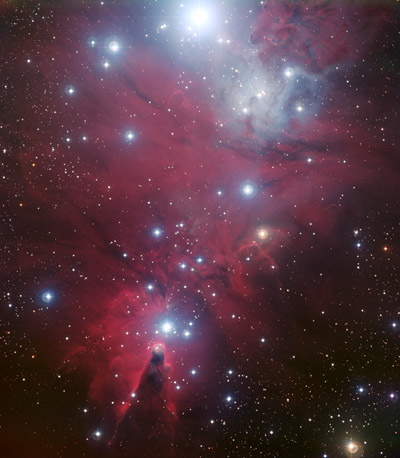
The festive season has arrived for astronomers at the European Southern Observatory (ESO) in the form of this dramatic new image. It shows the swirling gas around the region known as NGC 2264 — an area of sky that includes the sparkling blue baubles of the Christmas Tree star cluster.
NGC 2264 lies about 2600 light-years from Earth in the obscure constellation of Monoceros, the Unicorn, not far from the more familiar figure of Orion, the Hunter. The image shows a region of space about 30 light-years across.
Venus Express has made the first detection of an atmospheric loss process on Venus's day-side. Last year, the spacecraft revealed that most of the lost atmosphere escapes from the night-side. Together, these discoveries bring planetary scientists closer to understanding what happened to the water on Venus, which is suspected to have once been as abundant as on Earth.
The spacecraft's magnetometer instrument (MAG) detected the unmistakable signature of hydrogen gas being stripped from the day-side. “This is a process that was believed to be happening at Venus but this is the first time we measured it,” says Magda Delva, Austrian Academy of Sciences, Graz, who leads the investigation.
It must be December.
Those cheeky pranksters at BMJ are at it again, this time releasing an authentic-looking study that says head banging is bad for your head. Let's see how many media publications that basically print news releases without bothering to read them get suckered again (we mean you, BBC).
****
Head banging increases the risk of head and neck injury, but the effects may be lessened with reduced head and neck motion, head banging to lower tempo songs or to every second beat, and using protective equipment such as neck braces, finds a study in the Christmas issue published on bmj.com today.
In a study published in the Christmas 2008 issue of the British Medical Journal (and not one of their prank articles), Aaron Carroll, M.D., M.S., and Rachel Vreeman, M.D., M.S., of the Indiana University School of Medicine, explore the science behind six myths commonly associated with the holidays yet relevant year-round.