





Males and females process pain using different cells, a new study with mice suggests.
The findings could help researchers develop the next generation of medications for chronic pain—the most prevalent health condition humans face.

“Research has demonstrated that men and women have different sensitivity to pain and that more women suffer from chronic pain than men, but the assumption has always been that the wiring of how pain is processed is the same in both sexes,” says co-senior author Jeffrey Mogil, professor of pain studies at McGill University and director of the Alan Edwards Centre for Research on Pain.
What have I been doing for the last twoweeks, you ask? I’ve been waiting for news on the antibiotic front.  The G7 came out with a completely lame statement that has no specific commitments.  They suggest they meet together again to share ideas for “best practices.”  What we really need is money.  But again, no one wants to talk about that. 
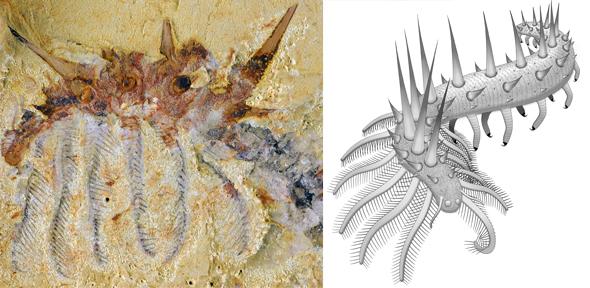
A new species of ‘super-armored’ worm, named Collinsium ciliosum, or Hairy Collins’ Monster after the palaeontologist Desmond Collins, who discovered and first illustrated a similar Canadian fossil in the 1980s, was a bizarre, spike-covered creature which ate by filtering nutrients out of seawater with its feather-like front legs, has been identified by palaeontologists.

The creature, which lived about half a billion years ago, was one of the first animals on Earth to develop armor to protect itself from predators and to use such a specialised mode of feeding.

Mosquitoes have been called the deadliest animal on the planet due to the diseases they spread.

Why feed them?

By using science, giving them an artificial buffet may lead to fewer of them, says Stephen Dobson, a University of Kentucky professor of medical and veterinary entomology. His work on developing artificial blood for mosquitoes has made him a Grand Challenges Explorations winner, in an initiative funded by the Bill&Melinda Gates Foundation.

The artificial blood he developed will allow people in remote areas around the world to sustain colonies of mosquitoes, even in those areas with limited resources and difficult logistics.

This isn't the Dr. Oz show or some nutrition site selling Vitamin D supplements or whatever the big Superfood/Miracle Vegetable craze is this week, 'miracle' is a bit of a dirty word in science. But when it fits, you have to use it.

And Hepatitis C may have gotten its miracle. 

It's not well known, Hepatitis C does not have the PR of diseases like AIDS, but 3 million people have it, many of them Baby Boomers. Some got it of their own volition, using skin poppers or needles for drugs, but hygiene was a different beast 50 years ago and it was also possible to get it just by going to the dentist.

Today, 30th June is asteroid day, to raise awareness of the searches astronomers do to detect and eventually deflect asteroids. This is your chance also to actually do something about them by signing the 100x petition (which has been signed by many famous astronomers and astronauts).

An asteroid impact is one of the few natural events we can actually prevent with our technology (unlike volcanoes, earthquakes and tsunami). With a few years or decades of warning, we can deflect them rather easily. But to find them in good time, first we need to detect them.

Wearing a computer on your sleeve may be a lot cooler than a plastic watch with an Apple logo on it - researchers at the University of Pittsburgh have designed a responsive hybrid material fueled by an oscillatory chemical reactions.

They can even perform computations based on changes in the environment or movement, and respond to human vital signs. The material system is sufficiently small and flexible enough to be integrated into fabric or introduced as an inset into a shoe.

If you suffer from chronic low back pain and need spinal fusion surgery, there is good news for your golf game. A new study shows an overwhelming majority of spinal fusion patients returned to play golf as well, if not better, than before surgery.

During spinal fusion surgery, two vertebrae are joined together using a bone graft taken from another part of the body. In traditional open surgery, a large incision is made to cut through muscles surrounding the spine. Minimally invasive surgery allows for a smaller incision with less muscle damage, resulting in less blood loss, shorter hospital stays and a quicker return to activities.
The catalogue of the Johannesburg Public Library in South Africa contains a poignant entry – “Biko, Steve. Long 0verdue”.

The entry refers to I Write What I Like, a volume of collected writings by Steve Biko, the Black Consciousness leader tortured to death in police custody in 1977.

The library used to have six copies of the volume but they have all been borrowed and never returned.

Scientists have developed a computer model that clarifies the complex processes driving ocean mixing in the vast eddies that swirl across hundreds of miles of open ocean.

The Lagrangian In-situ, Global, High-performance particle Tracking (LIGHT) model is a first-of-its-kind tool because of its ability to exploit the power available from today's supercomputers, the authors say.

