Over 60 percent of the nearly 5,000 genome projects reported in the Genomes OnLine Database involve microbes. It's no surprise. Microbes are important in everything from bioenergy to agriculture and medicine and are involved in Earth’s biogeochemical cycles.
A lot could be done with microbial genomics, says DOE JGI Genome Biology head Nikos Kyrpides writing in Nature Biotechnology, if researchers go beyond the present anthropocentric focus and institute shared standards for genomic data collection and analysis.
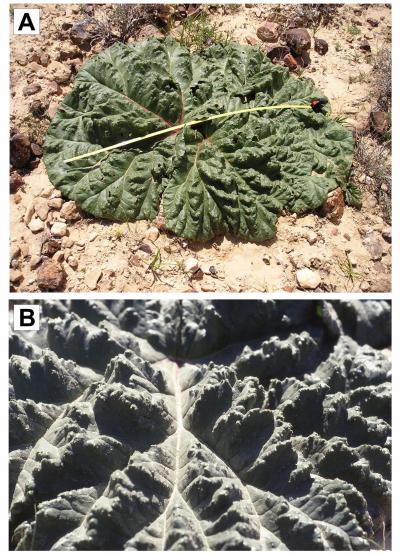
University of Haifa-Oranim researchers have managed to make out the “self-irrigating” mechanism of Rumex hymenosepalus, the desert rhubarb, which enables it to harvest 16 times the amount of water than otherwise expected for a plant in this region based on the quantities of rain in the desert - the first example of a self-irrigating plant worldwide.
The desert rhubarb grows in the mountains of Israel’s Negev desert, where average precipitation is particularly low (75 mm per year). Unlike most of the other desert plant species, which have small leaves so as to minimize moisture loss, this plant is unique in that its leaves are particularly large; each plant’s rosette of one to four leaves reaches a total diameter of up to one meter.
Dye-sensitized solar cells (DSSCs), expected to power Air Force unmanned aerial vehicles (UAVs) in the future because they are an optimum energy harvesting source that may lead to longer flight times without refueling, have gotten a boost by using a flexible film and a thin glass coating with transparent conductive electrodes.
The University of Washington's Multidisciplinary University Research Initiative (MURI) project team, with lead researcher Dr. Minoru Taya is working on the airborne solar cells and found that DSSCs made from organic materials, which use (dyes) and moth-eye film, are able to catch photons and convert them into synthesized electrons that can harvest high photon energy.
This topic requires many considerations that may be more political than economic, but to try and retain focus, the point is primarily to examine how economic principles (like
supply and demand) are dealt with in this arena.
There are two ways in which multi-national businesses may manifest. In one case, a company maintains operations to provide goods and services in another country and is completely self-contained. In other words, the goods/services provided are provided by individuals in that country for individuals in that country. This is simply another closed system
(1), albeit with a company that originated elsewhere.
In another post the general discussion regarding
free will seemed to teeter on the edge of a definition that recognized the significant role that our genes and indoctrination played, while allowing some "wiggle" room for something like free will to emerge. However this also lead me to wonder about the role of determinism in this, because ultimately the argument against free will is based on the idea that we are defined by our genes and teachings, so whatever we do is inevitable.
I just finished reading an interesting book review by physicist Martin Blume in a recent issue of Nature. Blume was reviewing Eugenie Samuel Reich’s provocative book “Plastic Fantastic: How the Biggest Fraud in Physics Shook the Scientific World,” and the whole thing prompted some further thoughts about scientific misconduct, objectivity, and the peer review system that is crucial to the advancement of science.
Reich’s book is apparently very well researched (I take Blume’s word for it, since material physics is not my field), but she draws exactly the wrong conclusion from the case study she so thoroughly investigated.
In case you've been living under a rock, you probably know that Monday is the 40th anniversary of the Apollo 11 moon landing. I don't remember seeing it on TV when I was a lad, though I am told I did (I do remember watching the live liftoff of Apollo 17, since Kennedy is about an hour drive from my boyhood home in Florida and we went to that one) but most everyone middle aged and older will - it remains the most watched program in history(1).
I'm sure that you don't seriously think I would tell you how to destroy all of the science community - do you?
Anyway, what I wanted to explain in simple terms to you is the four things that everybody seems to get wrong and drive scientists mad in the process. These are:
The Light year is a distance not a time
It makes sense that someone may think that: as it has the word year in it.
But, the light year is a measure of the distance light travels in one year. It is not a long period of time as it is often used in colloquial conversation. Understand?
If so; how many years are in a light year? None of course.
Georgia State University researchers are manipulating individual atoms in DNA and forming unique molecules in hopes of understanding the mechanisms of DNA replication and transcription, and perhaps leading to new treatments for diseases.
Chemistry and chemical biology Professor Zhen Huang and his lab were able, for the first time, to manipulate groups of molecules called methyl and phosphate groups in DNA that have been altered to contain selenium in order to bring them close enough together to form hydrogen bonds.
It isn't often that the government gets it right and the energy/climate change policies being jammed through Congress while there is no way to block them could be with us for a long time.