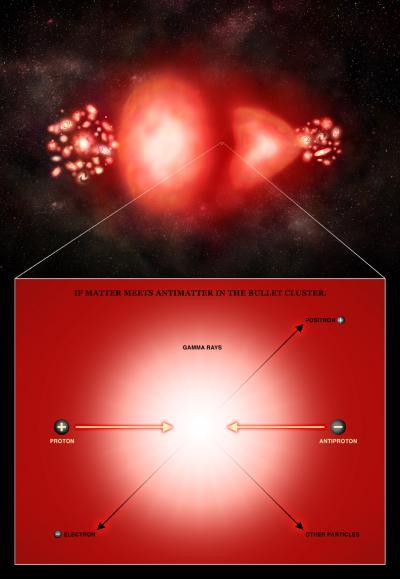





Scientists have long been on the hunt for evidence of antimatter, matter's arch nemesis and a staple of science fiction in the last century, that might be left over from the very early Universe.  But the latest  results using data from NASA's Chandra X-ray Observatory and Compton Gamma Ray Observatory suggest the search is not going to get any easier.

Antimatter would be made up of elementary particles, each of which has the same mass as their corresponding matter counterparts --protons, neutrons and electrons -- but the opposite charges and magnetic properties. When matter and antimatter particles collide, theory says they annihilate each other and produce energy according to Einstein's famous equation, E=mc2.
New research from the University of Bristol brings stem cell therapies for heart disease one step closer. The findings reveal that our bodies' ability to respond to an internal 'mayday' signal may hold the key to success for long-awaited regenerative medicine.   Dr Nicolle Kränkel and colleagues at the Bristol Heart Institute have discovered how our bodies initiate DIY rescue and repair mechanisms when blood supply is inadequate, for example in diabetic limbs or in the heart muscle during heart attack. Their findings also provide a practical step to advance progress in stem cell therapies.
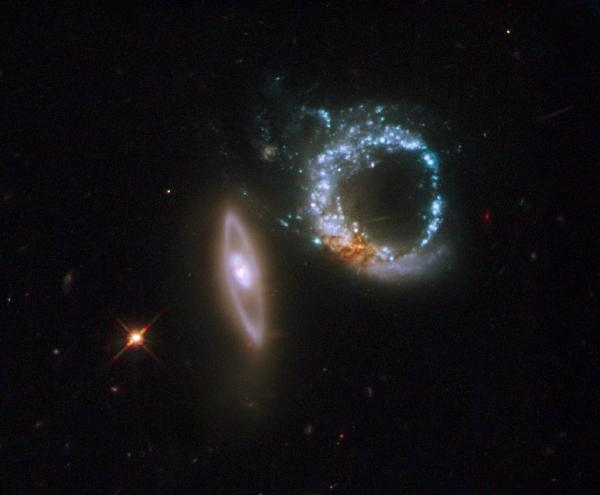
The NASA/ESA Hubble Space Telescope is back in business with a snapshot of the fascinating galaxy pair Arp 147. The science operations were resumed on 25 October 2008, four weeks after a problem with the science data formatter took the spacecraft into safe mode.

On Sunday 28 September 2008, the NASA/ESA Hubble Space Telescope automatically entered safe mode when errors were detected in the Control Unit/Science Data Formatter-Side A. This component is essential for the storage and transmission of data from the telescope's science instruments back to Earth. The component was reactivated on Thursday 23 October, and the Wide Field Planetary Camera-2 science observations resumed on Saturday 25 October. 
 
A fungus called microsporidia that causes chronic diarrhea in AIDS patients, organ transplant recipients and travelers has been identified as a member of the family of fungi that have been discovered to reproduce sexually. A team at Duke University Medical Center has proven that microsporidia are true fungi and that this species most likely undergoes a form of sexual reproduction during infection of humans and other host animals. 

The findings could help develop effective treatments against these common global pathogens and may help explain their most virulent attacks.
Researchers have defined a mutation in the mouse genome that mimics progressive hearing loss in humans. A team from the Wellcome Trust Sanger Institute in Cambridge, UK, working with colleagues in Munich and Padua, found that mice carrying a mutation called Oblivion displayed problems with the function of hair cells in the inner ear, occurring before clear physical effects are seen. The study is published October 31 in PLoS Genetics.
The past few weeks have seen the unfolding of the financial crisis and meltdown of global equity markets. During this time I have been traveling across North America giving speeches about the future to groups of CEOs and business owners. In every instance, the primary concern of everyone has been what the short and long term ramifications of the financial crisis will be. As a futurist I am asked at each presentation what I see ahead for the U.S. and global economy.
Los Alamos* says we can make gasoline with CO2 extracted from air -- plus water and energy. Furthermore, economic large-scale production is possible with off-the-shelf equipment and known processes. Result: Green Gasoline.

The Los Alamos concept was named Green Freedom, mainly, because it promises freedom from foreign oil by producing gasoline with a carbon-neutral power source. The main steps are:

1. Obtain CO2 from the atmosphere

2. Split H2O into H2 and O2

3. Combine H2 and CO2 to produce methanol

4. Convert methanol into gasoline.

COPENHAGEN, Denmark, October 29 /PRNewswire/ --

- Summary: Genmab Reports Results for the Nine Month Period Ended September 30, 2008

Genmab A/S (OMX: GEN) announced today results for the nine month period ended September 30, 2008. During this period, Genmab reported the following results:

- Genmab's revenues were DKK 667 million (USD 128 million) for the nine month period ended September 30, 2008. In the same period of 2007, Genmab recognized revenues of DKK 356 million (USD 68 million).

MOUNTAIN VIEW, California, October 29 /PRNewswire/ --

Bytemobile, Inc., the global leader in mobile internet solutions for network operators, today announced the opening of a new center for both research and development and customer support services in Belfast, Northern Ireland. The company established the facility under an agreement with Invest Northern Ireland (NI), which attracts new investment to the country.

SAN MATEO, California, October 29 /PRNewswire/ --

NeurogesX, Inc. (Nasdaq: NGSX), a biopharmaceutical company focused on developing and commercializing novel pain management therapies, today announced it will report results for its third quarter 2008 on Thursday, November 6, 2008, after the market closes.

A conference call to review the results and discuss corporate and clinical initiatives for the remainder of 2008 and into 2009 will begin at 4:30 p.m. ET (1:30 p.m. PT) on November 6, 2008 and will be hosted by Anthony DiTonno, President and Chief Executive Officer, and Stephen Ghiglieri, Chief Financial Officer.

