





Can professional teachers in a crowded classroom hobbled by arcane government policies teach kids well?   Probably, in most cases, but institutionalized education and their unions have gone to war against any changes to the status quo, even when the status quo is clearly broken.  The only acceptable change is more money.

Home schooling can do a great job, if it is structured and has a formal curriculum.  It may even be an advantage, according to a new study in Canada.
Kepler-19b, which orbits the Sun-like star Kepler-19 650 light-years from Earth in the constellation Lyra, has been found to have an 'invisible' world tugging on it.

How do astronomers know, since it's invisible?  Kepler-19b alternately runs late and early in its orbit, the first definite detection of a previously unknown planet using this method. No other technique could have found the unseen companion.   Kepler-19 is a 12th-magnitude star and can be seen by backyard telescopes on September evenings.
A new alginate binder material for lithium-ion battery electrodes could boost energy storage and perhaps help eliminate the toxic compounds in batteries - good news for Prius owners who are concerned their batteries may be doing more harm to the environment than their emissions are saving.
What did Greenland look like over the last 800,000 years?   Hard to know for sure but one thing is certain; it changed often, and quickly.

Drill cores taken from Greenland's vast ice sheets show that Earth's climate is capable of very rapid transitions - more of a mystery is why abrupt climate changes like that happen.

Layers of ancient snow accumulated and became compact to form the ice-sheets we see today. Each layer of ice can reveal past temperatures and even evidence for the timing and magnitude of distant storms or volcanic eruptions. By drilling cores in the ice scientists have reconstructed an incredible record of past climates. Those temperature records from Greenland covered only the last 100,000 years or so. 
Brain, pelvis, hands and feet  don't lie - and five recent studies of Australopithecus sediba, a primitive hominin that existed around the same time early Homo species first began to appear on Earth, suggest this ancient relative and its primitive and modern, human-like traits, make it the best candidate for an ancestor to the Homo genus.

The discoveries are casting doubt on some long-standing theories about human evolution, including the notion that early human pelvises evolved in response to larger brain sizes. And there is also some new evidence suggesting that 
Australopithecus sediba may have been a tool-maker.
Unfortunate subsets of some militant environmental groups believe that anyone who uses the land, including quite responsibly, is an enemy.   

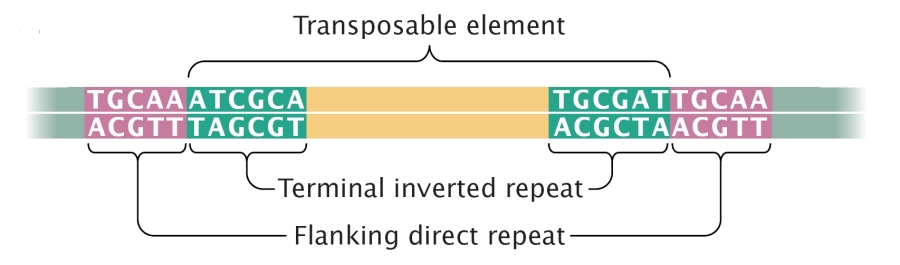
Jumping genes, or more technically, transposons (see figure 1), are sequences of DNA that can move around the genome and find themselves a new place. In eukaryotic DNA, these jumping genes can constitute a sizeable portion of the genome (up to 50% of the human genome is made up out of active transposons and the remains of former ones that became inactive).


Figure 1: General structure of a transposon.

(Source: Scitable, by Nature Education)


Beyond being a mystery in themselves, these bits of moving DNA (and their remnants) are remarkably prevalent in chromosome regions that are the last ones to replicate.

I know I keep talking about the incredible unpredictability of squids, but it's an endlessly fascinating topic! Every time you think you've got them figured out, they surprise you--and I'd say that goes for pretty much all squid species.

Of course, I'm particularly familiar with the Humboldt squid's propensity for perplexity. For a while, they were so abundant off California that sport fishermen were reeling them in as fast as they could throw jigs in the water. Now, the squid have disappeared.
In football, if you are a lineman, you are going to give and take a lot of hits - but running backs really get punished.

