
A recent edition of  ‘M/C – A Journal of Media and Culture’ features one of the very few, perhaps the only, fully blind, peer-reviewed academic papers on sugar pigs. Author Toni Risson, at the University of Queensland, Australia, first defines sugar-pigginess. “Sugar pigs are traditional confections shaped like sugar mice with little legs and no tail.” And then goes on to refine the implications of sugar pig consumption – starting at the beginning :

“As an imagined border between the private world inside the body and the public world outside, the mouth is an unstable limit of selfhood.”


Michael Brutsch appeared to be an upstanding citizen.

He is the father of a teenage son who joined the Marines, loves cats, and lives with his disabled wife in Arlington, TX. As a programmer for a financial services company, he punched the clock daily and paid his bills.

As pointed out recently, a new type of creationism has entered popular discourse through the backdoor. That was mostly about computer geeks and physicists trying to outperform "old atheists" in fashionable, gadgety ways, thus unwittingly bringing God back in. But there is another form of implicit denial of evolution worth mentioning, and it is similar in that it is again mostly done by “progressives”, atheists and humanists who claim to defend science, especially evolution!

Citizens who were told routine health checks were too expensive and so people did not get them, to the detriment of their health and higher costs later, just got good and bad news; the good news is that a new review says people don't need them. The bad news is that will be a reason not to have them available when the Affordable Care Act goes into force.

Check-ups don't reduce overall deaths or prevent serious diseases like cancer and heart disease, according to Cochrane researchers who carried out a systematic review on the subject. They warn against offering general health checks as part of a public health program, which is the opposite of what Americans have been told by the medical community for decades.
A planet around the mass of the Earth has been found, orbiting a star in the Alpha Centauri system; the nearest to Earth and also the lightest exoplanet ever discovered around a star like the Sun.

Secondary organic materials (SOM) in the atmosphere form two distinct types, liquids and jellies, and these airborne particles have begun to react with gases in the atmosphere. In the last 20 years' research and climate modeling, these SOM particles have been assumed to drift as liquids. In a liquid phase, the organic materials would absorb other compounds like ammonia or ozone very easily and then progress through a series of chemical changes, known as chemical aging, to form particles that reflect or absorb sunlight, or form clouds.

You may have heard of superfluids and superconductors, so why not supersolids?  In 2004 Moses Chan and Eunseong Kim thought they had discovered that super-cooled helium ice could essentially walk through walls – a defining characteristic of a supersolid.  

The experiment was to make a cylinder with tiny nanopores in its walls, fill the pores with solid helium ice, suspend the cylinder from a torsional spring, and then give it a little twist.  Like a kid on a swing set, the cylinder started rotating back and forth, with a frequency depending on its mass.  As they supercooled the cylinder even further, they saw that the oscillation frequency changed, as if it had less mass!  

Even today, landmines planted as far back as World War II are still being discovered, posing a serious threat to civilians in 69 countries worldwide. Approximately 70 people are killed every day as a result of a landmine explosion in accidents that should be avoidable; a lack of efficiency in clearing out areas which have been covered with landmines and the difficulty of detecting hidden and buried landmines make them a persistent threat to innocent men, woman, and children.
To people who are brand new to the culture wars, California's Proposition 37 might be scary. It has demonstrated that the world is a very small place, lies and hysteria can travel around the world and be perpetuated by the blogosphere, the Tweety pages and the Faceyspaceys well before there can be any fact checking or even common sense checking.
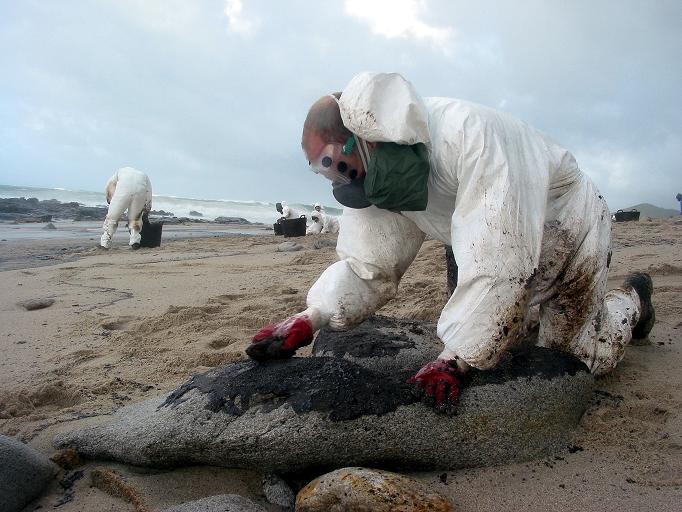
Next month will be the ten year anniversary of the Prestige sinking, which caused one of Spain's largest ecological disasters. The oil spill reached the coasts of Galicia and the rest of the Cantabrian coast, right up to the Landes area of France and Portugal. Thousands of people aided in the cleaning of the contaminated beaches and were exposed to the fuel for prolonged periods.

An experiment carried out on rodents exposed to fuel similar to that of the Prestige tanker oil spill concluded that inhalation of the fuel causes damage to genetic material. They say the results could be used to help people who carry out the industrial cleaning of coasts.