



According to WHO, "Although it is a vaccine-preventable disease, rabies still poses a significant public health problem in many countries in Asia and Africa where 95% of human deaths occur even though safe, effective vaccines for both human and veterinary use exist." 
Obesity is not just happening in New York City 7-Elevens(1), it is also happening in aging bones.

Bone marrow stem cells, which are adult stem cells, are in their fifth decade of uncontroversial new discovery. But they can still surprise us.  Our bones may be getting fatter as we age, and it could lead to osteoporosis, the condition where bone mineral density is 2.5 standard deviations below the mean (62%). The NIH estimates that up to 50% of women and 25% of men over the age of 50 will break a bone due to osteoporosis. 

An 8.6 magnitude earthquake occurred 62 miles off the coast of Sumatra on April 11th, 2012. 

Along with being severe by any measure, in one way it was the largest earthquake in observed human history; it originated within the plate rather than at a plate boundary.

The quake originated under the Wharton Basin in the Indian Ocean, where hundreds of miles of rock were under crushing tension, causing the plate to deform at its base. This 'deforming zone' was also absorbing tension as two plates, the Indian and Australian plates, rotated toward each other. 

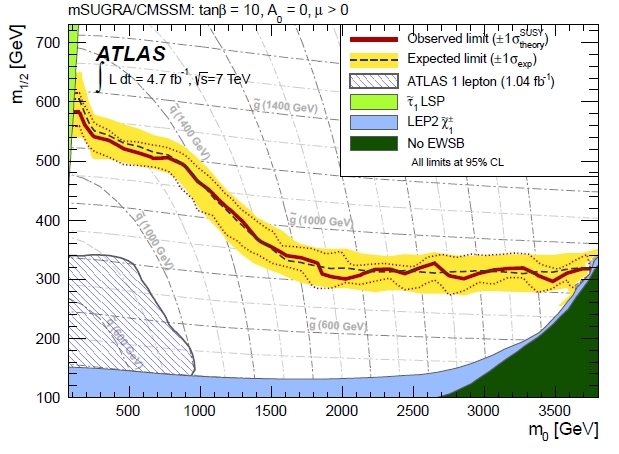
A new ATLAS search for supersymmetric signatures in 2011 LHC data has appeared last week in the arxiv. The result ? No hint of a signal, not even for ready money.

So if you are on a hurry, you can just have a glance at the graph below, which summarizes the measurement in terms of excluded regions of a slice of the complicated parameter space of SUSY theories.

Otherwise, if you want to know a bit more of what this is about, I can provide some detail.

Remember The-Shadow-Scholar, the deeply disturbing confirmation of that academia generally selects for meaningless drivel while making critical information unheard; the story that especially academic media try to contain as a side issue about student writing although it is obviously symptomatic of the whole of academia and much of modern society?

Spend too much time on Facebook?  Can't get enough LOLcat videos?

You no longer need to be ashamed.  You may have a disease. Psychologists interviewed a total of 843 people about their Internet habits and an analysis of the questionnaires showed that 132 men and women in the group exhibit problematic behavior in how they handle being online; all their thoughts revolve around the Internet during the day, and they feel their wellbeing is severely impacted if they have to go without it.
I'm not much of a drinker, never have been. I have always assumed it was because I did competitive athletics until I was about 25, which means I was outside the age where you 'learn' to like the taste of alcohol, so I never picked it up.

Older now, I can drink a beer socially and I sometimes drink a glass of red wine because the consensus says it is good for you in moderation, but I am still not really a drinker.
New research on Pelargoniums ('Geraniums' and 'Storkbills'), which have been cultivated in Europe since the 17th century and are now one of the most popular garden and house plants around the world, shows targeting two bacterial genes can produce long-lived and pollen-free plants.

Pelargoniums have been selectively bred to produce a wide range of leaf shapes, flowers and scents, and have commercial traits such as early and continuous flowering, pest and disease resistance and consistent quality and now they are getting some modern science engineering to allow people to enjoy them with less medicine. 
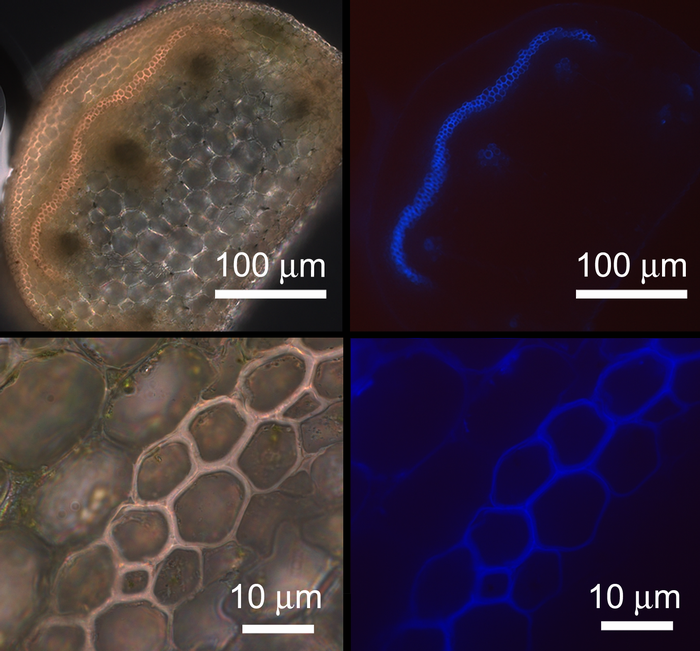
Instead of unwinding into a flat ribbon when stretched, like an untwisted coil normally would, a cucumber’s tendrils actually coil further - which has led to discovery of a biological mechanism for coiling and an unusual type of spring that is soft when pulled gently and stiff when pulled strongly.

Understanding this counterintuitive behavior required a combination of head scratching, physical modeling, mathematical modeling, and cell biology—not to mention a large quantity of silicone. A new study describes the mechanism by which coiling occurs in the cucumber plant and suggests a new type of bio-inspired twistless spring.


