




As oceans warm and become more acidic, ocean creatures are undergoing severe stress and entire food webs are at risk, according to scientists at a press briefing this morning at the annual meeting of the American Association for the Advancement of Science in Boston.

Gretchen Hofmann, associate professor of biology at the University of California, Santa Barbara, has just returned from a research mission to Antarctica where she collected pteropods, tiny marine snails the size of a lentil, that she refers to as the “potato chip” of the oceans because they are eaten widely by so many species. The National Science Foundation’s Office of Polar Programs funded the expedition.

Farmers, food suppliers, policy-makers, business leaders and environmentalists are joining forces to confront the threat of the ‘forgotten greenhouse gas’ by taking part in an influential new forum at the University of East Anglia (UEA).

Launched on February 22, the Nitrous Oxide Focus Group will engage with many influential organisations including the National Farmers Union, Marks & Spencer, British Sugar, Defra, the Country Land and Business Association and Unilever.

Não sei se chore, se ria.
Algumas ideias da conferência da American Association for the Advancement of Science, e sobre Saúde e Nutrição, onde se fala:

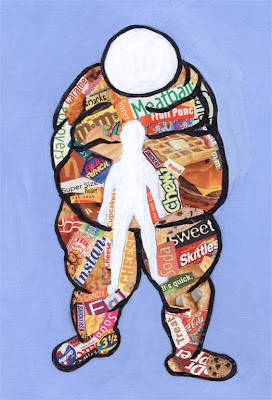
…da pegada ecológica originada pelos excessos alimentares…

The Korean War lasted from June 1950 to July 1953. It served as the basis of the 1968 book MASH: A Novel About Three Army Doctors by Richard Hooker (pen name of former army surgeon H. Richard Hornberger), describing the experiences of surgeons at a Mobile Army Surgical Hospital during the war. This was adapted into a film (MASH) starring Donald Sutherland in 1970, which in turn inspired the TV series M*A*S*H starring Alan Alda.

Scientists at UCL (University College London) have found the link between what we expect to see, and what our brain tells us we actually saw. The study, published in this week’s PLoS Journal of Computational Biology, reveals that the context surrounding what we see is all important – sometimes overriding the evidence gathered by our eyes and even causing us to imagine things which aren’t really there.

The paper reveals that a vague background context is more influential and helps us to fill in more blanks than a bright, well-defined context. This may explain why we are prone to ‘see’ imaginary shapes in the shadows when the light is poor.

Supposedly nanobacteria are cell-walled organisms much smaller than the generally accepted lower limits for cell size. The existence of nanobacteria has been a hot topic because of their putative roles in and heart disease and kidney stones.

The Journal "Open Medicine" has published a very thoughtful editorial on "Open science, open access and open source software at Open Medicine" by Sally Murray, Stephen Choi, John Hoey, Claire Kendall, James Maskalyk and Anita Palepu. Not only are they writing about it but they want to get their hands dirty as well:

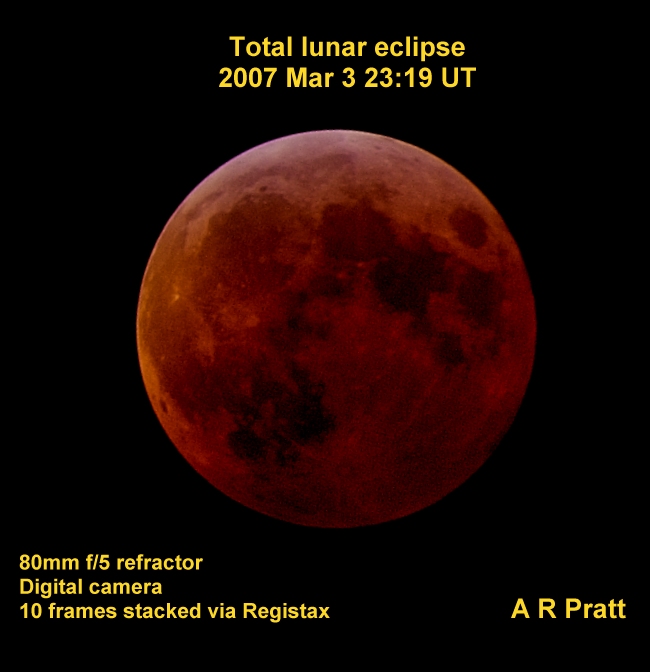
People across the western hemisphere may be surprised to see a rust-colored Moon in the sky in a few days - an ominous omen to ancient people but a more predictable occurrence now. Early on 21 February (the evening of the 20 February for observers in North and South America) will be this year’s first and only total eclipse of the Moon.

Bonus: unlike the solar equivalent, the whole event is safe to watch and needs no special equipment.

In a total lunar eclipse, the Earth, Sun and Moon are almost exactly in line and the Moon is on the opposite side of the Earth from the Sun. The Moon is full, moves into the shadow of the Earth and dims dramatically but usually remains visible, lit by sunlight that passes through the Earth’s atmosphere.

The evolution of human speech was far more complex than is implied by some recent attempts to link it to a specific gene, says Robert Berwick, professor of computational linguistics at MIT.

Berwick will describe his ideas about language in a session at the annual meeting of the American Association for the Advancement of Science on Sunday, Feb. 17. The session is called “Mind of a Toolmaker,” and explores the use of evolutionary research in understanding human abilities.

“Think globally, act locally” makes for a nice bumper sticker — but is it an effective policy for coping with global climate change? Can local actions make a difference in a process principally driven by worldwide trends?

The short answer is “no,” according to the Intergovernmental Panel on Climate Change. We cannot do much locally to lessen the effects of global drivers; therefore, our local policies must focus on adaptation.


