




LONDON, October 3 /PRNewswire/ -- FIS Software Ltd., a leading global provider of package-based software solutions for life and pensions companies, is delighted to announce the successful implementation of ALIS, its class leading policy administration system at Rosgosstrakh in Russia. The implementation went into production in July 2008 and ALIS is now operating live in all 65 regional sales offices across Russia.

Background

CLEVELAND, Ohio, October 3 /PRNewswire/ -- Simbionix, the world's leading developer of medical simulation systems, advances procedural simulation from theoretical promise to operating room reality.

The PROcedure Rehearsal Studio(TM), Simbionix' latest innovative medical simulation system, is the world's first medical simulator that enables clinicians to create practice scenarios based on their patient's unique pathology and anatomy.

Dr. Karl Illig, Chief of Vascular Surgery at Strong Medical Center in Rochester, NY, explains why physicians are eager to start using the new simulator: "PROcedure Studio helps us identify pitfalls and problems and solve them on the machine. If we're going to make a mistake, let's make it on the simulators first."

LONDON, October 3 /PRNewswire/ -- You may not know it, but animals around the world have a special day all of their own. World Animal Day which takes place on October 4th was first launched in 1931 at a convention of ecologists to draw attention to the plight of endangered species. Its scope has since developed to encompass the animal kingdom in general.

In light of World Animal Day, Party for Animals Worldwide (PAW) is calling on people to remember the numerous animal charities around the world that work hard on our behalf to help and protect animals in need.

LONDON, October 3 /PRNewswire/ --

- Cervical Cancer is the Second Most Common Cause of Death From Cancer Among Women Worldwide

- Every Year Half a Million Women are Diagnosed With Cervical Cancer Worldwide

- Over 280,000 women Die From Cervical Cancer Annually

- Cervical Cancer is Caused by the Human Papillomavirus (HPV) but can be Largely Prevented by Early Detection and HPV Vaccination

WHAT:

ZURICH, Switzerland, October 3 /PRNewswire/ -- Working with the mouse for long periods of time is usually uncomfortable. Lots of muscular tension in the fingers is required to control the mouse, click, move it a little bit and click again - the whole day long. The new HandshoeMouse by Hippus makes working with a mouse more comfortable. The novel mouse design enables the user to place the whole palm of the hand on the mouse without having to cling on to it. The HandshoeMouse comes in three different sizes to suit any hand and three different colours to suit all tastes. Available in snow-white, transparent and jet-black for EUR 120.

For ordering and other information, go to http://www.handshoemouse.com

LONDON, October 3 /PRNewswire/ -- Leading brand communications agency, Ogilvy Group UK, this week launches a campaign for its client Cancer Research UK to tie in with Breast Cancer Awareness Month (BCAM) which runs from 1st to 31st October.

To view the Multimedia News Release, please click: http://www.prnewswire.com/mnr/breastawarenessguy/35265/

Want to cause a fight between anthropologists and evolutionary biologists? Throw out an opinion on whether early societies were heirarchical or egalitarian.

Great apes societies are very heirarchical despite the presence of alliances and 'political' maneuvering but a new paper in PLoS says the first coalition-based societies of equals (they use the term 'egalitarian') occurred tens of thousands of years ago, and that has implications for the context of social networks and cognitive evolution.

Great apes' societies have each animal occupying a particular place in the existing dominance hierarchy. A major function of coalitions in apes is to maintain or change the dominance ranking. When an alpha male is well established, he usually can intimidate any hostile coalition or the entire community.

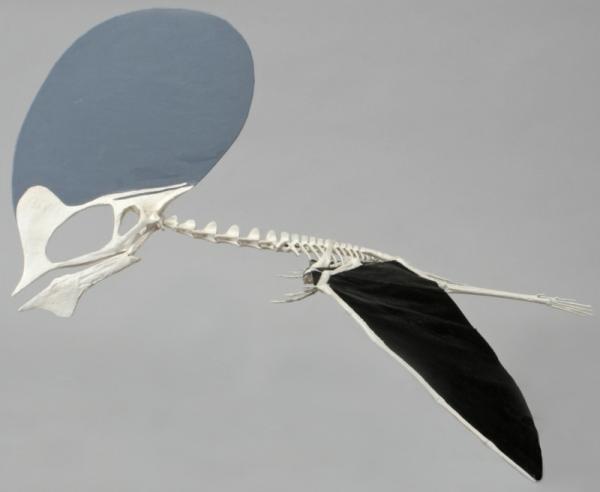
Paleontologist Sankar Chatterjee of Texas Tech University, aeronautical engineer Rick Lind of the University of Florida, and their students Andy Gedeon and Brian Roberts have reached back in time 115 million years to one of the most successful flying creatures in Earth’s history, the pterodactyl, to conjure a robotic spy plane with next-generation capabilities.

Mimicking the physical and biological characteristics of the Early Cretaceous Brazilian pterosaur Tapejara wellnhoferi -- skin, blood vessels, muscles, tendons, nerves, cranial plate, skeletal structure, and more -- the scientists are working to develop a Pterodrone -- an unmanned aerial vehicle that not only flies but also walks and sails just like the original.

In old movies we were going to improve society by making everything think like a computer. Now the goal is to make computers think like brains. Researchers at Missouri University of Science and Technology say they can make power network management more efficient by literally tapping brain cells grown on networks of electrodes.

The Missouri S&T group, working with researchers at Georgia Institute of Technology, plans to use the brain power to develop a new method for tracking and managing the constantly changing levels of power supply and demand.

Researchers are looking to increase security at border controls by developing a computer system that can detect guilt. Obviously a successful prototype could be used in multiple other applications, like police interrogations and interview scenarios. “Who knows - it could even be used to enhance our real-time computer gaming experiences,” says Dr Hassan Ugail, Head of Visual Computing Research at the University of Bradford’s School of Informatics.

Ugail is part of a team working on a £500,000 project to develop technologies that would assist the border control agencies in identifying people trying to smuggle contraband goods or narcotics through customs.
