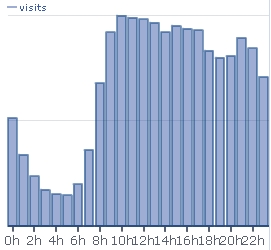
Have a look at the figure on the left. It shows the number of visits to this site broken down in hours of the day -the time of the server used by the visitor. The statistics of each bar is sufficient that the uncertainty on their height is of the order of 2%, so almost indistinguishable by eye. What you can see, therefore, are real variations with time of the traffic to this site, and not random fluctuations up and down.
Scientists cannot account for roughly half of the heat that is believed to have built up on Earth in recent years, according to a new article in Science.
While we may have been spared some of the warming that inevitably results from our reckless C02 emissions, "the heat will come back to haunt us sooner or later," says NCAR scientist Kevin Trenberth, the article's lead author.
The researchers warn that satellite sensors, ocean floats, and other instruments are inadequate to track this "missing" heat, which may be building up in the deep oceans or elsewhere in the climate system.
Through the study of a popular Martian meteorite's age, University of Houston researchers have uncovered important details about the history of volcanic activity on Mars.
ALH84001 is a thoroughly studied, well-known Martian meteorite, unique among Mars rocks available for study on Earth. Since its formation age is more than 2.5 billion years older than any other recognized Martian meteorite, it offers scientists the only view of Mars' early history. Data from this rock may also help geologists better understand, through analogy, the processes of early Earth evolution.
The new analysis of ALH84001 is published in Science
Life and health insurance companies are greedy, for-profit enterprises that do not care about public health, according to Harvard researchers writing in the American Journal of Public Health.
Why such scorn for the insurance industry? The authors of the study found that U.S., Canadian and European-based insurance firms hold at least $1.88 billion of investments in fast-food companies.
Although there is normally nothing wrong with investing in fast food companies, the busy bodies at Harvard are irritated because the health care legislation just enacted in the U.S. essentially guarantees business for these insurance companies, and they are invested in the industry that is supposedly making us unhealthy.
Legislation introduced today in the U.S. House of Representatives by Rep. Mike Doyle (D-PA) would require federal agencies with annual extramural research budgets of $100 million or more to provide online access to research no later than six months after publication in a peer-reviewed journal.
The legislation, H.R. 5037, would unlock unclassified research funded by the Department of Agriculture, Commerce, Defense, Education, Energy, Health and Human Services, Homeland Security, Transportation, Environmental Protection Agency, National Aeronautics and Space Administration, and the National Science Foundation.
New research conducted by Cardiff University scientists suggests that good parenting is still the best way to prevent teenage smoking.
The three-year-study of 3,500 11 to 15 year-olds found that children whose fathers regularly talk with them about 'things that matter' are less likely to take up smoking during early adolescence.
The findings were presented today at the British Psychological Society's Annual Conference.
Only children who had never smoked at the time the study began took part. As well as their smoking, children were also asked about the frequency of parental communication, arguments with family members and the frequency of family meals - none which had a significant effect on smoking.
Carried by winds high up in the atmosphere, a massive cloud of ash from the eruption of the Eyjafjallajoekull glacier in southwest Iceland has led to the closure of airports throughout the UK and Scandinavia, with further disruption in northern Europe expected later today.
The ash, which can be seen as the large grey streak in the image, is drifting from west to east at a height of about 11 km above the surface Earth. It poses a serious danger to aircraft engines; hence the airspace shut down.
The volcano erupted, for the first time since 1821, on March 20 and erupted for a second time on Wednesday. The volcano, under the glacier ice, has caused ice melt and subsequent flooding and damage locally.