




By injecting purified stem cells isolated from adult skeletal muscle, researchers have shown they can restore healthy muscle and improve muscle function in mice with a form of muscular dystrophy. Those muscle-building stem cells were derived from a larger pool of so-called satellite cells that normally associate with mature muscle fibers and play a role in muscle growth and repair.

In addition to their contributions to mature muscle, the injected cells also replenished the pool of regenerative cells normally found in muscle. Those stem cells allowed the treated muscle to undergo subsequent rounds of injury repair, they found.

"Our work shows proof-of-concept that purified muscle stem cells can be used in therapy," said Amy Wagers of Harvard University, noting that in some cases the stem cells replaced more than 90 percent of the muscle fibers. Such an advance would require isolation of stem cells equivalent to those in the mouse from human muscle, something Wagers said her team is now working on.

In one of those odd uses of statistics, higher gasoline prices have been associated with fewer deaths from car accidents, says a researcher at the University of Alabama at Birmingham (UAB).

An analysis of yearly vehicle deaths compared to gas prices found death rates drop significantly as people slow down and drive less. If gas remains at $4 a gallon or higher for a year or more, traffic deaths could drop by more than 1,000 per month nationwide, said Michael Morrisey, Ph.D., director of UAB's Lister Hill Center for Health Policy and a co-author on the new findings.

This means if we raise the price to $10 a gallon people might never die, right? Likewise if we drop the speed limit to 5 MPH or eliminate cars, there would be fewer deaths.

Imagine windows that not only provide a clear view and illuminate rooms, but also use sunlight to efficiently help power the building they are part of. MIT engineers report a new approach to harnessing the sun's energy that could allow just that.

The work involves the creation of a novel 'solar concentrator.' "Light is collected over a large area [like a window] and gathered, or concentrated, at the edges," explains Marc A. Baldo, leader of the work and the Esther and Harold E. Edgerton Career Development Associate Professor of Electrical Engineering.

As a result, rather than covering a roof with expensive solar cells (the semiconductor devices that transform sunlight into electricity), the cells only need to be around the edges of a flat glass panel. In addition, the focused light increases the electrical power obtained from each solar cell "by a factor of over 40," Baldo says.

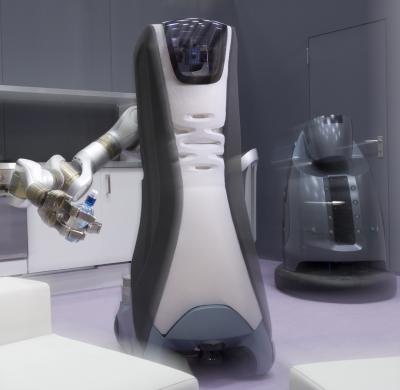
It looks like the folks behind Disney's WALL-E have some real-world competition. It's Care-O-bot® 3, the 1,45 meter tall prototype of a new generation of service robots designed to help humans in the household. The quick-to-learn assistant was developed by research scientists at the Fraunhofer Institute for Manufacturing Engineering and Automation IPA in Stuttgart.

But how does the robot know where to find the items it needs? And what has been done to make sure the robot does not inadvertently touch a human with its arm? It is fitted with numerous sensors to prevent this from happening. Stereo-vision color cameras, laser scanners and a 3-D range camera enable Care-O-bot® 3 to register its surroundings in three dimensions in real time. If a person moves into the radius of its arm, it stops moving. Another feature of the small, flexible helper is that it can move in any direction. "This is made possible by an omnidirectional platform with four separately steered and driven wheels," explains Birgit Graf, who heads the domestic and personal service robotics group at IPA. "In this way, the robot can even pass safely through narrow places in an apartment." The new Care-O-bot® has a highly flexible arm with seven degrees of freedom and a hand with three fingers. This allows it to pick up bottles, cups and similar objects and to operate machines. Force sensors prevent it from gripping too hard. The arm and the grippers were developed by Schunk.

 The new Care-O-bot has a highly flexible arm and a three-finger hand with which it can pick up items such as a bottle. Force sensors prevent it from gripping too hard.

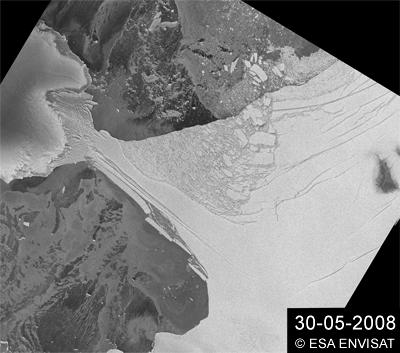
The Wilkins Ice Shelf is experiencing further disintegration that is threatening the collapse of the ice bridge connecting the shelf to Charcot Island. Since the connection to the island in the image centre helps to stabilise the ice shelf, it is likely the break-up of the bridge will put the remainder of the ice shelf at risk.

This animation, comprised of images acquired by Envisat's Advanced Synthetic Aperture Radar (ASAR) between 30 May and 9 July 2008, shows the break-up event which began on the east (right) rather than the on west (left) like the previous event that occurred last month. By 8 July, a fracture that could open the ice bridge was visible.

According to the image acquired on 7 July 2008, Dr Matthias Braun from the Center for Remote Sensing of Land Surfaces at Bonn University estimates the area lost on the Wilkins Ice Shelf during this break-up event is about 1350 km² with a rough estimate of 500 to 700 km² in addition being lost if the bridge to Charcot Island collapses.

Scientists and journalists get along much better than the anecdotal 'horror stories' would lead us to believe, according to new research published today in the journal Science, which has found that 57% of researchers were 'mostly pleased' with their media interaction, while only 6% percent were 'mostly dissatisfied'.

Previous research as well as anecdotal evidence has tended to focus on the negative aspects of scientists' media interaction, but today's survey, based on the responses of 1354 scientists working in the high-profile research fields of epidemiology and stem cell research in the UK, US, France, Germany and Japan, suggests that, for the most part, scientists are comfortable dealing with journalists.

The international team who produced the study asked the scientists how much they had to do with the media, and to evaluate their interactions with them, including whether they were 'misquoted' by 'biased' journalists, or whether they were able to 'get their message out'.

A third of reef-building corals around the world are threatened with extinction, according to the first-ever comprehensive global assessment to determine their conservation status. The study findings were published today by Science Express.

Leading coral experts joined forces with the Global Marine Species Assessment (GMSA) – a joint initiative of the International Union for Conservation of Nature (IUCN) and Conservation International (CI) – to apply the IUCN Red List Categories and Criteria to this important group of marine species.

"The results of this study are very disconcerting," stated Kent Carpenter, lead author of the Science article, GMSA Director, IUCN Species Programme. "When corals die off, so do the other plants and animals that depend on coral reefs for food and shelter, and this can lead to the collapse of entire ecosystems."

TOKYO, July 10 /PRNewswire/ --

The XML Technology Certification Committee today announced the worldwide release of the "XML Master Professional Database Administrator" exam, certifying technical professionals in XQuery and XML DB.

The new "XML Master Professional Database Administrator" certification is designed for database professionals, who must pass the "XML Master Basic Exam" and the "XML Master Professional Database Administrator Exam" to become certified.

LOS ANGELES, July 10 /PRNewswire/ --

- Nearly Two out of Three Executives Say Their Company is Hiring Recent Grads -

An uncertain global economy and labor market are not significantly affecting hiring plans for new graduates, according to survey results released today. The latest Executive Quiz from Korn/Ferry International (NYSE: KFY), a premier global provider of talent management solutions, was tabulated in June 2008 as the majority of new university graduates hit the job market.

HAIFA, Israel, July 10 /PRNewswire/ -- - Convenience Translation -


