

Traditional mirrors work by directing the path of photons of light but atoms possessing a magnetic moment can likewise be controlled using a magnetic mirror.  A new study investigates the feasibility of using magnetic domain walls to direct and ultimately trap individual atoms in a cloud of ultracold atoms. 
A team of scientists say they have reconstructed the Earth's climate belts of the late Ordovician Period, between 460 and 445 million years ago, and their study says these ancient climate belts were surprisingly like those of the present.

The team of scientists looked at the global distribution of fossils called chitinozoans – probably the egg-cases of extinct planktonic animals – before and during this Ordovician glaciation, and found a pattern that revealed the position of ancient climate belts, including such features as the polar front, which separates cold polar waters from more temperate ones at lower latitudes.
Why are some things funny? Philosophers have asked that for millenia but two marketing people think they've come up with the formula: humor comes from a violation or threat to the way the world ought to be that is, at the same time, benign. 

Most theories of humor are missing something, says A. Peter McGraw, assistant professor of marketing and psychology at the University of Colorado-Boulder, who co-authored the study with Caleb Warren, a Ph.D. candidate in marketing. Freud thought humor came from a release of tension, another theory holds that humor comes from a sense of superiority, and still another from incongruity.

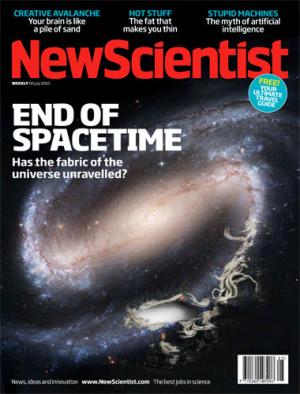
Can neuroscience help a magazine sell more copies?   New Scientist wants to find out, so they teamed up with NeuroFocus, who bill themselves the world's largest neuromarketing company, to make a magazine cover. 

Using high density arrays of electroencephalographic (EEG) sensors to capture test subjects' brainwave activity, NeuroFocus measured and analyzed their responses to three different cover designs for the August 7 edition of New Scientist.

