




Neuroscientists have long demonstrated that neuronal connections in the brain can be strengthened with neuronal activity in the process known as neuroplasticity, and that brain training can be the ideal remedy to sharpen the human mind and to slow down the progress of neurodegeneration. However, recent studies revealed that too much thinking can actually be detrimental to the brain, causing profound DNA damage often dubbed as the DNA double-stranded breakages (DSBs).

DSBs are identified by the accumulation of gH2A.X histone- a recruiter of the DNA-repair machinery- at the site of breakage, and are previously thought to be caused only by cell stress.

Second-hand stores like Goodwill, Salvation Army, and local mom&pop shops are treasure troves of things to hack or repurpose. When you hack something you’re probably using it in a way in which it was never intended to be used so, there is always a risk that things might not go the way you planned. But since you can get items from second-hand stores on the cheap, you don’t care too much if you are disappointed with the results. Luckily, this "MacGyverism" was successful.

The common perception is that cancer develops because of gradual mutations over time, finally overwhelming the ability of a cell to control growth.  A look at genomes in prostate cancer found instead that genetic mutations occur in abrupt, periodic bursts, causing complex, large scale reshuffling of DNA driving the development of prostate cancer. 

The researchers dub this process "punctuated cancer evolution," akin to the theory of human evolution that states changes in a species occur in abrupt intervals. After discovering how DNA abnormalities arise in a highly interdependent manner, the researchers named these periodic disruptions in cancer cells that lead to complex genome restructuring "chromoplexy."

School violence has always been an important social issue world-wide because it poses a significant threat to the health, achievement, and well-being of students.

 Chronic myeloid leukemia (CML) is now considered a highly curable disease, thanks to the emergence of powerful, targeted CML therapies known as tyrosine kinase inhibitors (TKIs) that allow patients to manage their disease with few symptoms by taking a well-tolerated pill.

Since the introduction of TKI therapy more than a decade ago, the annual mortality of patients with this disease has declined from 10 to 20 percent in the early 2000s to just 2 percent today and the estimated 10-year survival of CML patients has increased from 20 percent to more than 80 percent.

A paper in Journal of Affective Disorders
found that belief in God was correlated to improved outcomes for those receiving short-term treatment for psychiatric illness.

Dr. David H. Rosmarin, McLean Hospital clinician and instructor in the Department of Psychiatry at Harvard Medical School, examined individuals at the Behavioral Health Partial Hospital program at McLean in an effort to investigate the relationship between patients' level of belief in God, expectations for treatment and actual treatment outcomes.

The segment of society that puts an anti-corporate mentality hand-in-hand with being anti-science is not just on the left; a whole lot of people are now cynical about the goals of the $29 billion organic food industry, especially after their well-publicized effort in California to label GMOs but exempt organic food, alcohol and restaurants. It was regarded as cynical opportunism, a way to get the government to grant their business an opportunity the free market did not.

Surveys show people care more (or less) about the environment based on the economy; if that hierarchy of needs is not being met, people are not worried about who is flying off to global warming conferences, they care about jobs.

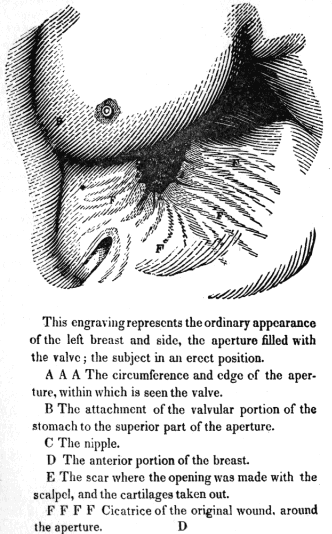
Army physician William Beaumont was stationed at Fort Mackinac on Mackinac Island in Michigan in the early 1820s, when it existed to protect the interests of the American Fur Company. The fort became the refuge for a wounded 19-year-old French-Canadian fur trader named Alexis St. Martin when a shotgun went off by accident in the American Fur Company store and duck shot tore into his abdomen at close range June 6th, 1822. 

That accident is key to much of our early knowledge about the workings of the digestive system, say speakers at the Experimental Biology 2013 meeting.

Mymaridae, commonly known as fairyflies, are one of about 18 families of chalcid wasps. Fairyflies are everywhere except Antarctica and include the world's smallest known insect - Kikiki huna, the body length of which is only 0.13 millimeters.

Fairyflies are among the most common chalcid wasps but seldom noticed by humans because of their minute size. Their apparent invisibility and delicate wings with long fringes invoke imagery of mythical fairies and earned them their common name.

Computer memory works on the basis of electrons that are moved around and stored. Electrons are small and, when it comes to insuring that information will not be lost over time, can be difficult to control using relatively thick insulator walls, so that information will not be lost over time.

The physics issues limit storage density and cost the system a great deal of energy so researchers pursue nanoelectronic components that make use of ions, i.e. charged atoms, for storing data. Ions are some thousands of times heavier that electrons and are therefore much easier to 'hold down'. In this way, the individual storage elements can almost be reduced to atomic dimensions, which enormously improves the storage density.

