




Plants help keep us cool by absorbing CO2 - sometimes too cool. 

The arrival of the first plants 470 million years ago triggered a series of ice ages, according to a research team that set out to identify the effects that the first land plants had on the climate during the Ordovician Period, which ended 444 million years ago. During this period the climate gradually cooled, leading to a series of 'ice ages'. This global cooling was caused by a dramatic reduction in atmospheric carbon, which this research now suggests was triggered by the arrival of plants.

NGC 3324, on the northern outskirts of the chaotic environment of the Carina Nebula in the constellation of Carina (The Keel, part of Jason’s ship the Argo), is about 7500 light-years from Earth and has been sculpted by many other pockets of star formation. A rich deposit of gas and dust in the NGC 3324 region fueled a burst of star birth there several millions of years ago and led to the creation of several hefty and very hot stars.

We are all familiar with velocities. Velocities tell us how positions change with time. Velocities can not be assigned to individual objects, as they describe a relation between pairs of objects. We know this since Galileo Galilei. Yet, in common day language this profound fact is mostly ignored.
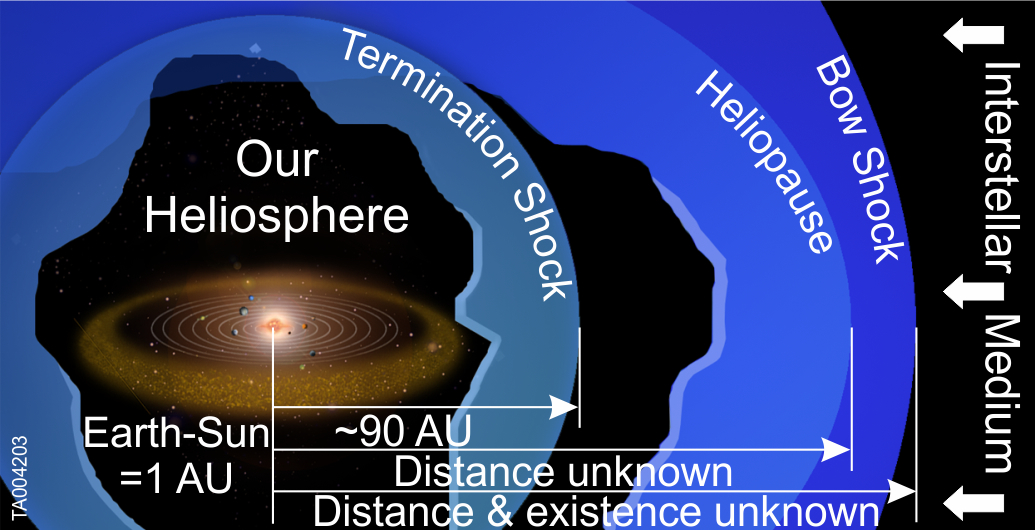
NASA's Interstellar Boundary Explorer (IBEX) spacecraft has allowed researchers to measure neutral "alien" particles entering our solar system from interstellar space; a first look at the constituents of the interstellar medium, the matter between star systems, and how they interact with our heliosphere.
If you ask Europeans about the metric system, they declare America should get with the program because it is more popular. When it comes to speaking English, however, barely a third of the EU's 500 million citizens speak English yet that is how the business of the EU's 27 member countries is conducted.  No one is expected to speak 23 different languages.

A study of 64,659 women, recently published in the journal Academic Radiology, found that while 1,246 of these women were at high enough breast cancer risk to recommend additional screening with MRI, only 173 of these women returned to the clinic within a year for the additional screening.

“It’s hard to tell where, exactly, is the disconnect,” says Deborah Glueck, PhD, investigator at the University of Colorado Cancer Center and associate professor of biostatistics and informatics at the Colorado School of Public Health, the paper’s senior author.

The Wall Street Journal published an excellent case study in denialism on Friday, in the form of a letter from sixteen scientists seeking to perpetuate gridlock in climate policy.  While nothing they have to say raises any scientific issues about climate change, the letter is interesting to peruse simply to see what arguments they use, and what that says about their motivations.

The letter uses several denialist tactics, including,
1) Cherry-picked examples placed out of context,
2) Unsupported claims
3) Irrelevant distractions
4) Implications of conspiracy, and
5) Self-portrayal as stubborn heroes fighting against the odds.
Over 30 percent of all terrorist attacks from 1970 to 2008 occurred in just five metropolitan U.S. counties, according to a report published today by researchers in the National Consortium for the Study of Terrorism and Responses to Terrorism (START), a Department of Homeland Security Science and Technology Center of Excellence based at the University of Maryland and the University of Massachusetts-Boston.  So what areas should you avoid, if you play the odds?
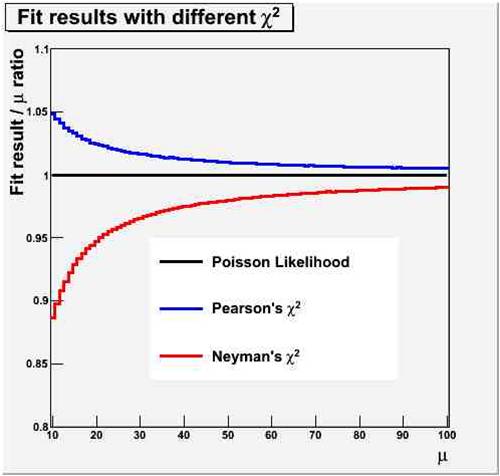
Last week I spent a few interesting days in the pleasant winter setting of Engelberg, a mountain location in the Swiss alps. There I attended the CHIPP 2012 winter school, an event organized by Vincenzo Chiochia  from University of Zurich and Gabriella Pazstor from University of Geneva. They invited me to give a three-hour mini-course in Statistics for data analysis in High-Energy Physics, something which was a new experience for me. It took me the best part of the last couple of months to get prepared, but I was glad I did. In the end, the material I put together could have been used profitfully for five or six hours of lecture, but by skipping some of the topics I could get to the end without using a silly speed.

Conventional wisdom holds you're born with perfect pitch or you're not. The conventional wisdom is wrong. Here's how to train perfect pitch.

For my book Brain Trust, I interviewed Diana Deutsch, University of California San Diego professor and president of the Society for Music Perception and Cognition, and she said the trick is pairing pitch with meaning -- early!

