If you are of a certain age, perhaps your parents told you to eat slowly. They may have said something about better digestion but if you were one of many poor people it also had to do with feeling fuller on less food.
Common wisdom was your brain did not keep up with your stomach so if you slowed down, your brain had time to realize the stomach was full. In general experience, that seems to hold up. You rarely see obese people who eat really slow.(1) Two new studies by researchers at the University of Rhode Island bear this out and found that men eat significantly faster than women, heavier people eat faster than slimmer people and refined grains are consumed faster than whole grains, among other findings.
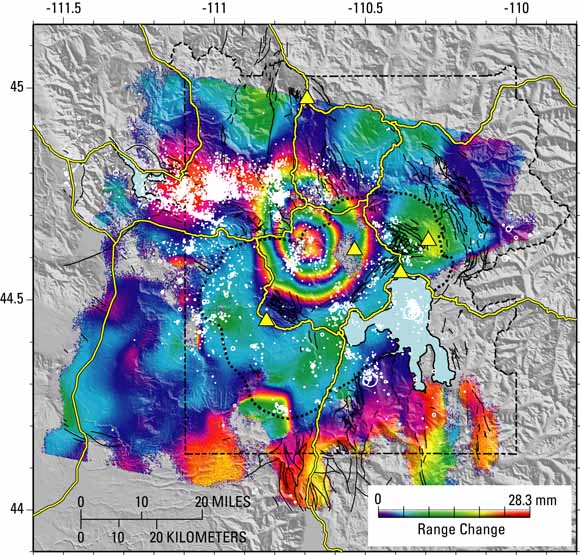
This post is the first of a new series I plan to write, on the techniques used to study and monitor volcanoes. The reason science is the best method we have of investigating the world around us is not so much what we know, but how we know it. I thought I'd start with a technique that always amazes me; we can measure centimetres of ground deformation over an area of many square kilometres, from an altitude of 800 km. Interferometric Synthetic Aperture Radar, InSAR for short.
Scientists have found pristine clouds of the primordial gas that formed just after the Big Bang and it matches the composition made by predictions, which adds to direct evidence in support of the modern cosmological explanation for the origins of elements in the universe. Only the lightest elements, mostly hydrogen and helium, were created in the Big Bang. A few hundred million years passed before clumps of this primordial gas condensed to form the first stars, where heavier elements were forged.
But astronomers have always detected "metals" (their term for all elements heavier than hydrogen and helium) wherever they have looked in the universe.
(That's glue made
by squids, not glue made
from squids. Don't be mean.)
Yesterday I explained that the little pygmy squid
Idiosepius' glue gland produces two different oozes, and so it must be either a
duo-gland or an
epoxy gland. (By the way, "duo-gland" is a very scientific term. "Epoxy gland" I just made up; glue scientists will probably look at you weirdly if you use it.)
And then I quoted some data from a paper arguing that it is probably an epoxy gland--that is, the two different oozes mix together to form glue.

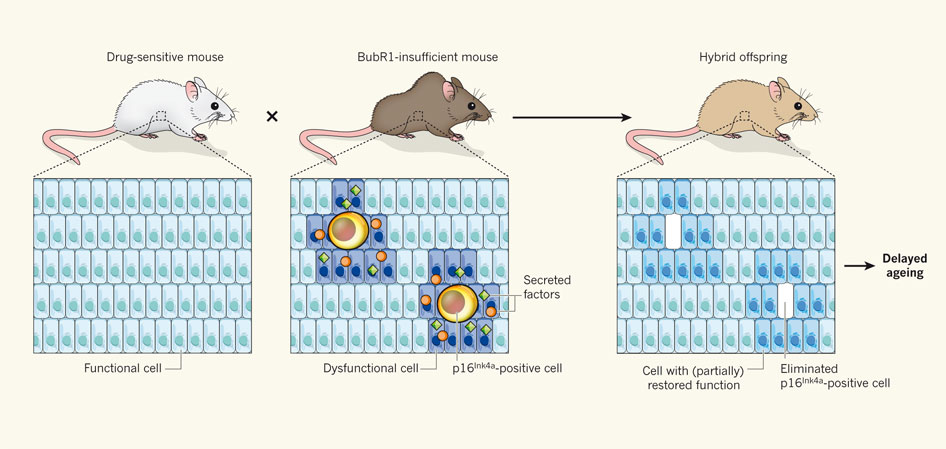
As we reach old age, our bodies undergo several changes. And not for the better. More and more people are beginning to wonder whether we can do something about this. A lot of research is going on to uncover the mechanisms of aging, which should give us a better understanding of the origin of the changes that occur. Some claim that with this understanding comes the increasing possibility that we will actually be able to do something about it.
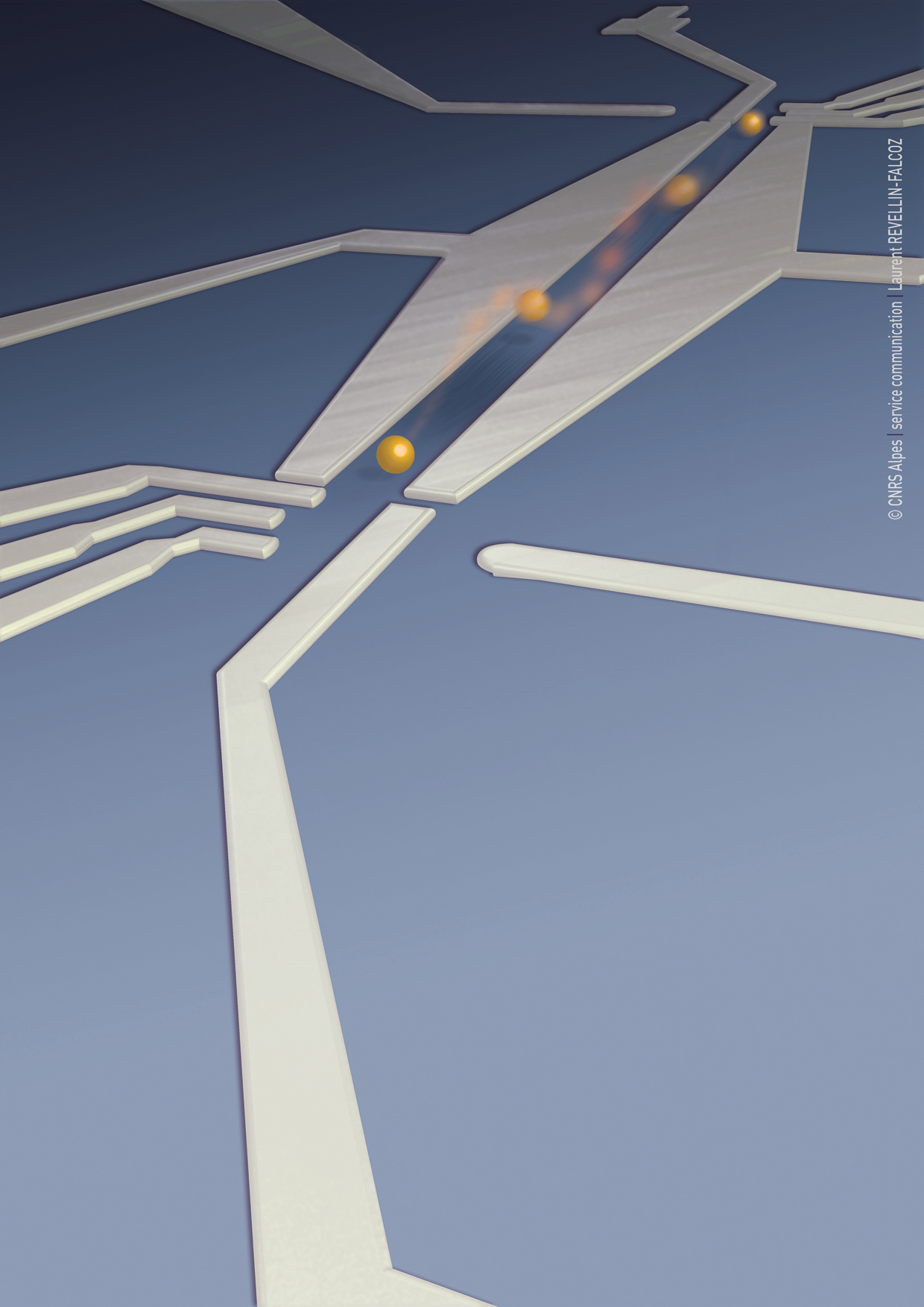
Physicists have succeeded in taking a decisive step towards the development of more powerful computers; they were able to define two little quantum dots (QDs), occupied with electrons, in a semiconductor and to select a single electron from one of them using a sound wave, and then to transport it to the neighboring QD.
A single electron “surfs” thus from one quantum dot to the next like a fish on a wave. This manipulation of a single electron will also enable the combination of considerably more complex quantum bits instead of classical bits (“0” and “1” states).
I've mentioned
the Littlest Squid before: the genus
Idiosepius, which contains only a handful of very small, very adorable species. And I commented that they have this habit of gluing themselves to seaweed, to hide from predators.
Well, today I'm here to explain how they do it, because
a new paper just came out on the topic of itty-bitty squids and their glue organs.
I met Makana in August 2005, where an old lava flow meets the ocean in a series of ledges and tide pools on Kauai, one of the Hawaiian Islands. He was a “local” of about my age who got his name (Hawaiian for “gift”) from the old volcano that formed the backdrop of our introduction. He wasn’t in college, but had a good job as a caddy at an upscale golf course, where Bill Clinton had tipped one of his buddies well the day before. In the afternoons, he and his friends came to this spot — still called “The Queen’s Bath” decades after the days of Hawaii’s royal rulers — to “talk story” and swap tales with an endless stream of tourists.
If you're worried about getting the flu, chances are that you got an influenza vaccine; these are created on an annual basis and use a method from the 1950s; it is egg-based technology, literally produced in chicken eggs. Some vaccines, like polio, are now created using laboratory-grown cell lines that are capable of hosting a growing virus. The first is inefficient, the second is expensive.(1)
The future of vaccines looks a little different. The race is on to create a universal flu vaccine, one that does not have to be recreated each year, and to also bring the technology cost down to where it is more financially constructive to get people a vaccine than have them in the hospital.(2)