For this instance of my "Guess the plot" series I wish to go back to the basics. So I picked a graph which allows me to illustrate a general concept, something about particle physics (but we could say physics in general, and actually extending to other exact sciences) which is a source of endless awe for me: the fact that some functions exist, in the infinite-dimensional space of all real functions of a real variable, which describe some specific feature of our world.
As health care costs continue to rise and more people want more services for less money, it will be important that doctors engage in evidence-based medicine.
The Centers for Disease Control and Prevention (CDC) have determined that the majority of primary care providers continue to recommend annual cervical cancer screening, though cervical cancer screening guidelines recommend a combination of a Papanicolaou test and an HPV test, known as an HPV co-test, for women 30 years of age and older.
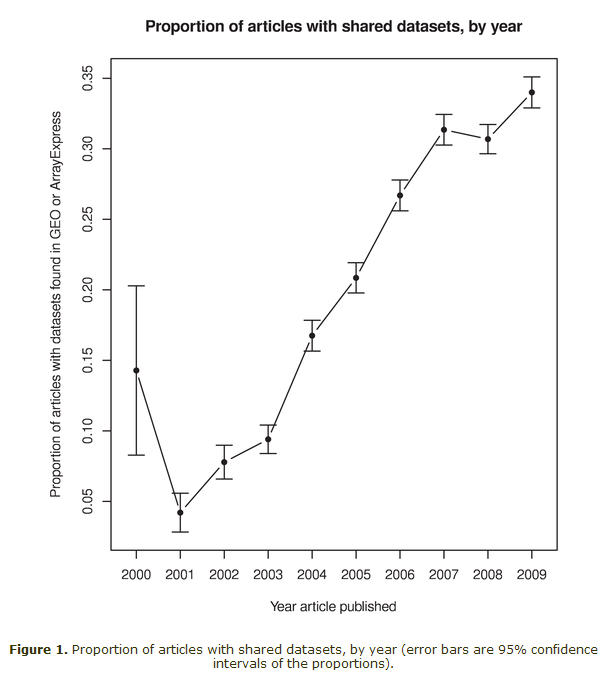
Five years into the Science 2.0 experiment I can tell you down to the eyeball how many people are involved in the communication pillar of it - but in the collaboration realm, it's not so easy.
Science 2.0 fave Heather A. Piwowar from the Department of Biomedical Informatics at Pitt recently gave it a shot, and the answer was...it's unknown.
Cancer, diabetes, stroke and transplant patients can all get benefit from one common thing; frog skin.
An international research project is collecting proteins from our amphibian friends (no frogs were harmed in the writing of this article or in the research) and adding to a growing bank of biological data needed to build up our understanding of the naturally occurring medicines in frogs.
They have already found that the peptides (mini-proteins) collected from the Waxy Monkey Frog and the Giant Firebellied Toad can be used in a controlled and targeted way to regulate 'angiogenesis', the process by which blood vessels grow in the body.
University of Alberta researcher David Bressler has an idea for the future of recycling.
Using throwaway parts of beef carcasses that were sidelined from the value-added production process after Mad-cow disease (bovine spongiform encephalopathy or BSE) damaged the Canadian beef industry in 2003, Bressler has collaborated with industry, government and other researchers to forge cattle proteins into heavy-duty plastics that could soon be used in everything from car parts to CD cases.
Police blotters can make fun reading, especially when they show up in your news alert for "squid," and
especially when they use the word "caper":
The caper began when someone used blue spray paint to draw a large squid or octopus on the northwest side of the Warner Park Community Recreation Center, 1425 Troy Drive.
Squid
or octopus? Why didn't they call a marine biologist to identify it? Anyway, a few days later the police were investigating the suspect of a hit-and-run crash in his house:
Analysis of a piece of lunar rock brought back to Earth by the Apollo 16 mission in 1972 has shown that we may have been wrong about the age of the Moon.
It is commonly accepted that the Moon was created by the impact of a large planet-like object and our proto-Earth very early in the evolution of our solar system. The energy of this impact was sufficiently high that the Moon formed from melted material that began with a deep liquid magma ocean. As the Moon cooled, this magma ocean solidified into different mineral components, the lightest of which floated upwards to form the oldest crust. Analysis of a lunar rock sample of this presumed ancient crust has given scientists new insights into the formation of the Moon.
What is five times the tensile strength of steel and the best currently available synthetic fibers? If you read the title you already know.
Spider thread is a fascinating and often-studied material but no one has managed to produce it on an industrial scale. Scientists of the TU Muenchen (TUM) and the Universitaet Bayreuth (UBT) say they have now succeeded in discovering another secret of silk proteins and the mechanism that imparts spider silk with its strength.
How do spiders manage to first store the silk proteins in the silk gland and to then assemble them in the spinning passage in a split second to form threads with these extraordinary characteristics? And what exactly gives the threads their tremendous tensile strength?
Scientists at the Smithsonian and partnering organizations have discovered a remarkably primitive eel they have named Protoanguilla palau in a fringing reef off the coast of the Republic of Palau.
This fish exhibits many primitive anatomical features unknown in the other 19 families and more than 800 species of living eels, resulting in its classification as a new species belonging to a new genus and family.
Usually when you think of drugs, you think of mules, but camels have also unique properties, except those can be used in future drug development.
Members of the camelid family have particular heavy-chain antibodies in their blood known as nanobodies that may serve as therapeutic proteins. One of the most powerful advantages of nanobodies is that they can be easily attached to other proteins and nanoparticles by simple chemical procedures.
Scientists at the Department of Pharmaceutics and Analytical Chemistry, University of Copenhagen, have designed nanoparticle systems of smaller than 150nm that are decorated with nanobodies expressing high specificity for the cancer marker Mucin-1, which is connected to breast and colon cancer.






 enhances the strength of spider silk.jpg "Revealed: Source Of Spider Silk's Extreme Strength")


