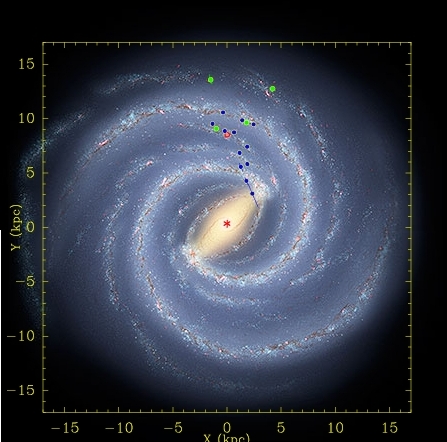










Let's face it, with all that talk about life on other planets and dark matter, we lose sight of the big picture.  To start 2009 off right, the Milky Way, our galaxy, wants you to know she is not out of coolness yet.  To wit, new measurements of the Milky Way say our home Galaxy is rotating about 100,000 miles per hour faster than previously thought.
Physicists at Indiana University have developed a promising new way to identify a possible abnormality in a fundamental building block of Einstein's theory of relativity known as "Lorentz invariance." If confirmed, the abnormality would disprove the basic tenet that the laws of physics remain the same for any two objects traveling at a constant speed or rotated relative to one another.

IU distinguished physics professor Alan Kostelecky and graduate student Jay Tasson take on the long-held notion of the exact symmetry promulgated in Einstein's 1905 theory and show in a paper to be published in the Jan. 9 issue of Physical Review Letters that there may be unexpected violations of Lorentz invariance that can be detected in specialized experiments.
Women with bulimia nervosa appear to respond more impulsively during psychological testing than those without eating disorders, and brain scans show differences in areas responsible for regulating behavior, according to a report in the January issue of Archives of General Psychiatry.
Commonly used pneumococcal polysaccharide vaccines do not appear to be effective for preventing pneumonia, found a study by a team of researchers from Switzerland and the United Kingdom writing in the Canadian Medical Association Journal.

In many industrialized countries, polysaccharide pneumococcal vaccines (PPVs) are currently recommended to help prevent pneumococcal disease in people aged 65 and over and for younger people with increased risk due to conditions like HIV. Studies have shown conflicting results regarding the efficacy of PPV. 
Astronomers have turned to an unexpected place to study the evolution of planets -- dead stars. 

Observations made with NASA's Spitzer Space Telescope reveal six dead "white dwarf" stars littered with the remains of shredded asteroids. This might sound pretty bleak, but it turns out the chewed-up asteroids are teaching astronomers about the building materials of planets around other stars. 

So far, the results suggest that the same materials that make up Earth and our solar system's other rocky bodies could be common in the universe. If the materials are common, then rocky planets could be, too. 
Iowa State University's Martin Pohl is part of a research team that has developed the first complete map of the Milky Way galaxy's spiral arms.

The map shows the inner part of the Milky Way has two prominent, symmetric spiral arms, which extend into the outer galaxy where they branch into four spiral arms.

"For the first time these arms are mapped over the entire Milky Way," said Pohl, an Iowa State associate professor of physics and astronomy. "The branching of two of the arms may explain why previous studies – using mainly the inner or mainly the outer galaxy – have found conflicting numbers of spiral arms."
The mystery of why ancient South American peoples who created the mysterious Nazca Lines also collected human heads as trophies has long puzzled scholars who theorize the heads may have been used in fertility rites, taken from enemies in battle or associated with ancestor veneration.

A recent study using specimens from Chicago's Field Museum throws new light on the matter by establishing that trophy heads came from people who lived in the same place and were part of the same culture as those who collected them. These people lived 2,000 to 1,500 years ago. 
With cold and flu season in full swing, the fact that viruses and bacteria rapidly 'evolve' is apparent with every sneeze, sniffle, and cough. A new report in The FASEB Journal seeks to explain how humans keep up with microbes by rearranging the genes that make antibodies to foreign invaders. This research fills a significant gap in our understanding of how the immune system helps us survive.
Smithsonian Center for Astrophysics astronomers examined the 5 million-year-old star cluster NGC 2362 with NASA's Spitzer Space Telescope, which can detect the signatures of actively forming planets in infrared light, and found that all stars with the mass of the Sun or greater have lost their protoplanetary (planet-forming) disks.

Only a few stars less massive than the Sun retain their protoplanetary disks. These disks provide the raw material for forming gas giants like Jupiter. Therefore, gas giants have to form in less than 5 million years or they probably won't form at all.

So baby Jupiter had to gain weight quickly. 

Sometimes studies are done that are common sense but, without them, people would say, about things that are common sense, 'no studies actually show that... so that is why we mention a recent study showing that shade trees on the west and south sides of a house in California can reduce a homeowner's summertime electric bill by about $25.00 a year.

The study, conducted last year on 460 single-family homes in Sacramento, is the first large-scale study to use utility billing data to show that trees can reduce energy consumption.


