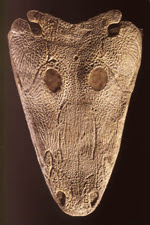
The beautiful thing about the Antarctic is that it is one of Earth’s last unexplored frontiers. New information about climate, geology, and paleontology is discovered regularly and today, the Journal of Vertebrate Paleontology announced the discovery of a fossilised amphibian which lived more than 245 million years ago in the Triassic of Antarctica. Its presence suggests that the climate at the time was mild enough to allow cold-blooded creatures to live near Pangea’s southern margin, at least seasonally.

A compound derived from green tea greatly diminished the neurotoxicity of proteins secreted by the human immunodeficiency virus, suggesting a new approach to the prevention and treatment of HIV-associated dementia, also known as AIDS dementia complex. The disorder is the most severe form of HIV-related neuropsychiatric impairment.

The first clinical trial to test a revolutionary treatment for blindness in children has been announced by researchers at UCL (University College London). The trial, funded by the Department of Health, is the first of its kind and could have a significant impact on future treatments for eye disease.

Aided by new observations from the Coupled Boundary Layer Air-Sea Transfer (CBLAST) hurricane field program, scientists at the Rosenstiel School of Marine and Atmospheric Science have helped to develop and test a new, high-resolution computer model to better understand how air-sea interactions directly affect hurricane intensity, a factor not yet possible in the current operational forecast models.

Elderly men and women who consumed higher levels of calcium and vitamin D are significantly more likely to have greater volumes of brain lesions, regions of damage that can increase risk of cognitive impairment, dementia, depression and stroke.

Duke University scientist Dr. Martha Payne reported this finding at Experimental Biology 2007, in Washington, DC.

Researchers have found a chemotherapy treatment that targets specific cells, reducing discomfort.

A new class of compounds developed by two University of Kentucky researchers shows promise as a nontoxic treatment of some cancers previously treated with toxic chemotherapy, the researchers report today.

In order to comprehend the continuous stream of cacophonies and visual stimulation that battle for our attention, humans will breakdown activities into smaller, more digestible chunks, a phenomenon that psychologists describe as "event structure perception."

Event structure perception was originally believed to be confined to our visual system, but new research published in the May issue of Psychological Science, a journal of the Association for Psychological Science, reports that a similar process occurs when reading about everyday events as well.

One of the most serious and least understood threats to the world's ecosystems is the problem of invasive species-exotic plants, animals and other organisms that are brought into habitats and subsequently spread at a rapid rate, often replacing native species and reducing biodiversity.

Urbanization changes landscapes and local environments, which can alter the life histories and traits of the creatures living in and around these areas. Studying European blackbirds (Turdus merula), Jesko Partecke and Eberhard Gwinner (Max Planck Institute for Ornithology) discovered certain adaptive traits, that in the long run, could lead to more offspring. The study, "Increased sedentariness in European Blackbirds following urbanization: a consequence of local adaptation?," appears in the April issue of Ecology.

Was Chris De Burgh's sexy "Lady in Red," perhaps, ovulating? A new UCLA and University of Wisconsin-Eau Claire study finds evidence that women put more effort into their clothing and grooming during their most fertile periods.