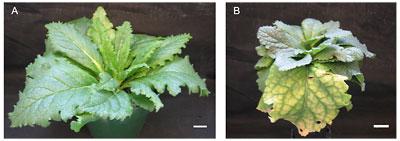






In normal plants, when sugars (made from water and carbon dioxide during photosynthesis) accumulate in the leaves, photosynthesis slows down, and the plant does not take in as much carbon dioxide from the air. Likewise, when the sugars move out of the leaves, the rate of photosynthesis and carbon intake increases.

How do many plants ship sugars from their leaves to flowers, roots, fruits and other parts of their structure? Using genetic engineering techniques, Cornell researchers have finally proven a long-standing theory of how this occurs.

The findings not only deepen understanding of basic plant biology but could one day allow researchers to genetically engineer plants with increased photosynthetic rates, yields and carbon dioxide intake.

Record-breaking amounts of ice-free water have deprived the Arctic of more of its natural "sunscreen" than ever in recent summers. The effect is so pronounced that sea surface temperatures rose to 5 C above average in one place this year, a high never before observed, says the oceanographer who has compiled the first-ever look at average sea surface temperatures for the region.

Such superwarming of surface waters can affect how thick ice grows back in the winter, as well as its ability to withstand melting the next summer, according to Michael Steele, an oceanographer with the University of Washington's Applied Physics Laboratory. Indeed, since September, the end of summer in the Arctic, winter freeze-up in some areas is two months later than usual.

Hydrogen is the fuel of the future. Unfortunately, one problem remains: Hydrogen is a gas and cannot easily be pumped into a tank like gasoline. Storage in the form of solid hydrides, chemical compounds of hydrogen and a metal or semimetal, are good storage materials in principle, but have not been well suited to automotive applications.

An American research team at the Ford Motor Company in Dearborn and the University of California, Los Angeles, has now developed a novel hydride that could be a useful starting point for the development of future automotive hydrogen-storage materials.

Did you know even bacteria get old? Scientists traditionally assumed that bacteria were immortal, since these single-celled organisms split into two apparently identical daughter cells, which in turn divide, and so on. We now believe that this is not true. Eric Stewart of Northeastern University, and his colleagues took fluorescent images of individual E. coli cells over ten generations. Each generation the E. coli cells divide down the middle, giving each daughter cell one new tip and an old tip from its mother, or grandmother, or some older ancestor.

The other shoe drops. A year ago Atul Gawande wrote in The New Yorker about the Apgar score, a low-tech measurement of newborn viability that led to vast improvements in obstetrics. That’s the “how to improve?” side of things. Now Gawande has written about something equally simple and powerful on the “here’s how to improve” side of medicine: the use of checklists to improve ICU treatment.

Nothing is stranger than telling someone you play guitar and having them respond that you would therefore really enjoy playing "Guitar Hero" on a television.

Wouldn't the time they spent learning an interface and practicing a game have been better spent practicing on an actual guitar?

It would seem. There are some things that are fun to do virtually because obviously we can't do them in real life. In real life a British shoemaker got to put an end to Napoleon's dreams of conquest but I can't go back in time 200 years and learn to make shoes and go to war. Likewise I can't defeat alien Nazis in World War II but ... bowling? I can do that.

Should we drink at least eight glasses of water a day?
Does shaving hair cause it to grow back faster or coarser?
Does reading in dim light ruin your eyesight?
What percentage of our brains do we use?
Do fingernails grow after death?

These and other common medical beliefs were tackled in this week’s Christmas issue of the BMJ.

Researchers in the United States selected seven medical beliefs, espoused by both physicians and members of the general public, for critical review. They then searched for evidence to support or refute each of these claims. The quality of evidence was taken into account and instances in which no evidence supported the claim were noted.

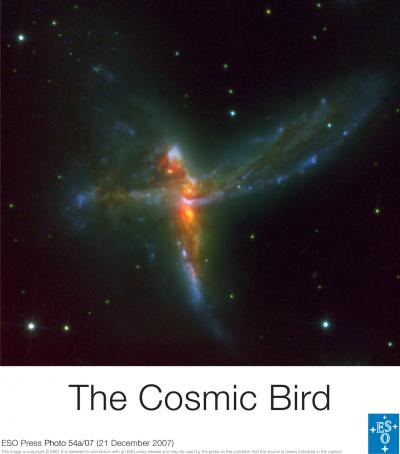
Using ESO's Very Large Telescope, an international team of astronomers [1] has discovered a stunning rare case of a triple merger of galaxies. This system, which astronomers have dubbed 'The Bird' - albeit it also bears resemblance with a cosmic Tinker Bell - is composed of two massive spiral galaxies and a third irregular galaxy.

The galaxy ESO 593-IG 008, or IRAS 19115-2124, was previously merely known as an interacting pair of galaxies at a distance of 650 million light-years.

Not all individuals who have epilepsy respond to traditional treatments and these individuals are said to have medically refractory epilepsy.

Strict use of a ketogenic diet high in fats and extremely low in carbohydrates is sometimes used for treatment of refractory epilepsy, and is effective about half of the time. However, the mechanisms whereby ketogenic diets suppress epileptic symptoms have long been a mystery.

New data generated by Kelvin Yamada and colleagues at the Washington University School of Medicine, St. Louis, has revealed that intranasal delivery of leptin, a hormone important in feeding and energy metabolism, delayed the onset of convulsions in a rodent model of seizures.

New research at York has revealed so-called ‘Jekyll and Hyde’ bacteria, suggesting a novel way to control insect pests without using insecticides.

Researchers at the University of York studied the relationship between plant-dwelling insects and the bacteria that live in them – and discovered an unexpected interaction.

Plants are not ‘easy meat’ for insects. In fact, many insects thrive on plant food only because of the presence of a third party: symbiotic bacteria that live in the insects and provide extra nutrients.

