In times of social rancor and strife, most will fight each other, but societies are saved by those who think about the bigger issue.
There is a lesson humans could learn from wasps. Polistes canadensis
wasps are more like China than a democracy, so when their ruler dies, power struggles and social turmoil result. Amidst the violence and chaos, individuals compensate by helping the group rather than fighting each other.
In tropical paper wasps, reproduction is controlled by a queen but the other females aren't sterile, and when a power vacuum arises, others may try to ascend. In experiments, researchers removed queens from established and watched as female aggression escalated to create reproductive dominance, The colony’s usual social networks rapidly broke down.
Yet the colonies did not collapse because “compensators” arose. They avoided engaging in violent Antifa-style conflict and power struggles and increased foraging and brood care. Food continued to reach developing offspring so the colony would still be intact once societal turmoil was over.
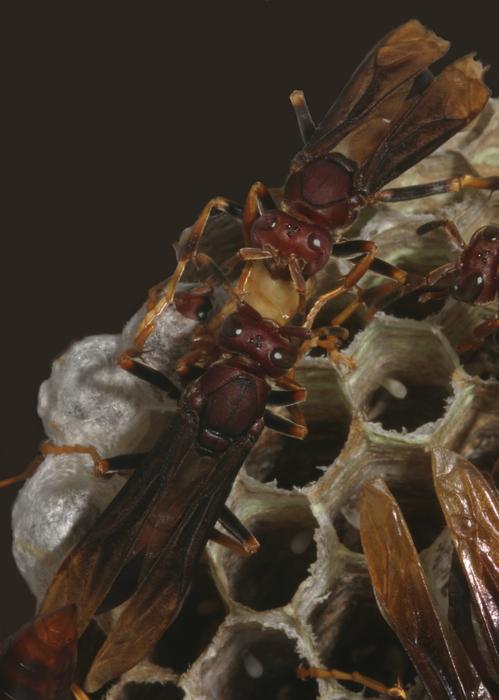
Polistes canadensis, tropical paper wasps. Credit: UCL
They are not biologically different, any more than Portland or Washington protesters are, they made strategic decisions rather than side with a tribe in conflict. "Cooperation didn’t disappear; it was redistributed,” noted lead author Dr. Owen Corbett of University College London.
These wasps behave differently than social authoritarian hierarchies with predictable succession rules but they showed aggression-based succession is not a biological mandate.
Citation: Owen R. Corbett, Stephanie Dreier, Thibault Lengronne, Solenn Patalano, Max Reuter, Seirian Sumner, Compensation of labour by noncompetitive individuals mitigates costs of aggressive succession contest in a social wasp, Animal Behaviour, 2026, 123581, ISSN 0003-3472, www.sciencedirect.com/science/article/pii/S0003347226001181