




Researchers at the University of Illinois have developed a new model of global carbon and nitrogen cycling that will fundamentally transform the understanding of how plants and soils interact with a changing atmosphere and climate.

The new model takes into account the role of nitrogen dynamics in influencing the response of terrestrial ecosystems to climate change and rising atmospheric carbon dioxide.

Current models used in the assessment reports of the Intergovernmental Panel on Climate Change do not account for nitrogen processing, and probably exaggerate the terrestrial ecosystem’s potential to slow atmospheric carbon dioxide rise, the researchers say. They will present their findings this week at the annual meeting of the American Geophysical Union in San Francisco.

A new study comparing the composite output of 22 leading global climate models with actual climate data finds that the models do an unsatisfactory job of mimicking climate change in key portions of the atmosphere.

This research, published in the Royal Meteorological Society’s International Journal of Climatology, raises new concerns about the reliability of models used to forecast global warming.

“The usual discussion is whether the climate model forecasts of Earth’s climate 100 years or so into the future are realistic,” said the lead author, Dr. David H. Douglass from the University of Rochester. “Here we have something more fundamental: Can the models accurately explain the climate from the recent past? It seems that the answer is no.”

A team of astronomers have used the NASA/ESA Hubble Space Telescope to detect, for the first time, strong evidence of hazes in the atmosphere of a planet orbiting a distant star. The discovery comes after extensive observations made recently with Hubble’s Advanced Camera for Surveys (ACS).

The team, led by Frédéric Pont from the Geneva University Observatory in Switzerland, used Hubble’s ACS to make the first detection of hazes in the atmosphere of the giant planet. "One of the long-term goals of studying extrasolar planets is to measure the atmosphere of an Earth-like planet, this present result is a step in this direction" says Pont.

We've reached an important milestone on our CombiUgi project involving the synthesis of falcipain-2 inhibitors. In my last update I described how our focus was more on doing many reactions in parallel and only looking for Ugi products that precipitate in pure form within a few days. It took little longer than I hoped. In order to do more reactions, we reduced our efforts towards monitoring. One of the assumptions that we made was to trust a bottle's label to accurately describe its contents.

Mood and anxiety disorders are the most common mental disorders but psychiatrists remain divided as to how to define and classify them.

Definitions in the upcoming Diagnostic and Statistical Manual (DSM-V), the “gold standard” reference book for psychiatrists will have at least have the benefit of high quality longitudinal data.

Ian Colman, Ph.D., lead author of “A Longitudinal Typology of Symptoms of Depression and Anxiety Over the Life Course”, notes, “Rarely have classification systems in psychiatry considered the nature of symptoms of depression and anxiety over time; however research into trajectories of alcohol abuse and antisocial behaviour shows that accounting for symptoms over time may help in better understanding causes and outcomes of these disorders.”

Cancer patients are suffering unnecessarily because they wrongly believe that morphine and other opioids are only used as “comfort for the dying” and as a “last resort” rather than seeing them as legitimate pain killers that can improve their quality of life.

In a study published in the cancer journal Annals of Oncology [1], experts in palliative care also say “the belief that opioids hasten death is widely held” amongst patients and this “has a significant impact on pain management, as patients felt that an offer of opioids signified imminent death”. Previous studies have estimated that between 40-70% of cancer patients may not have their pain properly controlled with the right medication for a variety of reasons.

It has been 35 years since humans last walked on the moon, but there has been much recent discussion about returning, either for exploration or to stage a mission to Mars.

Although psychiatrists are among the least religious physicians, they seem to be the most interested in the religious and spiritual dimensions of their patients, according to survey data published in the December issue of the American Journal of Psychiatry.

Ever since Freud described religious faith as an illusion and a neurosis there has been tension and at times hostility between religion and psychiatry. Psychiatrists are less religious on average than other physicians, according to previously published data from the same survey, and non-psychiatrist physicians who are religious are less willing to refer their patients to psychiatrists.

Polybrominated diphenyl ethers (PBDEs), chemicals used as fire retardants, can be found in numerous items in the home, such as the television, computer, toaster and the sofa. Now, as reported in a KNBC story on Nov. 28, they are being found in alarming concentrations, in human blood and breast milk – a potentially major concern for human health.

In addition, these industrial chemicals have been associated with cases of feline hyperthyroidism, a potentially fatal condition in cats.

UC Riverside scientists interviewed for the KNBC story have done research using rat tissue that shows that PBDEs disrupt mechanisms that are responsible for releasing hormones in the body.

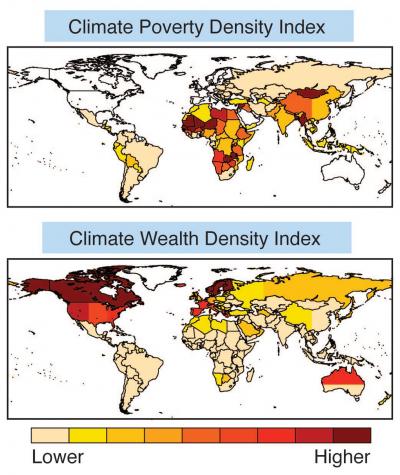
As the United Nations climate negotiations proceed in Bali, Indonesia, researchers have taken a first step toward quantifying the "socioclimatic" exposure of different countries to future climate change.

The research team from Purdue University and the Abdus Salam International Centre for Theoretical Physics in Trieste, Italy, found that China, India and the United States - major greenhouse gas-emitting nations that are currently unbound by the Kyoto treaty - face substantial exposure relative to other nations, but that every area of the world faces high exposure in at least one category.


This image illustrates the projected relative exposure for each country given expected 21st century climate change and

