





Many studies have suggested that moderate red wine consumption is beneficial to cardiovascular health. But what if you’d like to skip the alcohol?

Take heart: laboratory research, just presented at the WINEHEALTH 2007 conference in Bordeaux, France, showed that Concord grape juice stimulated an arterial relaxation effect in a similar fashion to red wine. The French researchers also reported that the Concord grape juice induced a prolonged relaxation effect that has not yet been reported with red wine.

Dr. Valérie Schini-Kerth and a team of researchers of the Université Louis Pasteur de Strasbourg, France, found that Concord grape juice stimulated the production of nitric oxide in endothelial cells, providing a vasorelaxation effect.

Some of the elements necessary to support life on Earth are widely known - oxygen, carbon and water, to name a few. Just as important in the existence of life as any other component is the presence of adenine, an essential organic molecule. Without it, the basic building blocks of life would not come together. Scientists have been trying to find the origin of Earth's adenine and where else it might exist in the solar system. University of Missouri-Columbia researcher Rainer Glaser says he may have the answer.

Life exists on Earth because of a delicate combination of chemical ingredients. Using a theoretical model, Glaser is hypothesizing the existence of adenine in interstellar dust clouds.

Tom Goetz wrote a thoughtful article "It's Time to Free the Dark Data of Failed Scientific Experiments" in Wired this week.
So what happens to all the research that doesn't yield a dramatic outcome —or, worse, the opposite of what researchers had hoped? It ends up stuffed in some lab drawer. The result is a vast body of squandered knowledge that represents a waste of resources and a drag on scientific progress. This information — call it dark data — must be set free. ... There are some islands of innovation. Since 2002, the Journal of Negative Results in Biomedicine has offered a peer-reviewed home to results that go negative or against the grain.

In public imagination, the sabre-toothed cat Smilodon ranks alongside Tyrannosaurus rex as the ultimate killing machine. Powerfully built, with upper canines like knives, Smilodon was a fearsome predator of Ice-Age America's lost giants.

For more than 150 years, scientists have debated how this iconic predator used its ferocious fangs to kill its prey. Now a new Australian study, published today in the US Proceedings of the National Academy of Science, hopes to lay the arguments to rest. And the results will put in dent in Smilodon's reputation.

Scientists from the University of New South Wales and University of Newcastle have used a computer-based technique called Finite Element Analysis (FEA) to test the bite force and feeding mechanics of the fearsome predator.

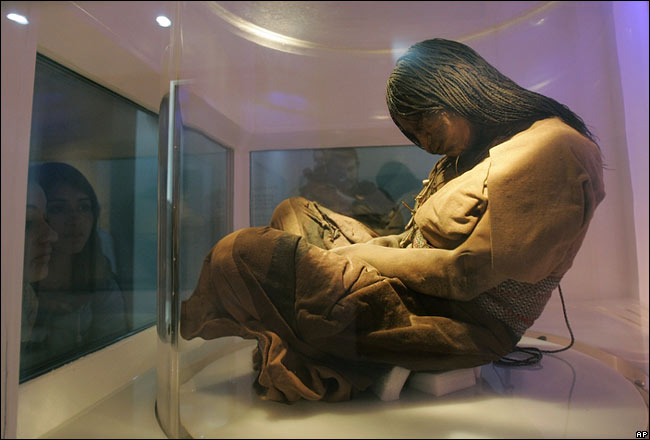
Hair samples from naturally preserved child mummies discovered at the world's highest archaeological site in the Andes have provided a startling insight into the lives of the children chosen for sacrifice. Researchers funded by the Wellcome Trust used DNA and stable isotope analysis to show how children as young as six years old were 'fattened up' and taken on a pilgrimage to their death.

A team of scientists led by Dr Andrew Wilson at the University of Bradford analysed hair samples taken from the heads and from small accompanying bags of four mummies found in the Andes.

Early findings by Carnegie Mellon University researchers suggest that people who are suckered by a spoof email into visiting a counterfeit Web site are also people who are ready to learn their lesson about “phishing” attacks.

Phishing attacks have become a common method for stealing personal identification information, such as bank account numbers and passwords. Lorrie Cranor, associate research professor of computer science, said phishing often is successful because many people ignore educational materials that otherwise might help them recognize such frauds.

Current recommendations developed by the Institute of Medicine in 1990 suggest women should gain at least 15 pounds during pregnancy and places no upper limit on pregnancy weight gain.

Not a good idea, says Raul Artal, M.D., chairman of the department of obstetrics, gynecology and women’s health at Saint Louis University School of Medicine.

“Guidelines for nutrition during pregnancy at that time were based solely on expert opinion and not on scientific data. Obesity was not the problem it is now,” Dr. Artal says.

A new study led by Artal,published in the October issue of Obstetrics & Gynecology, found that women of different weights should gain or even lose different amounts of weight.

Comets are made of the most primitive stuff in the solar system. As hunks of rock and ice that never coalesced into more planets, they give researchers clues to the evolution of solar systems.

In February, during its mission to study the sun's polar regions, the spacecraft Ulysses flew through McNaught's ion tail 160 million miles from the comet's core.

Instrument readings showed there was "complex chemistry" at play, said University of Michigan space science professor George Gloeckler. Gloeckler is the principal investigator on the Solar Wind Ion Composition Spectrometer (SWICS) aboard Ulysses, which measured the composition and speed of the comet tail and solar wind.

According to an analysis by Dr. Kathryn Wilson, associate professor of economics at Kent State University and colleagues, the United States has the highest level of income inequality among all rich nations. For example, low-income households, or those at the 10th percentile of the income distribution, spend approximately $8,900 per year per child, while high-income families, or those at the 90th percentile, spend $50,000 per child.

“People like to think of America as the land of opportunities,” says Wilson. “The irony is that our country actually has less social mobility and more inequality than most developed countries.”

The present can tell you a lot about the past, but you need to know where to look. A new study appearing this month in Genome Research reveals that protein architectures – the three-dimensional structures of specific regions within proteins – provide an extraordinary window on the history of life.

In the study, researchers at the University of Illinois describe contemporary protein architectures as “molecular fossils” or “historical imprints” that mark important milestones in evolutionary history. The research team compiled a global census of protein architectures, and used these relics to plot the emergence, diversification and refinement of each of the three superkingdoms of life: Archaea, Bacteria and Eukarya.

