
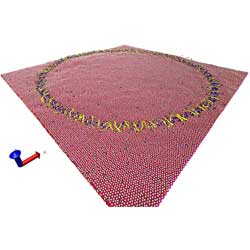








Danish nano-physicists have made a discovery that can change the way we store data on our computers. This means that in the future we can store data much faster, and more accurate.

Your computer has two equally important elements: computing power and memory. Traditionally, scientists have developed these two elements in parallel. Computermemory is constructed from magnetic components, while the media of computing is electrical signals. The discovery of the scientists at Nano-Science Center and the Niels Bohr Institute at the University of Copenhagen, Jonas Hauptmann, Jens Paaske and Poul Erik Lindelof, is a step on the way towards a new means of data-storage, in which electricity and magnetism are combined in a new transistor concept.

The National Grid Service in the UK and the TeraGrid in the U.S. have joined forces to help University College London (UCL) scientists shed light on how life on Earth may have originated.

Deep ocean hydrothermal vents have long been suggested as possible sources of biological molecules, such as RNA and DNA, but it was unclear how they could survive the high temperatures and pressures that occur round these vents.

Peter Coveney and colleagues at the UCL Centre for Computational Science have used computer simulation to provide insight into the structure and stability of DNA while inserted into layered minerals.

Nice blog today on mutualisms by Olivia Judson who writes the Wild Side blog/column for the New York Times (I seem to be writing a lot about writers for the NY Times these days ... not sure what is going on with that).

A new study suggests that a genetic fingerprint associated with normal embryonic stem cells may be important for the development and function of cancer stem cells. The research in Cell Stem Cell demonstrates that embryonic stem cells and multiple types of human cancer cells share a genetic expression pattern that is repressed in normal differentiated cells, a finding that may have significant clinical implications for cancer therapeutics.

“Self-renewal is a hallmark of stem cells and cancer, but existence of a shared stemness program remains controversial,” explains study co-author, Dr. Howard Y. Chang from Stanford University. Dr. Chang, Dr.

A gene called Diaphanous (or Dia) has just been uncovered as a major regulator during embryo formation. The research now published in the journal Development shows how Dia mutations in fruit flies embryos result in a serious of defects during morphogenesis (process by which cells differentiate into tissues and structures), including loss of adhesion, abnormal movements and even migration of cells from one tissue to another.

The discovery contributes to a better understanding of how tissue and organ formation is regulated and, consequently, to, one day, be able to intervene therapeutically. Furthermore, the loss of adhesion and abnormal mobility that occurs when Dia is mutated is very similar to what happens during cancer metastases formation, suggesting that this gene might also have a role in cancer.

Scientists have discovered a possible terrestrial-type planet orbiting a star in the constellation Leo. The new planet lies at a distance of 30 light years from the Earth and has a mass five times that of our planet but is the smallest found to date. One full day on the new planet would be equivalent to three weeks on Earth.

A team of astronomers from the Spanish Research Council (CSIC) working with Dr Jean-Philippe Beaulieu, a visiting astrophysicist at University College London (UCL), made the discovery from model predictions of a new exoplanet orbiting a star in the constellation of Leo. Simulations show that the exoplanet, dubbed GJ 436c, orbits its host star (GJ 436) in only 5.2 Earth days, and is thought to complete a revolution in 4.2 Earth days, compared to the Earth’s revolution of 24 hours and full orbit of 365 days.

Maintaining aerobic fitness through middle age and beyond can delay biological ageing by up to 12 years and prolong independence during old age, concludes an analysis published ahead of print in the British Journal of Sports Medicine.

Aerobic exercise, such as jogging, improves the body’s oxygen consumption and its use in generating energy (metabolism).

But maximal aerobic power starts to fall steadily from middle age, decreasing by around 5 ml/[kg.min] every decade.

Inter-country adoptions are causing a rise in the number of children in orphanages in EU countries, say psychologists at the University of Liverpool.

More adoptions are leading to higher numbers of children in institutions, says the study, because in EU countries such as France and Spain, people are choosing to adopt healthy, white children from abroad rather than children in their own country who are mainly from ethnic minorities.

Researchers found that EU countries with high proportions of international adoptions also had the highest rates of children living in institutions. High adoption did not reduce the number of children in institutional care but they say instead attributed to an increase.

Aimed primarily at the increasing problem of terrorist acts by individuals affiliated with groups such as the Animal Liberation Front against investigators conducting research in non-human primates in the United States, an editorial in Biological Psychiatry goes after people who slam the integrity ("who does their funding?" and physical safety of medical researchers.

Collectively, the 87 authors of “It Is Time to Take a Stand for Medical Research and Against Terrorism Targeting Medical Scientists” say they wish to not only declare their stance against these acts, but also to emphasize the unique and vital role that non-human primate research plays in furthering our understanding of the neurobiology and treatment of psychiatric disorders.

Open Knowledge, cyber-activism and social uses of technologies are some of the topics that Dutch Media theorist and activist Geert Lovink likes to tackle. He is Associate Professor in the Media & Culture department at the University of Amsterdam and holds a PhD from the University of Melbourne. He is founder and director of the Institute of Network Cultures and co-founder of Internet projects such as The Digital City, Nettime, Fibreculture and Incommunicado. Lovink is also the author of "Dark Fiber", which has been translated into Italian, Spanish, Romanian, German and Japanese.

Lovink visited Spain this week to talk about ‘The politics of open knowledge production’ at El Círculo de Bellas Artes in Madrid, and ‘About critic culture in the Internet’ in Seville at Zemos98 Festival and Enrique Sacristan from Servicio de Informacion y Noticias Cientificas(SINC) conducted this interview:

