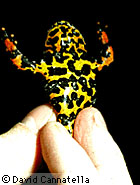









Researchers have confirmed the first case of a frog without lungs - the aquatic frog Barbourula kalimantanensis apparently gets all the oxygen it needs through its skin. Previously known from only two specimens, two new populations of the aquatic frog were found during a recent expedition to Indonesian Borneo.

Of all tetrapods (animals with four limbs), lunglessness is only known to occur in amphibians. There are many lungless salamanders and a single species of caecilian, a limbless amphibian resembling an earthworm, known to science. The complete loss of lungs is a particularly rare evolutionary event that has probably only occurred three times.

Airborne soot's heating effects have been found to be 60 percent of CO2's, yielding a 40/60 soot/CO2 global atmospheric heating combination. In higher altitudes soot is just as important as CO2 in melting tropical glacial packs like the Himalayas (and perhaps Kilimanjaro) while also devasting Arctic ice by making it more heat-absorbant.

INDOEX lead researcher V. Ramanathan has co-authored a paper on his team's findings that airborne soot (aka black carbon, or BC for short) plays a far greater role in atmospheric warming than the UN's IPCC reports have yet indicated.

One thing that would make the cultural transition to cleaner fuels easier would be gasoline that works with current engine technology. Reporting in Chemistry & Sustainability, Energy & Materials, a group of researchers have made a breakthrough in the development of this "green gasoline" - a liquid identical to standard gasoline yet created from sustainable biomass sources like switchgrass and poplar trees.

It may be five to 10 years before green gasoline arrives at the pump or finds its way into a fighter jet but the breakthrough by George Huber of the University of Massachusetts-Amherst (UMass) and graduate students Torren Carlson and Tushar Vispute of the first direct conversion of plant cellulose into gasoline components is a big step.

A rare type of galax with a higher number of X-rays than thought possible has been detected.

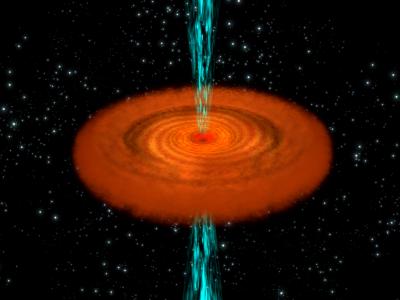
Quasars are cosmic 'engines' that pump energy into their surroundings - theorists speculate that an enormous black hole drives each one. As matter falls into the black hole, it collects in a swirling reservoir called the accretion disc, which heats up. Computer simulations suggest that powerful radiation and magnetic fields present in the region eject some of gas from the gravitational clutches of the black hole, throwing it back into space.

You may never have heard of the Perkins high-speed diesel engine but the system is still used in numerous buses, taxis, ambulances, fire engines and ships of today.

Autobiographical notes written by the Lancashire inventor of the engine have been recovered from a garage in Manchester after lying forgotten for 25 years. University of Manchester historian Dr. Yaakov Wise -- who made the discovery -- says the Charles Chapman manuscript gives a unique insight into that 1932 "world beater."

Dr Wise, who worked at the legendary Perkins Engines where Chapman was based was given the document in 1983 - four years after the inventor died aged 82- but rediscovered it after clearing out a garage 25 years later.

‘Mother cells’ which produce the neurons affected by Parkinson’s disease have been identified by scientists, according to new research published in the journal Glia.

The new discovery could pave the way for future treatments for the disease, including the possibility of growing new neurons, and the cells which support them, in the lab. Scientists hope these could then be transplanted into patients to counteract the damage caused by Parkinson’s.

The new study focuses on dopaminergic neurons – brain cells which produce and use the chemical dopamine to communicate with surrounding neurons. The researchers found that these important neurons are created when a particular type of cell in the embryonic brain divides during the early stages of brain development in the womb.

Green tea is high in the antioxidant EGCG (epigallocatechin-3- gallate) which helps prevent the body’s cells from becoming damaged and prematurely aged.

Studies have suggested that the combination of green tea and EGCG may also be beneficial by providing protection against certain types of cancers, including breast cancer.

A new study conducted by researchers at the University of Mississippi researchers now finds that consuming EGCG significantly inhibits breast tumor growth in female mice. These results bring us one step closer to better understanding the disease and potentially new and naturally occurring therapies.

Scrapie can be transmitted to lambs through milk, according to new research published in BMC Veterinary Research. The study provides important information on the transmission of this prion-associated disease and the control of scrapie in affected flocks. Scrapie is a fatal neurodegenerative disease of sheep and goats.

Clinical signs include itchiness, head tremor, wool loss and skin lesions as well as changes in behaviour and gait.

Timm Konold and colleagues from the Veterinary Laboratories Agency in Weybridge, UK, investigated the transmission of scrapie by feeding milk from scrapie-affected ewes to lambs that are genetically susceptible to contracting scrapie. The researchers were looking for the presence of the prion protein, PrPd, which is associated with the disease.

Attention-deficit/hyperactivity disorder(ADHD) is a behavioral disorder, usually first diagnosed in childhood, that is characterized by inattention, impulsivity and hyperactivity.

Children with ADHD appear likely to experience sleep problems, according to a report in the April issue of Archives of Pediatrics & Adolescent Medicine. Sleep problems in these children may be associated with poorer child psychosocial quality of life, child daily functioning, caregiver mental health and family functioning.

Mice given caffeine equivalent to a human drinking six to eight cups of coffee a day were protected from developing experimental autoimmune encephalomyelitis (EAE), the animal model for the human disease Multiple Sclerosis (MS), according to researchers at Cornell University.

Caffeine is a well-known adenosine receptor blocker, and the researchers believe results show the importance of this molecule in permitting the infiltration of immune cells into the central nervous system of patients with MS.

Dr. Jeffrey H. Mills, a postdoctoral associate in the laboratory of Dr. Margaret S. Bynoe, presented the findings at Experimental Biology 2008 on April 7. The presentation was part of the scientific programs of the American Society of Immunologists.

