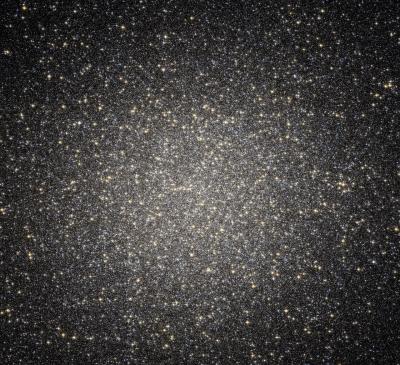







Omega Centauri is visible from Earth with the naked eye and is one of the favorite celestial objects for stargazers from the southern hemisphere.

Although the cluster is 17,000 light-years away, located just above the plane of the Milky Way, it appears almost as large as the full Moon when the cluster is seen from a dark rural area.

Exactly how Omega Centauri should be classified has always been a contentious topic. It was first listed in Ptolemy’s catalogue nearly two thousand years ago as a single star. Edmond Halley reported it as a nebula in 1677. In the 1830s the English astronomer John Herschel was the first to recognise it as a globular cluster.

Now, more than a century later, this new result suggests Omega Centauri is not a globular cluster at all, but a dwarf galaxy stripped of its outer stars.

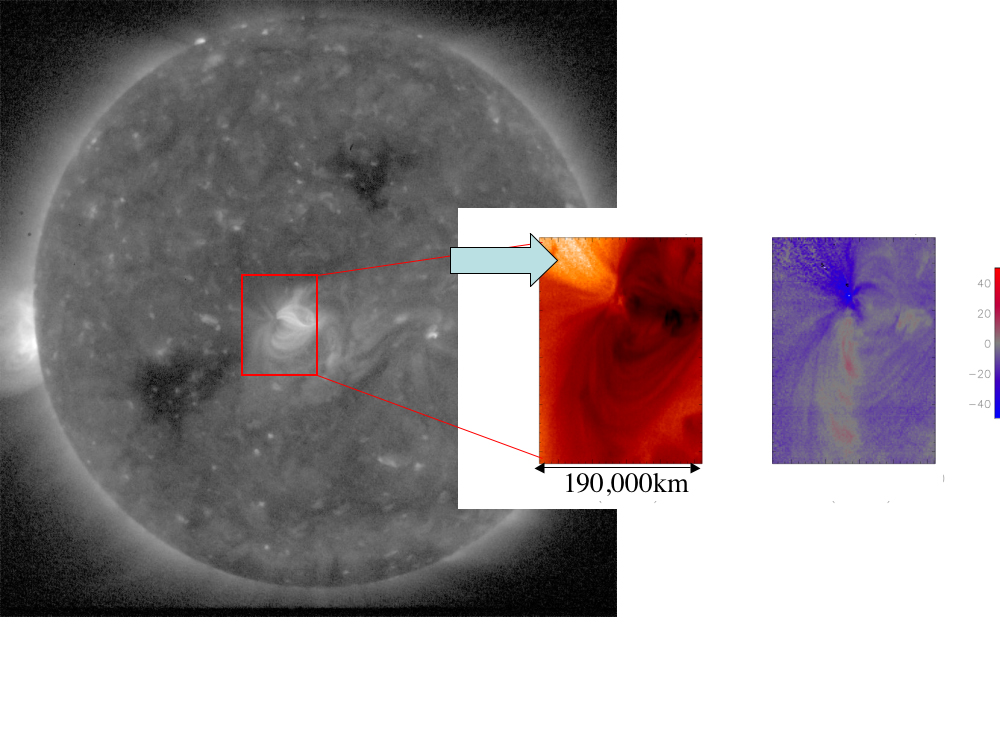
An international team of scientists, led by Prof Louise Harra, University College London, Mullard Space Science Laboratory, have found a source of the stream of particles that make up the slow solar wind using data from Hinode and SOHO.

The solar wind can have low or high speeds. The low-speed or slow solar wind moves at only 1.5 million km/h. The high-speed wind is even faster, moving at speeds as high as 3 million km/h. As it flows past Earth, the solar wind changes the shape and structure of Earth's magnetic field.

ESA’ s SOHO and Hinode Project Scientist, Bernhard Fleck says, “In the past, apart from creating beautiful auroral displays, the solar wind didn’t affect us directly. But as we’ve become increasingly dependent on technology, we are more susceptible to its effects. We’re learning that variations in its flow can dramatically change the shape of Earth's magnetic field, which can damage satellites, disrupt communications and electrical power systems.”

AUSTIN, Texas, April 2 /PRNewswire/ --

- Guarantees Price, Performance, and Value Leadership

Database-Brothers, Inc. (DBI) today introduced new performance tuning and space management tools for Oracle environments: Brother-Owl(TM) for SQL tuning, Brother-Wolf(TM) for space management, and Brother-Eagle(TM) Enterprise Edition for real-time performance monitoring. The new tools provide DBAs with greater insight into performance problems while proactively resolving issues for optimal business availability.

(Logo: http://www.newscom.com/cgi-bin/prnh/20060505/NYF037LOGO)

Scottish astronomers have found a baby planet still in the stages of forming and encased within a 'womb' of gas.

The embryonic planet, thought to be the youngest ever seen, was discovered by Dr Jane Greaves of the University of St Andrews and colleagues from across the UK and the US.

The finding provides a unique view of how planets take shape, because the supporting images also shows the womb-like parent disk material from which the new planet formed. The 'protoplanet', called HL Tau b after its parent star HL Tau, could be as young as a few hundred years old.

Dr Greaves, of the School of Physics & Astronomy at St Andrews, explained, "The planet will probably take millions of years to settle down into its final form of something like Jupiter.

Scientists have long known that emotions and other personality traits and disorders run together in families but finding which genes are most important in controlling emotions has proven difficult. Humans and mice have similar numbers of genes, but mice are valuable because their genes can be deleted or added. Many researchers have begun to study mouse behaviors to try to link genes with complex behaviors.

A new report by Wang et al., found that male mice make high-frequency vocalizations during sexual interactions with female mice. These high-frequency calls are associated with approach behaviors, and with genes that control positive emotions.

COPENHAGEN, Denmark and HELSINKI, Finland, April 2 /PRNewswire/ -- Nordic venture capital investor Sunstone Capital announced today that Helsinki-based Pekka Vartiainen, former head of Nokia Mobile Phones Americas in the United States, has joined Sunstone Capital as Venture Partner. He contributes to the Sunstone team his unique insight from building and managing world-class operational and sales organizations on three continents, and will act as Sunstone's spearhead for investment opportunities and business partnerships in both Finland and the global wireless space.

Researchers in a large, multi-institutional study have found one gene variant that is linked to an increased risk of lung cancer.

The research team collected DNA from 1,154 smokers who have lung cancer and 1,137 smokers without lung cancer. Each DNA sample was analyzed at more than 300,000 points, looking for variations—known as single nucleotide polymorphisms, or SNPs for short—between those with cancer and those without. They then analyzed the top 10 SNPs in an additional 5,075 DNA samples from smokers with and without lung cancer.

Two of the 10 SNPs were consistently associated with lung cancer risk and both of them are located in chromosome 15 inside a region that contains genes for the nicotinic acetylcholine receptor alpha subunits 3 and 5, which already are suspected to play a role in lung cancer progression.

A few weeks ago I wrote a blog about a Chicago charter school.

I was naive enough to believe that if a group of ninth graders could not read it was unique to this Chicago school. Today I read a report by Christopher B. Swanson, Ph.D. titled "Cities in Crisis: A Special Analytical Report on High School Graduation." Dr. Swanson’s report clearly shows that we are in an academic crisis in the U.S.

In the first experiment of its kind conducted in nature, a University of British Columbia evolutionary biologist has come up with strong evidence for one of Charles Darwin’s cornerstone ideas – adaptation to the environment accelerates the creation of new species.

“A single adaptive trait such as color could move a population towards the process of forming a new species, but adaptation in many traits may be required to actually complete the formation of an entirely new species,” says UBC post-doctoral fellow Patrik Nosil. “The more ways a population can adapt to its unique surroundings, the more likely it will ultimately diverge into a separate species.”

Nosil studied walking-stick insects in the Santa Barbara Chaparral in southern California.

SHANGHAI, China, April 2 /PRNewswire/ --

- 93% Power Efficiency, 0.27 GFlops/Watt, and 7-Year Lifecycle

