If you have a 'difficult' baby, don't worry too much about your parenting skills. A new report in Psychological Science says that a child's temperament may be due in part to a combination of a certain gene and a specific pattern of brain activity.
The pattern of brain activity in the frontal cortex of the brain has been associated with various types of temperament in children. For example, infants who have more activity in the left frontal cortex are characterized as temperamentally "easy" and can be soothed with less effort. Conversely, infants with greater activity in the right half of the frontal cortex are temperamentally "difficult" and are easily distressed and require more effort to soothe.
A study done by Stanford University School of Medicine and Stanford Hospital&Clinics suggests that the use of a dietary supplement after Roux-en-Y gastric bypass surgery can help obese patients to more quickly lose weight and to avoid deficiency of a critical B vitamin.
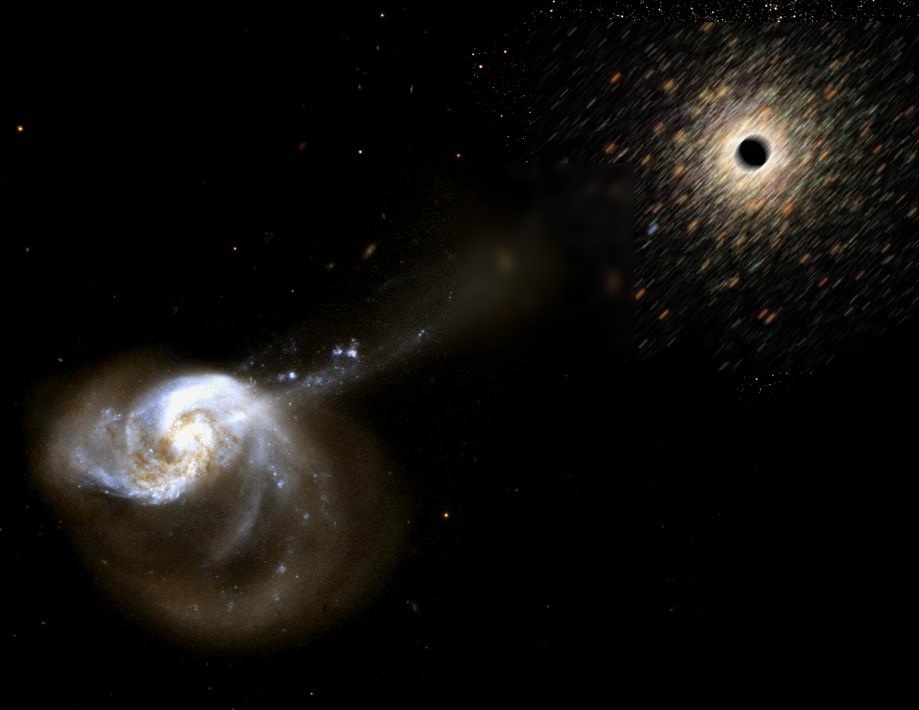
The cluster of stars surrounding a supermassive black hole after it has been ejected from a galaxy are a new kind of astronomical object, according to a paper published in Astrophysical Journal.
More importantly, the stars contain a 'fossil record' from the 'kicking' galaxy.
The phrase 'like herding cats' resonates with people for a reason; it's difficult to get them to do anything they don't already want to do.
But they have no problem getting humans to do their bidding, according to a report published in Current Biology, which shows that even biologists are concerned about future feline-human relations.
It seems crafty felines accelerate the filling of food dishes by sending a mixed signal: an urgent meowing coupled with an otherwise pleasant purr. Humans find it annoying and difficult to ignore. It's not April 1st or December so calibrate your belief accordingly.
Summertime, and the livin' is easy, wrote Ira Gershwin and Du Bose Heyward in 1933. The current gasoline prices are not easy on the budget because they are rising again. According to the New York Times of 8 June 2009: "Gas prices have risen 41 days in a row, to a national average of almost $2.62 a gallon. That is a sharp increase from the low of $1.62 a gallon that prevailed at the end of last year."
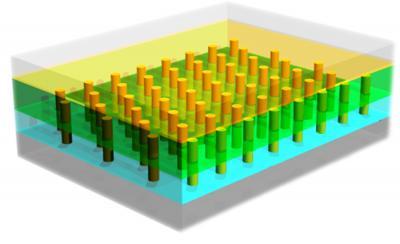
Researchers at Lawrence Berkeley National Lab and UC Berkeley say they have demonstrated a way to fabricate efficient solar cells from low-cost, flexible materials; optically active semiconductors in arrays of nanoscale pillars, each a single crystal, with dimensions measured in billionths of a meter.
Want to live forever but
starving is not for you? A study published in
Proceedings of the National Academy of Sciences may be more to your liking.
Sulfate gets all the attention but iron and manganese compounds may be important role in converting methane to carbon dioxide and eventually carbonates in the Earth's oceans, according to a team of researchers looking at anaerobic sediments.
Those same compounds may also have been key to methane reduction in the early, oxygenless days of the planet's atmosphere. On the early Earth, where oxygen was absent from the atmosphere, sulfates were scarce.
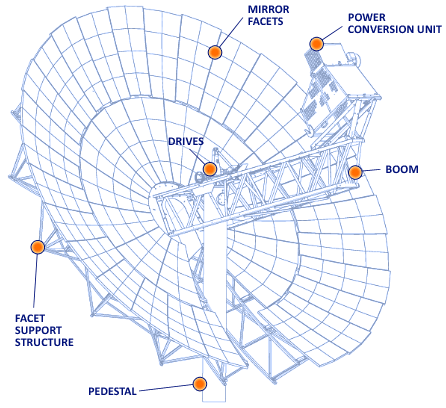
Stirling Energy Systems (SES) and Tessera Solar recently unveiled four newly designed solar power collection dishes at Sandia National Laboratories’ National Solar Thermal Test Facility (NSTTF).
Sandia’s concentrating solar-thermal power (CSP) team has been working closely with SES over the past five years to improve the system design and operation.
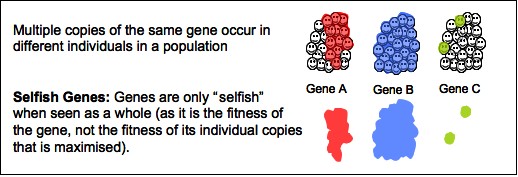
I’ve been prompted to write this because of the misconceptions about the concept of the “Selfish Gene” in Evolutionary theory – evident in both blog replies on this site and more widely.
I get really irritated when I see writers in the social sciences characterise evolutionary biology as somehow being based on the same assumptions as rational choice theory. Here is the first paragraph from a book chapter I saw today which motivated me to start this blog and write this entry...