If you were born at a time when social security numbers were not required, you can probably recognize other people from your home state if you see or hear their numbers. You may have thought there was a smarter system in place by now.
Not so, and it's actually easy to glean a social security number, say project lead Alessandro Acquisti, associate professor of information technology and public policy at Carnegie Mellon's H. John Heinz III College, and Ralph Gross, a post-doctoral researcher, who have shown that public information readily gleaned from governmental sources, commercial data bases, or online social networks can be used to routinely predict most — and sometimes all — of an individual's nine-digit Social Security number.
Parasites don't get a lot of respect these days but we may have to reconsider that. In spite of their nasty reputation, they may have given us the joy of sex.
What's so great about sex?
If you don't know, this article cannot help and even from an evolutionary perspective the answer is not as obvious as one might think.
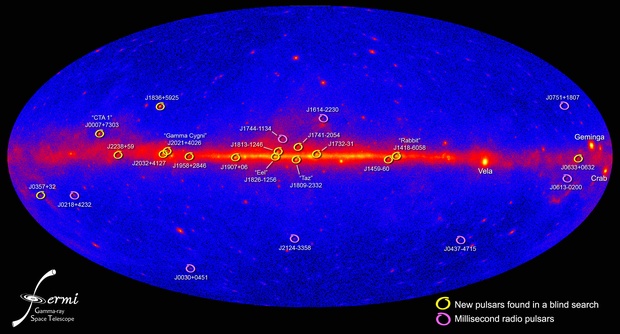
Two studies published in Science Express show the analysis of gamma-rays from two dozen pulsars, including 16 discovered by NASA's Fermi Gamma-ray Space Telescope. Fermi is the first spacecraft able to identify pulsars by their gamma-ray emissions alone.
A pulsar is the rapidly spinning and highly magnetized core left behind when a massive star explodes. Most of the currently cataloged pulsars, some 1800 of them, were found through their periodic radio emissions; pulses caused by narrow, lighthouse-like radio beams emanating from the pulsar's magnetic poles, according to current theory.
Why do some species have parents working together to raise young? In humans, it is the norm but in nature it is rare.
Birds, like humans, have offspring raised by two parents and bird biologists at the University of Bath want to know more about why. The study, published in the Journal of Evolutionary Biology, analyzed more than 50 previous studies of birds to understand why and how they share their parental duties.
Even among giants Messier 87, with two to three billion times the mass of our sun, stands out, completely dominating the Virgo cluster.
A supermassive black hole exists in the center of Messier 87 and gigantic plasma flows shoot out from the vicinity of the black hole at close to light speed. Scientists have now observed, simultaneously in gamma and radio frequencies, this active galactic core region and in doing so discovered that the elementary particles are accelerated to extremely high energy levels in closest proximity to the black hole.
The
2009 World Conference on Science Journalism took place last week in heat-wave-struck London, at the convenient location of
Westminster Central Hall (see below). More than 900 delegates got together from 90 countries to discuss the future of science journalism, understand the challenges the field is facing, and finding strategies to face them. An impressive event, excellently organized.

Mars, Incorporated, the global brand dealing primarily with chocolate, other candy and pet food (1), wants to discuss its cocoa sustainability program as part of a summer-long sustainability exhibition on Mainau Island - a botanical island famed locally for its flora and fauna and located in the middle of Lake Constance, Germany, one of Germany's most popular tourist destinations.
The exhibition, which opens today, follows on from the annual Lindau Nobel Laureate Meeting in Germany last week, in which Mars was a sponsor.
Robots, lacking families and pensions, will rush into scenarios where humans fear to tread, like rescue missions following natural disasters. So they need our support.
RoboCup Rescue is a new effort to promote research and development in the field of rescue robotics. Robots for search and rescue missions, the efficient co-ordination of rescue services or decision-support systems are all the practical result of rescue robotics research. Two RoboCup leagues give an insight into digitally supported rescue possibilities: Rescue Simulation and Real Rescue.
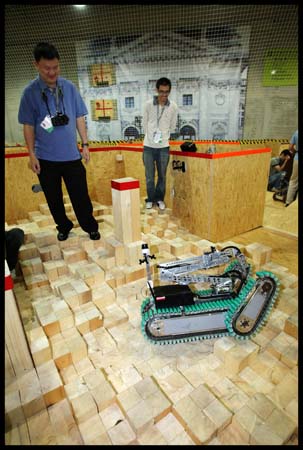 Rescue Robot at RoboCup 2009. Photo: TU Graz
Six groups of scientists from the Departments of Biology and Chemistry at the University of York and the Astbury Centre for Structural and Molecular Biology, Faculty of Biological Sciences, at the University of Leeds have set out discover how a group of proteins that are highly effective at killing bacteria could hold the key to developing new types of antibiotics.
Researchers from the Universities of York and Leeds have been awarded £3.3m from the Biotechnology and Biological Sciences Research Council (BBSRC) to find out how a family of proteins known as colicins force their way into bacterial cells before destroying them.
Philosophers have the embarrassing habit of apologizing for formal logic. Mathematicians don’t bother because they don’t care -- they’re just interested in the pretty pretty symbols and waste no part of their lives checking to see if their activities actually mean anything. But philosophers worry about everything, and the more obvious a thing or its explanation might be, the more worrisome it becomes to them. And since a particularly large part of philosophy in the last 140 years has specifically centered itself around the importance of formal logic -- which is “obviously” important -- this becomes especially problematic.