MUNICH, May 15 /PRNewswire/ --
- Investigating the Real Burden of Hypertension, Addressing the Challenges of Getting to Blood Pressure Goal and SHARE(ing) the Knowledge (http://www.SHARE-hypertension.com)
LONDON, May 15 /PRNewswire/ --
- Four awards celebrate service provider and product excellence
The winners of Light Reading's prestigious Ethernet Expo: Europe 2009 Awards were announced yesterday as a finale to the highly successful conference and exhibition at the ExCel Conference Centre in London. In the Vendor of the Year category two winners were announced: Alcatel-Lucent's Service Router Portfolio for the Best Infrastructure Product, and ANDA EtherReach for the Best Access Product. Meanwhile British Telecom's Etherflow UK scooped the Best New Service, and COLT Telecom the Best Product Portfolio in the Service Provider of the Year categories.
LONDON, May 15 /PRNewswire/ -- XP Power, one of the world's leading developers and manufacturers of mission critical power control solutions to the electronics industry, is today issuing an update on trading for the four months ended 30 April 2009 in line with its normal practice.
Trading in the first four months of the current financial year has been satisfactory and in line with expectations, with revenues being in line with those achieved in the same period of 2008.
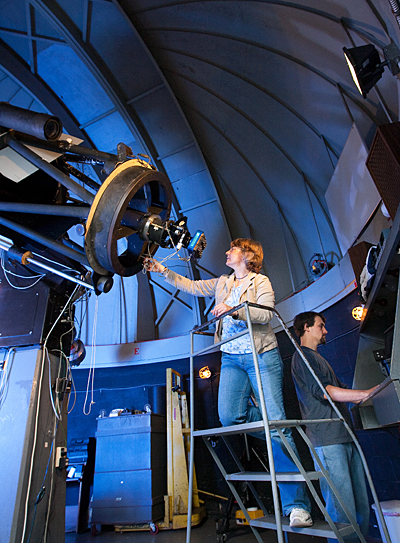
The Whole Earth Telescope (WET), a worldwide network of observatories coordinated by the University of Delaware, is synchronizing its lenses to provide round-the-clock coverage of a cooling star. As the star dims in the twilight of its life, scientists hope it will shed light on the workings of our own planet and other mysteries of the galaxy.
The dying star, a white dwarf identified as WDJ1524-0030, located in the constellation Ophiuchus in the southern sky, is losing its brightness as it cools, its nuclear fuel spent. It will be monitored continuously from May 15 to June 11 by WET, a global partnership of telescopes which was formed in 1986.
Scientists at South Dakota State University are exploring the mechanisms by which a substance derived ultimately from Red Sea coral could help treat skin cancer.
The study built on earlier work by SDSU distinguished professor Chandradhar Dwivedi’s lab looking at the chemopreventive effects of sarcophine-diol, made from a substance called sarcophine that can be isolated from soft coral found in the Red Sea. The new study carried the work beyond looking at sarcophine-diol’s possible use in prevention of skin cancer to consider its potential as a tool in therapies to actually treat skin cancer.
“We are finding that sarcophine-diol could be used both for chemoprevention and as a chemotherapeutic agent,” Dwivedi said.
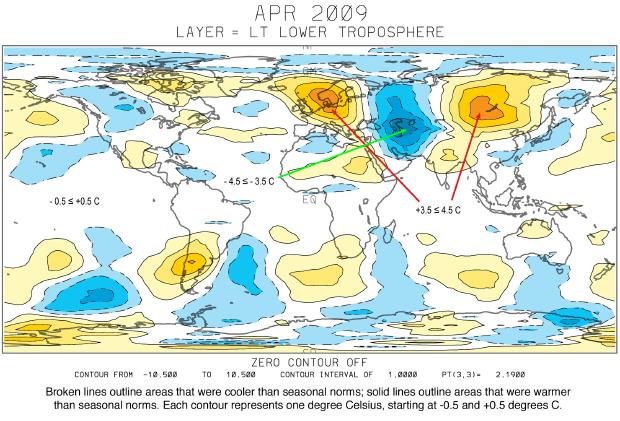
Global warming isn't spiking but the global composite temperature during April revealed an increase above the 20-year average for that month. The report is issued monthly as part of an ongoing joint project between The University of Alabama in Huntsville, NOAA and NASA.
As part of an ongoing joint project between The University of Alabama in
Huntsville, NOAA and NASA, Dr. John Christy, director of U.A. Huntsville's
Earth System Science Center, and Dr. Roy Spencer, a principal research
scientist in the ESSC, use data gathered by microwave sounding units on NOAA
and NASA satellites to get accurate temperature readings for almost all
regions of the Earth. This includes remote desert, ocean and rain forest
David Sloan Wilson is doing a great job in his blog at The Huffington Post, exposing the contradictions that lie at the heart of selfish gene theory.
He’s run a series of articles under the umbrella title of Truth and Reconciliation for Group Selection, singling out Richard Dawkins as a target for some pretty heavy broadsides. Like this; “Richard has become unaccountable, in part by becoming a public icon. That disqualifies him as a spokesperson for science.” And this; “when it comes to semantic confusion, you can't beat selfish gene theory.”
It just makes me feel warm and tingly all over.
Duplicating our organic tissue synthetically isn't as easy as it sounds. Our bodily tissue is both soft and tough but modern implants - and replacement organs - will need to be as close to natural as possible to be effective.
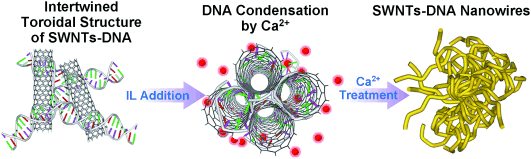
A team of Australian and Korean researchers led by Geoffrey M. Spinks and Seon Jeong Kim has now developed a novel, highly porous, sponge-like material whose mechanical properties closely resemble those of biological soft tissues. It consists of a robust network of DNA strands and carbon nanotubes.
Dartmouth Medical School geneticists say they have made new inroads into understanding the regulatory circuitry of the biological clock that synchronizes the ebb and flow of daily activities, according to two studies published May 15.
Research on the relationship between clocks and temperature, reported in Cell, offers insight into a longstanding puzzle of temperature compensation: why the 24-hour circadian rhythm does not change with temperature when metabolism is so affected. A related study, in Molecular Cell, tracks a clock protein in action, mapping hundreds of highly choreographed modifications and interactions to provide the first complete view of regulation across a day.
Let's be honest, the one thing you worry about most when driving your Hummer and sipping corporate-farmed coffee is how much damage that Union Oyster House ("oldest restaurant in America!") refrigerator magnet in your house is doing to the environment.
You're out of luck. The refrigerator magnets scientists are a step closer to making are for environmentally-friendly 'magnetic' refrigerators and air conditioning systems.