If bioethanol is going to make a major contribution to our fuel supplies, we will require using biomatter a lot more efficiently than we do now - but we may be able to get some assistance from tiny insect helpers, says Michael Scharf, an assistant professor of entomology at the University of Florida, Gainesville.
In Biofuels, Bioproducts&Biorefining, Scharf and his colleague Aurélien Tartar describe how the enzymes produced by both termites and the micro-organisms that inhabit their gut – known as symbionts – could help to produce ethanol from non-edible plant material such as straw and wood.
Contrary to popular belief, polar dinosaurs may not have traveled nearly as far as originally thought when making their bi-annual migration.
University of Alberta researchers Phil Bell and Eric Snively have suggested that while some dinosaurs may have migrated during the winter season, their range was significantly less than previously thought, which means their treks were shorter. Bell and Snively's findings were recently published in Alcheringa: An Australasian Journal of Paleontology.
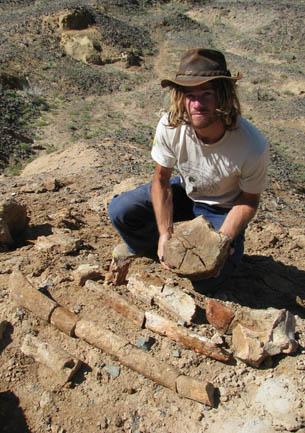 Phil Bell holding a vertebra of a 70-million-year-old Saurolophus.
We believe we know a lot about the universe but there's a lot left to be explained, especially about its origins. A team of cosmologists from the University of the Basque Country are searching for a model that best explains how the universe evolved - mathematically.
One of the phenomena that standard models of physics have not yet been able to explain is that of the accelerated expansion of the universe. Although Einstein proposed a static model to describe the Cosmos, phenomena like supernovas tell us the universe is expanding.
Yale researchers have described how dueling brain systems may explain why you forget to drop off the dry cleaning and may point to ways that substance abusers and people with obsessive compulsive disorder can overcome bad habits.
In Proceedings of the National Academy of Sciences, Christopher J. Pittenger, M.D., and colleagues describe a sort of competition between areas of the brain involved in learning that results in what Pittenger calls the “dry cleaning effect.”
One area of the brain called the striatum helps record cues or landmarks that lead to a familiar destination. It is the area of the commuter’s brain that goes on autopilot and allows people to get to work, often with little memory of the trip.
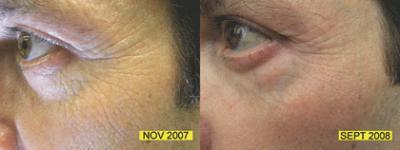
Researchers in Germany are describing a potential alternative to Botox and cosmetic surgery for easing facial wrinkles. Their study, scheduled for the November 5 issue of ACS' Crystal Growth&Design, reports that high intensity visible light from light emitting diodes (LEDs) applied daily for several weeks resulted in "rejuvenated skin, reduced wrinkle levels, juvenile complexion and lasting resilience."
LEDs, if you're not a regular reader here (though you should be) are the miniature lights used in an array of products, from TV remote controls to traffic lights.
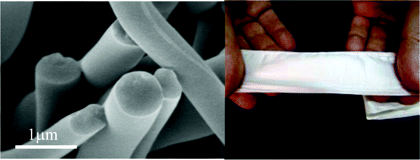
Scientists in Israel are reporting the first successful spinning of a key natural protein into strong nano-sized fibers about 1/50,000th the width of a human hair. The advance could lead to a new generation of stronger, longer-lasting biocompatible sutures and bandages to treat wounds. The study is scheduled for the November 10 issue of Biomacromolecules.
Using more coal won't solve greenhouse gas issues but it buys time for clean energy to become cost- and energy-effective. Our coal supply, unlike oil, will last for hundreds of years .
Scientists in Italy are reporting that a new process could eliminate key obstacles to the expanded use of coal gasification to transform that abundant domestic energy resource into synthetic liquid fuels for cars and trucks. The study is scheduled for the November 19 issue of Energy&Fuels.
With larger populations and greater demand for food, pesticide usage has increased over the last few decades. Luckily, a new study has found that concentrations in ground water have not matched the increase.
Samples taken from over 300 wells across the US show they have not retained a high concentration of pesticide contamination, according to results of a decade-long study to assess the extent of the impact of contaminants on the nation's water supply.
Over the past 30 years, the U.S. population has reduced its fat intake and increased its consumption of carbohydrates. During the same time period, obesity has been rising along with the prevalence of metabolic liver disease in which fatty deposits in the liver can lead to inflammation, fibrosis and cirrhosis. Some studies have suggested that a high carbohydrate diet leads to fat formation in the liver, although confirming the association has been difficult.
When carbohydrates are restricted, the liver relies more on substances like lactate and amino acids to form glucose, instead of glycerol. These findings are in the November issue of Hepatology.
Do we want people to have water or cleaner energy? As the search for new fuels intensifies, researchers in Texas report that switching to certain alternative fuels to power cars, trucks, and SUVs may require the use of much more water than conventional petroleum-based gasoline and diesel.
The findings suggest that producing alternative fuels could strain already limited water supplies in some regions of the country. Their study is scheduled for the October 15 issue of Environmental Science&Technology.