


A 'Super Moon' - a new or full moon at 90% of its closest perigee - hasn't happened since...well, last year. But it's still cause for concern, according to people who need things to be concerned about.

It's mind over mechanics. A group in the University of Minnesota's College of Science and Engineering have developed a new noninvasive system that allows people to control a flying robot using only their mind.

It sounds fun but it also has the potential to help people who are paralyzed or have neurodegenerative diseases. 

Five subjects (three female and two male) who took part in the study were each able to successfully control the four-blade flying robot, also known as a quadcopter, quickly and accurately for a sustained amount of time.

A thick paper by the ATLAS collaboration has been published by the Cornell Arxiv today. It is going to become a reference to all ATLAS analyses searching for new phenomena at high energy, or studies of boosted top quarks or vector bosons; and a good example of the new techniques that make sense of the energy distribution inside high-momentum jets.
It was no less than Aristotle himself who wondered “Why are the stones on the seashore which are called pebbles round, when they are originally made from long stones and shells?” In typical Aristotlean fashion, he not only asked the question, but went on to provide a very plausible explanation (see appendix below) – one which lay untested for more than 2000 years. It now been verified in practice by professor Douglas Durian and his Durian Research Group at the University of Pennsylvania, Philadelphia, US.

Check out this June 7th, 2011 eruption showing dark filaments of gas blasting outward from the Sun's lower right. The solar plasma appears dark against the Sun's bright surface but it actually glows at a temperature of about 18,000 degrees Fahrenheit. 

When the blobs of plasma hit the Sun's surface again, they heat up by a factor of 100 to a temperature of almost 2 million degrees F. As a result, those spots brighten in the ultraviolet by a factor of 2 – 5 over just a few minutes.

Cities have long been likened to organisms, ant colonies, and river networks. Yet clever analogies fail to capture the essence of how cities really function.  

A paper in Science attempts to derive a series of mathematical formulas that describe how cities' properties vary in relation to their population size, and then posits a unified, quantitative framework for understanding how cities function and grow. The resulting theoretical framework predicts dozens of statistical relationships observed in thousands of real cities around the world for which reliable data are available.

The Van Allen radiation belts in in the Earth's upper atmosphere, two doughnut-shaped rings of highly charged particles, were discovered in 1958. The Van Allen radiation belts consist of an inner ring of high-energy electrons and energetic positive ions, and an outer ring of high-energy electrons.  

But then in February of this year, a team of scientists writing in Science reported a previously unknown third radiation ring, which circled the Earth between the inner and outer rings in September 2012 and then almost completely disappeared.  

How did this temporary radiation belt appear and dissipate?

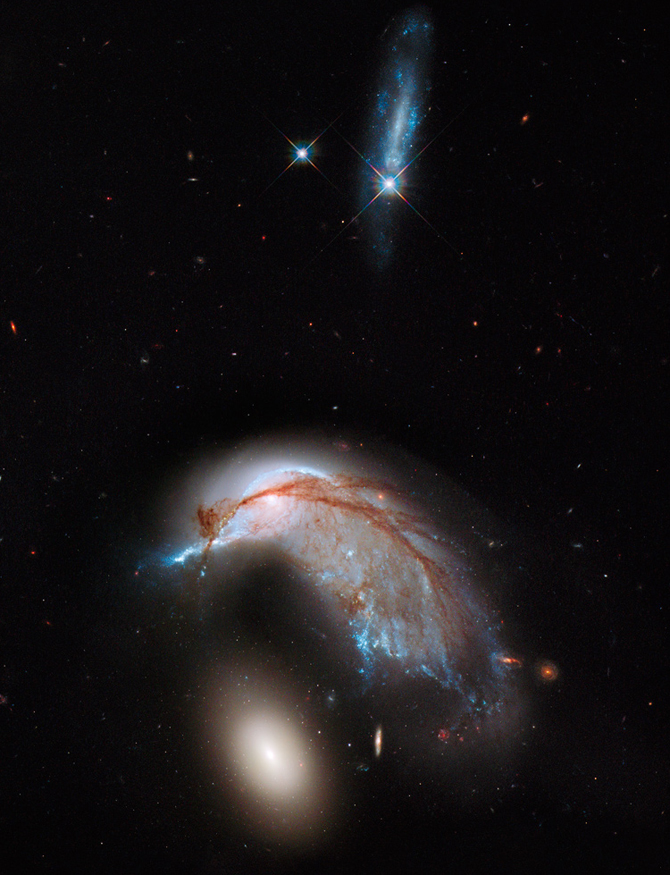
Arp 142 looks like the profile of a celestial bird but its imagery shouldn't overlook the fact that close encounters between galaxies are a messy business.

The interacting galaxy duo Arp 142 contains the disturbed, star-forming spiral galaxy NGC 2936, along with its elliptical companion, NGC 2937.

Once part of a flat, spiral disk, the orbits of the galaxy's stars have become scrambled due to gravitational tidal interactions with the other galaxy. This warps the galaxy's orderly spiral, and interstellar gas is strewn out into giant tails like stretched taffy.

The Red Queen hypothesis, a popular idea in evolution named after Lewis Carroll's character who in "Through the Looking Glass" described her country as a place where "it takes all the running you can do, to keep in the same place", recently got studied by a group of researchers who were thinking beyond the death of individual species -  they examined how the lack of new emerging species also contributes to extinction. 

Environmental brochures highlight fears about groups of animals, such as frogs or the "big cats," going extinct. But in science that is only part of the story.

Chlamydia trachomatis is a human pathogen that is the leading cause of bacterial sexually transmitted disease worldwide.

More than 90 million new cases of genital infections occur each year. About 70 percent of women infected with Chlamydia remain asymptomatic and these bacteria can establish chronic infections for months and even years. Even when it causes no symptoms, Chlamydia can damage a woman's reproductive organs but standard antibacterial drugs are proving increasingly ineffective in complete eradication, as Chlamydia goes in to persistent mode, leading to asymptomatic chronic infection.

